
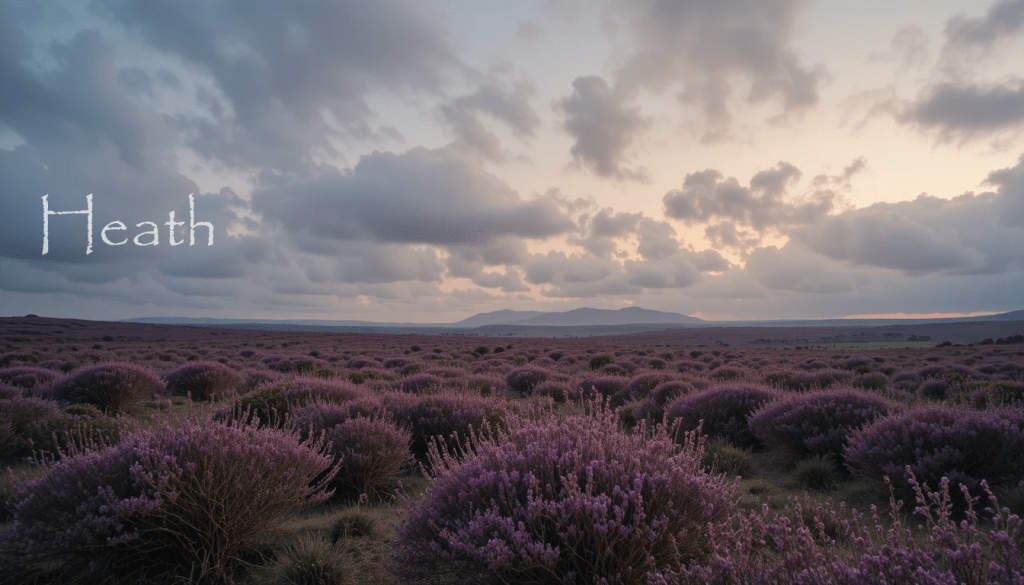
Heath
IPA Pronunciation: /hiːθ/
Part of Speech: Noun
Origin
First attested in Old English as hæth or hæþ, meaning “wasteland, uncultivated land,” derived from Proto-Germanic haiþiz — “heather-covered place, open country.”
Cognates include Old Norse heiðr (“moor, upland”), Old High German heida, and Gothic haidus.
Its Indo-European root, kai- or kei- (“bright, open, shining”), suggests not desolation but exposure and openness — a land under sky, bare and boundless.
Etymology
- Old English: hæth — an open tract of land covered with low shrubs.
- Proto-Germanic: haiþiz — “heathland, moor.”
- Proto-Indo-European Root: kai- / kei- — “bright, open.”
Thus, Heath originally denoted a sunlit, windswept expanse — land unplowed and untamed, lying between the cultivated field and the wilderness.
Core Definitions
- A Tract of Open, Uncultivated Land
Usually covered with heather, gorse, or coarse grasses; typical of moorlands or uplands.
“They crossed the heath at dusk, the horizon wide and silent under a low wind.” - A Landscape Between Worlds
A liminal space — neither forest nor field, neither barren nor fertile — embodying the rawness of nature untouched by man.
“The heath stretched endlessly, a twilight country of shadow and wind.” - Poetic / Symbolic Use
A symbol of solitude, endurance, or wild purity; the dwelling place of outcasts, wanderers, and ghosts of ancient faith.
“He found a strange peace on the heath, as though the earth itself had remembered him.”
Explanation & Nuance
- Heath evokes not barrenness, but openness — a landscape exposed to sky, where the natural world breathes freely.
- It represents untamed existence, land without human order, shaped only by wind, weather, and time.
- In literature, the heath often stands as a stage of revelation or desolation — a setting where civilization falls away and truth emerges in its starkest form.
- Its mood is both melancholic and sacred: austere yet luminous, lonely yet eternal.
- The word carries an ancient echo of paganism — heathen (originally “dweller on the heath”) later came to mean one outside the faith, one who belongs to the open earth rather than the church.
Examples in Context
Natural:
“The heath rolled on in muted purples and greys, the heather whispering beneath a restless wind.”
Literary:
“On the lonely heath, Lear raged against the storm — man’s heart laid bare beneath heaven’s vast indifference.”
Symbolic:
“She walked the heath to shed her burdens, letting the wind scour her soul clean of memory.”
Cultural / Historical:
“The heath was common land — neither owned nor tamed, a remnant of the ancient landscape before the plough.”
Spiritual / Reflective:
“There is something in the heath — its silence, its openness — that recalls the first world, before walls and worship.”
Symbolic Dimensions
- Wilderness – nature unbounded, the world before cultivation.
- Solitude – space for introspection, exile, or revelation.
- Transition – the border between civilization and wildness.
- Freedom – unclaimed land, unmeasured by human boundaries.
- Memory – echo of ancient rituals and forgotten gods.
Synonyms & Related Terms
- Moor – open, often boggy land; darker and wetter than a heath.
- Down – chalk upland, smoother and more pastoral.
- Wold – gentle rolling plain or open country.
- Common – land held for shared use, often heath-like.
- Waste – old poetic term for uncultivated ground.
(Among these, Heath alone carries the balance of openness and austerity — a landscape that feels both alive and eternal.)
Cultural & Intellectual Resonance
- Medieval England: Heaths were common land, often scenes of gathering or wandering, but also associated with danger, isolation, and the supernatural.
- Literature: In Shakespeare’s King Lear, the heath becomes a landscape of existential revelation; in Hardy’s Return of the Native, it is a living character — wild, brooding, and eternal.
- Myth & Folklore: Heaths are thresholds — places where fairies, spirits, and the forgotten gods of the land once lingered.
- Romanticism: Poets saw the heath as a space of sublime melancholy — freedom untouched by the world’s corruption.
- Modern Symbolism: Represents the untamed soul, the place of authenticity beneath civilization’s artifice.
Takeaway
Heath is the word for the open places of the world — windswept, untamed, and enduring.
It speaks of solitude without sorrow, of freedom without possession, of beauty born from barrenness.
In the heath, one meets the world as it is — unshaped, unguarded, and profoundly alive.
Heath
An open, uncultivated expanse of land, often covered with heather or gorse; a symbol of solitude, freedom, and the quiet majesty of the earth unclaimed.
Curious about what happened today in history? Want to learn a new word every day?
You’ll find it all—first and in one place—at The-English-Nook.com!
If you love languages, this is your space.
Enjoy bilingual short stories, fun readings, useful vocabulary, and so much more in both English and Spanish.
Come explore!
 Word of the Day - The English Nook
Leave a comment