
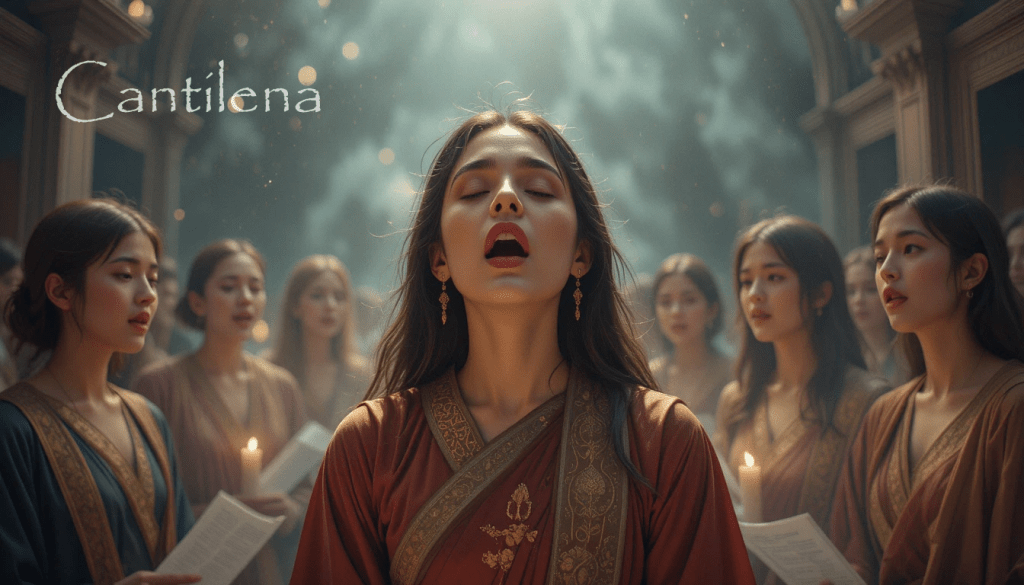
Cantilena
IPA Pronunciation: /ˌkæn.tɪˈleɪ.nə/
Part of Speech: Noun
Origin
First attested in Late Middle English (15th century), from Latin cantilēna — “song, melody, lullaby,” derived from cantus (“song”) + the diminutive suffix -lēna, indicating a form of tender or continuous singing.
In its earliest uses, cantilena referred to a smooth, flowing melodic line, particularly in Medieval and Renaissance music, where the term described a lyrical passage sung above a slower-moving accompaniment.
Over time, it came to signify not only a musical style, but a mood of lyrical grace — a melodious unfolding of sound, word, or thought, soft and continuous, like the voice of memory itself.
Etymology
- Latin: cantus — “song, melody, chant.”
- Latin: lēna (from the root for continuity and softness).
- Italian (borrowed form): cantilena — “a smooth, singable line.”
Thus, cantilena evokes a song that lingers, flowing gently and unbroken — the melody that does not end but carries onward, tenderly sustained.
Core Definitions
- Music:
A smooth, lyrical melody or sustained vocal line, often simple yet expressive; a passage marked by graceful legato phrasing.
“The violin sang its cantilena over the soft murmuring of the strings.” - Poetic / Literary:
A songlike or lilting passage of language, marked by rhythm and flow rather than strict structure.
“Her prose moved like a cantilena — unhurried, luminous, quietly rhythmic.” - Figurative:
A tone or atmosphere of gentle continuity; the emotional cadence of something softly sung or endlessly repeated.
“The waves came and went in a cantilena of the sea — eternal, unbroken.”
Explanation & Nuance
- Cantilena occupies the space between song and silence — a melody that carries feeling without strain.
- In music, it suggests the art of sustained expression: every note connected, every phrase breathing as one.
- In language, it embodies the flow of thought rendered musical — writing that moves like breath through time.
- In emotion, it signifies calm continuity — the sense of something that endures softly, like love remembered or sorrow forgiven.
- The word is inherently tender, a sound that seems to soothe even as it names itself.
Examples in Context
Musical:
“The pianist shaped each phrase as a cantilena — unbroken, luminous, serene.”
Literary:
“Her letters carried a cantilena of longing, each line an echo of what could not be said.”
Natural:
“The rain fell in a quiet cantilena against the glass, rhythmic and unceasing.”
Emotional:
“His memories came in waves, a cantilena of voices long gone.”
Spiritual:
“The chant rose and fell in a sacred cantilena, the sound of breath woven into devotion.”
Symbolic Dimensions
- Continuity / Flow – movement without rupture or discord.
- Voice / Soul – the sound of being expressed through gentleness.
- Memory / Time – the persistence of song beyond its singer.
- Grace / Stillness – beauty that lies in smoothness, in absence of struggle.
- Eternal Return – the repetition that comforts, like a lullaby reborn.
Synonyms & Related Terms
- Melisma – ornate vocalization; more elaborate and decorative.
- Legato – smooth connection of notes; technical rather than emotional.
- Lyricism – poetic musicality; broader, less specific.
- Aria – solo song; more dramatic than introspective.
- Chant / Hymn – repetitive melody with spiritual purpose.
(Cantilena alone conveys the continuous melodic soul — music that breathes without breaking, beauty carried on air.)
Cultural & Intellectual Resonance
- Medieval & Renaissance Music: Cantilena referred to melodic clarity and expressive grace, often sung above instrumental accompaniment.
- Romantic Era: Used to describe the singing tone of instruments, especially the violin or human voice.
- Literature & Rhetoric: The rhythm of prose that flows like music; the sonic architecture of emotion.
- Philosophy of Aesthetics: Represents continuity as beauty — harmony found in the unbroken line.
- Modern Usage: A metaphor for emotional constancy, the quiet endurance of feeling through time.
Takeaway
Cantilena is the word for melody made tender — the art of flowing continuity, of sound or speech that carries emotion gently and endlessly forward.
It is not the grandeur of performance, but the intimacy of expression, the quiet pulse of beauty that does not need to end to be complete.
It is the echo that remains after the song — a melody remembered by the soul.
Cantilena
A smooth, lyrical melody or phrase; the gentle flow of sound or language that endures in soft continuity — music in its purest, most human form.
Curious about what happened today in history? Want to learn a new word every day?
You’ll find it all—first and in one place—at The-English-Nook.com!
If you love languages, this is your space.
Enjoy bilingual short stories, fun readings, useful vocabulary, and so much more in both English and Spanish.
Come explore!
 Word of the Day - The English Nook
Leave a comment