
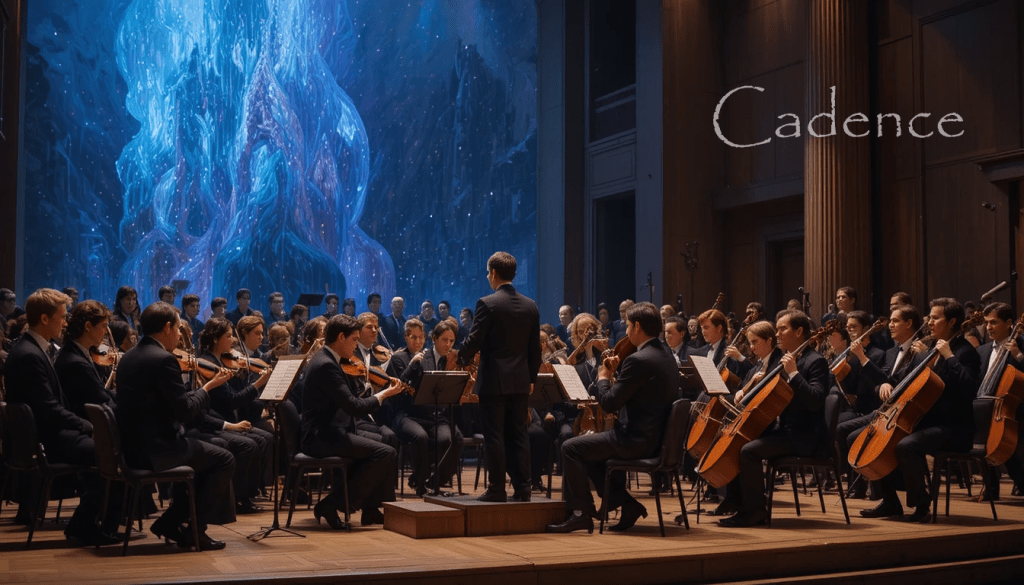
Cadence
IPA Pronunciation: /ˈkeɪ.dəns/
Part of Speech: Noun
Origin
First recorded in Middle English (14th century), from Old French cadence (“rhythm, fall, tone”), derived from Latin cadentia, from cadere — “to fall.”
Originally signifying a falling or descending of sound, cadence referred to the natural rise and fall of the human voice and the measured flow of verse or music.
Over time, its sense broadened beyond the literal to describe any patterned movement, rhythm, or concluding flow — in speech, sound, emotion, or life itself.
Etymology
- Latin: cadere — “to fall.”
- Latin participial form: cadentia — “a falling, cadence.”
- Old French: cadence — “rhythm, tone, balance.”
Thus, cadence literally means “a falling” — the gentle descent that closes a motion, phrase, or thought.
Core Definitions
- Musical:
A sequence of notes or chords marking the end or pause of a phrase, producing a sense of resolution or repose.
“The final cadence lingered in the air like breath after prayer.” - Speech / Language:
The rhythmic flow or modulation of voice in speaking or reading.
“Her voice moved with a natural cadence, each sentence a soft rise and fall.” - Poetic / Literary:
The measured rhythm or movement of words; the musicality of language.
“The prose carried a quiet cadence — steady, reflective, like footsteps in thought.” - General / Abstract:
Any regular, flowing pattern or rhythmic progression, whether in motion, emotion, or sequence.
“The days passed in a slow, deliberate cadence of routine and reflection.”
Explanation & Nuance
- At its root, cadence evokes motion tempered by gravity — the art of falling gracefully.
- It unites sound, rhythm, and meaning, describing not only how something moves, but how it rests.
- In music, a cadence is closure — the point where tension resolves into harmony.
- In speech, it is the signature of sincerity or emotion, the way tone carries thought to rest.
- In life and art, cadence represents pattern, repetition, and return — the breathing rhythm of existence.
- It implies not monotony, but measured beauty — the understanding that all things move toward pause, and all pauses prepare for motion again.
Examples in Context
Musical:
“The symphony concluded on a tranquil cadence, dissolving into silence.”
Linguistic:
“His words rose and fell with the cadence of memory, as if echoing another time.”
Poetic:
“The river’s cadence matched her heart — slow, insistent, eternal.”
Emotional:
“In their parting, there was a cadence — the quiet inevitability of an ending long foreseen.”
Philosophical:
“Every existence has its cadence: the rhythm between striving and stillness, ascent and fall.”
Symbolic Dimensions
- Fall / Resolution – the natural descent into rest or completion.
- Rhythm / Harmony – order emerging through movement.
- Voice / Breath – the pulse of being made audible.
- Time / Repetition – cycles of return that give shape to experience.
- Life / Mortality – the beauty of closure, the grace of endings.
Synonyms & Near-Relations
- Rhythm – regular pattern of movement; broader, less emotive.
- Tempo – speed or pace; technical, not aesthetic.
- Flow – continuous movement; lacks formal structure.
- Inflection – variation of tone; partial aspect of cadence.
- Meter – formal rhythm of verse; mechanical rather than organic.
(Among them, cadence alone carries the union of structure and emotion, the sense of beauty in falling, completion in closure.)
Cultural & Intellectual Resonance
- Music Theory: Central to the art of harmony and phrasing — the cadence as punctuation in sound.
- Rhetoric & Oratory: The art of cadence in speech defines persuasion, passion, and poetic force.
- Literature: Writers use cadence to shape prose and verse alike — rhythm as emotion made audible.
- Philosophy & Aesthetics: Cadence represents the measured pulse of becoming, the balance between motion and repose.
- Life & Psychology: The human heart and breath themselves follow cadences — the fundamental rhythm of being.
Takeaway
Cadence is the art of rhythm fulfilled — the harmony between motion and rest, ascent and fall.
It names the moment when sound, speech, or action comes to its natural and graceful close, leaving behind the quiet resonance of completion.
In a broader sense, it is the rhythm of existence itself — the steady music by which life moves, pauses, and begins again.
Cadence
The rhythmic fall of sound or motion; the measured flow that gives shape, balance, and beauty to movement and time.
Curious about what happened today in history? Want to learn a new word every day?
You’ll find it all—first and in one place—at The-English-Nook.com!
If you love languages, this is your space.
Enjoy bilingual short stories, fun readings, useful vocabulary, and so much more in both English and Spanish.
Come explore!
 Word of the Day - The English Nook
Leave a comment