
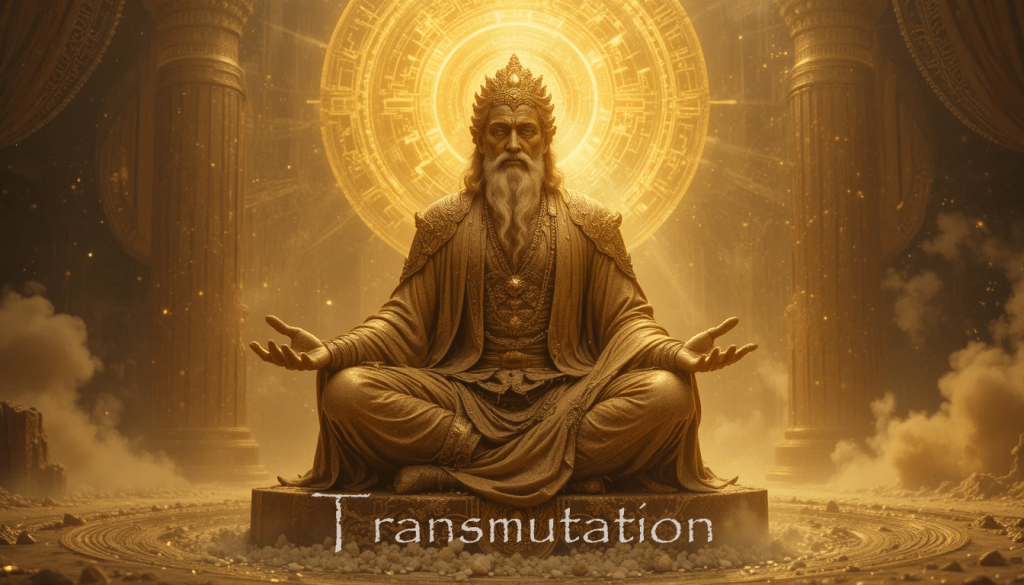
Transmutation
IPA Pronunciation: /ˌtrænz.mjuːˈteɪ.ʃən/
Part of Speech: Noun
Origin
First attested in Middle English (14th century), from Old French transmutacion, derived from Latin transmutatio — from trans- (“across, beyond”) + mutare (“to change”).
Originally used in alchemy and philosophy, the term denoted the transformation of one substance or essence into another — most famously, the fabled conversion of base metals into gold.
Over centuries, transmutation evolved beyond alchemy into a universal concept of transformation — physical, moral, spiritual, or metaphysical — describing the profound change of nature, state, or being.
Etymology
- Latin: trans- — “across, beyond.”
- Latin: mutare — “to change, alter, exchange.”
- Compound Sense: transmutatio — “a crossing-over of change.”
Thus, transmutation signifies change carried across boundaries, an alteration not only in form, but in essence.
Core Definitions
- Alchemy / Ancient Science:
The transformation of one element or substance into another, especially the conversion of base metals into gold, or the quest for the Philosopher’s Stone.
“The alchemist labored toward transmutation — to refine not only metal, but the soul.” - Physics:
The conversion of one chemical element into another through nuclear reaction or decay.
“Transmutation occurs when one element’s nucleus alters to form another.” - Philosophical / Spiritual:
A profound change of nature, form, or consciousness; the elevation of the base into the refined.
“Suffering, endured wisely, becomes transmutation — pain turned into wisdom.” - Metaphorical / Psychological:
The process by which emotion, experience, or energy is transformed into art, insight, or peace.
“Grief is not destroyed but transmuted, finding new voice in creation.”
Explanation & Nuance
- Transmutation occupies the threshold between matter and meaning — the act by which one thing becomes another without ceasing entirely to be itself.
- In alchemy, it represented both a chemical and a spiritual ideal: purifying the impure, turning darkness into light, ignorance into illumination.
- In modern science, it names a literal metamorphosis at the atomic level — where even matter is not fixed, but mutable and radiant with change.
- In psychology and mysticism, transmutation is the inner alchemy: the transformation of instinct, sorrow, or desire into higher forms of being.
- The word implies not mere alteration, but elevation — a passage from the crude to the luminous, the dense to the refined.
Examples in Context
Alchemical:
“The philosopher’s true gold was transmutation — the soul’s ascent from base matter to spirit.”
Scientific:
“Radioactive decay is a natural transmutation, where one element yields another through time.”
Spiritual:
“Through compassion, anger finds transmutation — fire reshaped into light.”
Psychological:
“Art is the transmutation of memory: pain distilled into meaning.”
Literary:
“In her poems, every loss undergoes transmutation, each wound gleaming with altered truth.”
Symbolic Dimensions
- Fire / Gold – purification through ordeal; refinement of the impure.
- Death / Rebirth – dissolution leading to renewal.
- Matter / Spirit – transformation across planes of existence.
- Pain / Creation – the artist’s alchemy of turning suffering into beauty.
- Shadow / Illumination – darkness yielding to light.
Synonyms & Near-Relations
- Metamorphosis – change of form; biological or poetic; lacks spiritual resonance.
- Transformation – general change; broader but less alchemical.
- Transfiguration – exalted change of appearance; implies divinity or revelation.
- Conversion – turning from one state or belief to another; moral or religious.
- Refinement – gradual purification; lacks the depth of essence implied by transmutation.
(Among these, transmutation alone embodies the total change of essence, bridging the material and the metaphysical — the union of science and soul.)
Cultural & Intellectual Resonance
- Alchemy: The heart of the hermetic tradition — transmutatio as the sacred science of turning the mundane into the divine.
- Mysticism & Esotericism: Symbol of spiritual ascension — the soul’s journey from shadow into enlightenment.
- Science: Redefined through nuclear physics as the transformation of atomic identity.
- Psychology & Art: A metaphor for creative and emotional sublimation — turning life’s raw matter into expression.
- Philosophy: Suggests that change is the nature of being, and that the deepest transformations occur within.
Takeaway
Transmutation is the word of essential change — the passage from one state of being to another, through fire, pressure, or understanding.
It names the universal law that nothing remains fixed: that all matter, all mind, all meaning is capable of becoming something greater.
To undergo transmutation is to cross the threshold of self, to turn heaviness into light, and experience into essence.
Transmutation
The profound transformation of one form, element, or essence into another — the alchemy of change that turns the base toward the sublime.
Curious about what happened today in history? Want to learn a new word every day?
You’ll find it all—first and in one place—at The-English-Nook.com!
If you love languages, this is your space.
Enjoy bilingual short stories, fun readings, useful vocabulary, and so much more in both English and Spanish.
Come explore!
 Word of the Day - The English Nook
Leave a comment