
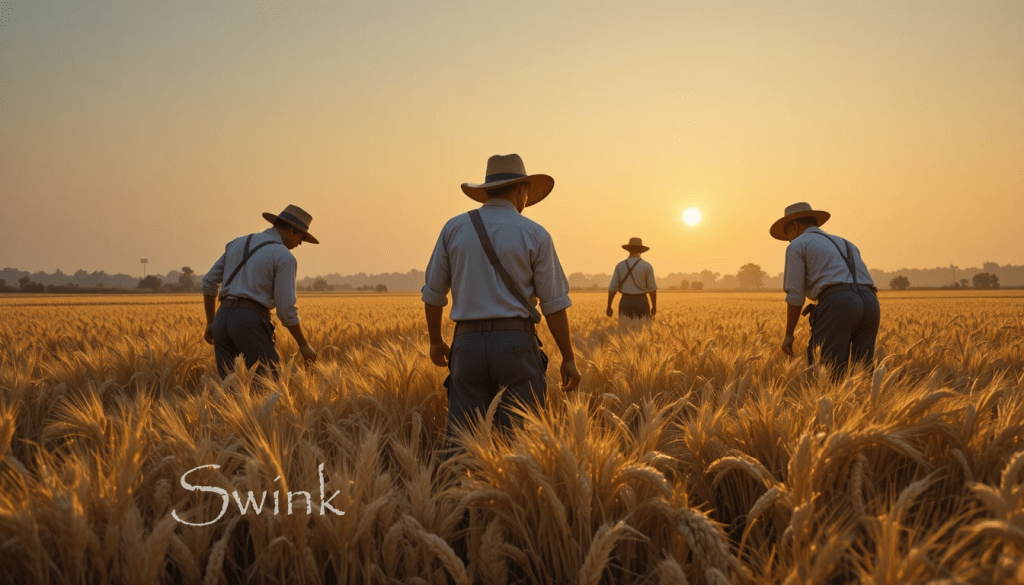
Swink
IPA Pronunciation: /swɪŋk/
Part of Speech: Verb (archaic), Noun (rare, poetic)
Origin
First attested in Old English (swincan), meaning “to toil, labor, struggle, or exert oneself strenuously.”
Derived from Proto-Germanic swinkaną — “to toil, suffer, be weary” — related to Old High German swincan (“to labor, be in pain”) and Middle Dutch swinken (“to work hard”).
In early English literature, especially in Chaucer and Spenser, swink was used to denote honest labor, wearisome effort, or the sweat of virtue and necessity.
Though largely obsolete in modern English, the word endures in poetry and dialect, admired for its muscular simplicity and moral resonance.
Etymology
- Old English: swincan — to toil, labor, exert.
- Proto-Germanic: swinkaną — to be weary, labor under strain.
- Proto-Indo-European root: sweng- — to press, strain, or exert force.
Originally signifying both physical and moral exertion, swink encompassed not only work but the burden and dignity of endurance.
Core Definitions
As a Verb (Archaic)
- To Labor or Toil Diligently
To work hard, especially with bodily effort or sustained struggle.
“They swink from dawn till dusk for their daily bread.” - To Endure or Struggle
To labor through difficulty, hardship, or sorrow.
“He swinked beneath the weight of years and duty.” - To Serve or Earn by Labor
To achieve through toil or effort; to win by sweat and perseverance.
“Through many swinking days he built his home of stone.”
As a Noun (Rare, Poetic)
- Labor; Hard Work; Toil
“Rest follows swink, as peace follows the storm.” - Effort Undertaken in Necessity or Devotion
The noble exertion that shapes character and sustains life.
“Her swink was her offering — the art of the patient hand.”
Explanation & Nuance
- Swink belongs to the moral and sensory language of toil — not mere activity, but labor with soul and endurance.
- It carries an undertone of suffering made meaningful, of work that weaves virtue into exhaustion.
- In medieval and pastoral literature, swink often evokes the toil of peasants, craftsmen, or pilgrims, sanctified by perseverance.
- Unlike the neutral work, swink implies struggle, humility, and moral weight — the ache that gives rise to grace.
- The sound of the word itself — short, dense, muscular — embodies its meaning: effort compacted into rhythm.
Examples in Context
Medieval:
“Full swink they did, yet never did complain, / Their sweat the silver coin of honest pain.”
Pastoral:
“The shepherd swinked beneath the sun, his flocks the fruit of patient care.”
Spiritual:
“She took her swink as prayer — a steady offering of body and devotion.”
Philosophical:
“To live is to swink in the fields of time — each act a furrow toward understanding.”
Modern Poetic:
“Amid the noise of engines and ambition, his quiet swink went unseen.”
Symbolic Dimensions
- Labor / Virtue – effort as the moral ground of life.
- Endurance / Faith – toil transformed into meaning.
- Humility / Humanity – the worker’s grace in obscurity.
- Creation / Sacrifice – the fusion of pain and purpose.
- Earth / Flesh – the body as instrument of persistence.
Synonyms & Near-Relations
- Toil – laborious effort; lacks swink’s old moral hue.
- Drudge – mechanical labor; swink implies dignity.
- Sweat – physical strain; earthy but less poetic.
- Work – general act; lacks weight of endurance.
- Endure – to suffer patiently; related in spirit, not motion.
(Swink alone fuses labor and sanctity, naming the effort that is both burden and virtue — the rhythm of human necessity.)
Cultural & Literary Resonance
- Chaucer: Frequently employed swink in The Canterbury Tales to describe the honest toil of everyday folk.
- Spenser & Milton: Used it to ennoble labor as both spiritual and aesthetic virtue.
- Pastoral & Allegorical Poetry: The word’s resonance with rural life and moral endurance made it a favorite symbol of humble perseverance.
- Modern Revival: Occasionally revived by poets to evoke archaic honesty, moral simplicity, or pre-industrial toil.
Takeaway
Swink is the old English heart of labor — to work with the body, and to endure with the soul.
It names not only the act of toiling, but the ethical beauty of effort, the quiet dignity of those who build, bear, and persist.
To swink is to move within necessity, yet find meaning in motion — to labor not only for bread, but for being.
Swink
To labor with endurance and humility; the effort that shapes both the world and the self.
Curious about what happened today in history? Want to learn a new word every day?
You’ll find it all—first and in one place—at The-English-Nook.com!
If you love languages, this is your space.
Enjoy bilingual short stories, fun readings, useful vocabulary, and so much more in both English and Spanish.
Come explore!
 Word of the Day - The English Nook
Leave a comment