
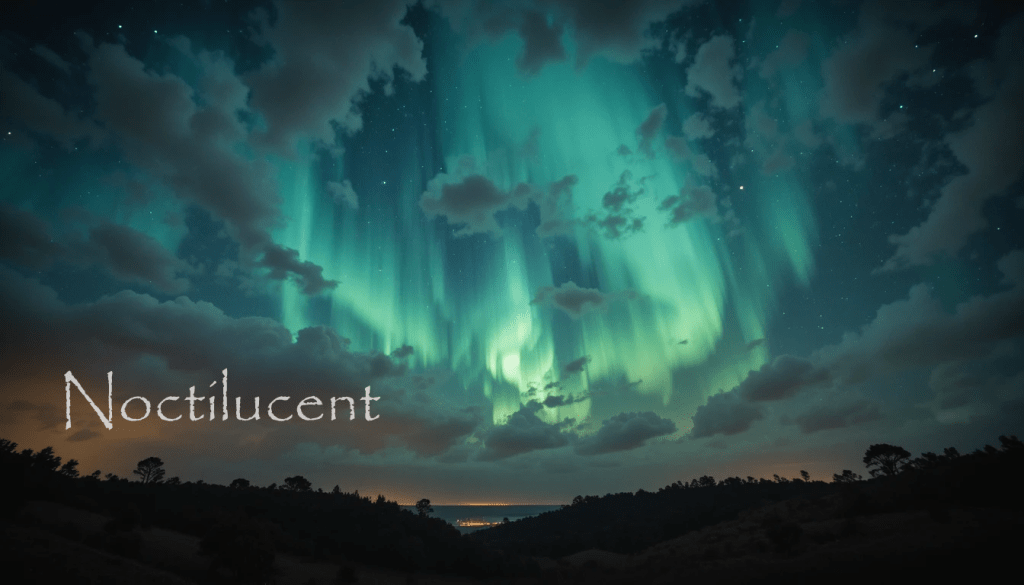
Noctilucent
IPA Pronunciation: /ˌnɒk.tɪˈluː.sənt/
Part of Speech: Adjective
Origin
First attested in late 19th-century English, from Latin roots noctis (“night”) and lucēns (“shining,” from lucere, “to shine”).
Coined initially in the field of meteorology and astronomy to describe high-altitude clouds that glow after sunset, illuminated by sunlight from beyond the horizon.
The term has since entered poetic and symbolic vocabulary, evoking any light that persists through darkness — soft, spectral, or transcendent.
Etymology
- Latin: noctis — “of the night.”
- Latin: lucēns, present participle of lucere — “to shine.”
- Compound Sense: noctilucent — “shining in the night.”
Thus, the word literally means “night-shining” — describing that which glows in darkness, often faintly, beautifully, and beyond reach.
Core Definitions
- Scientific:
Luminous in the night; reflecting sunlight after sunset.
Specifically applied to noctilucent clouds — rare, high-altitude formations visible during twilight, shining with pale blue or silver light.
“Noctilucent clouds shimmered along the horizon, ghostly lanterns of the upper air.” - Poetic or Figurative:
Glowing or radiant amid darkness; luminous in obscurity.
“Her thoughts were noctilucent — faintly gleaming through the vast dark of solitude.” - Metaphorical or Philosophical:
Symbolic of beauty or truth that persists within shadow or despair.
“The artist’s faith was noctilucent — a quiet radiance that refused extinction.”
Explanation & Nuance
- Noctilucent stands at the intersection of light and darkness, naming the paradox of illumination through obscurity.
- Scientifically, it refers to ethereal atmospheric clouds glowing at the edge of night — a phenomenon visible only in the twilight between sunset and true darkness.
- Metaphorically, it suggests the persistence of hope, memory, or insight that endures in dark times.
- The word carries a rare serenity: not the blaze of light, but a tempered, spectral gleam — illumination that coexists with shadow.
- In literature, it is often used for souls, minds, or moments that shine quietly, unseen yet undiminished.
Examples in Context
Scientific:
“Above the fading horizon, noctilucent clouds traced silver threads across the indigo sky.”
Poetic:
“Her voice was noctilucent, gleaming gently through the long night of his grief.”
Philosophical:
“Consciousness itself is noctilucent — a flicker of awareness in the darkness of being.”
Emotional:
“In his heart remained a noctilucent calm, faint but unyielding.”
Literary:
“The poet sought the noctilucent moment — when sorrow, touched by reflection, becomes luminous.”
Symbolic Dimensions
- Light / Darkness – illumination surviving within obscurity.
- Hope / Despair – quiet endurance amid shadow.
- Spirit / Matter – the immaterial glow that outlives the material world.
- Memory / Time – what remains luminous when all else fades.
- Beauty / Distance – radiance untouchable, perceived yet unreachable.
Synonyms & Near-Relations
- Luminous – shining; lacks nocturnal nuance.
- Lucent – glowing; more formal, less ethereal.
- Phosphorescent – glowing without heat; more scientific than poetic.
- Iridescent – rainbow-like sheen; visual, not emotional.
- Radiant – bright or beaming; lacks the gentleness of noctilucent.
(Among them, noctilucent alone expresses the paradox of soft brilliance within darkness — a light born of night itself.)
Cultural & Intellectual Resonance
- Astronomy & Meteorology: Describes a rare and fragile atmospheric beauty — clouds glowing at the edge of space, between Earth and cosmic shadow.
- Literature: A favored metaphor for subtle resilience, quiet enlightenment, or surviving beauty.
- Philosophy: Used to express the persistence of consciousness or moral light within existential darkness.
- Art & Aesthetics: Symbolic of luminosity through restraint, the art of revealing light without banishing the dark.
Takeaway
Noctilucent is the language of light within shadow — a word for what gleams quietly in obscurity, fragile yet enduring.
It names that rare phenomenon — physical, emotional, or spiritual — where darkness itself becomes the medium of radiance.
Noctilucent
Shining in the night; softly luminous against darkness — the serene light that endures beyond the sun.
Curious about what happened today in history? Want to learn a new word every day?
You’ll find it all—first and in one place—at The-English-Nook.com!
If you love languages, this is your space.
Enjoy bilingual short stories, fun readings, useful vocabulary, and so much more in both English and Spanish.
Come explore!
 Word of the Day - The English Nook
Leave a comment