
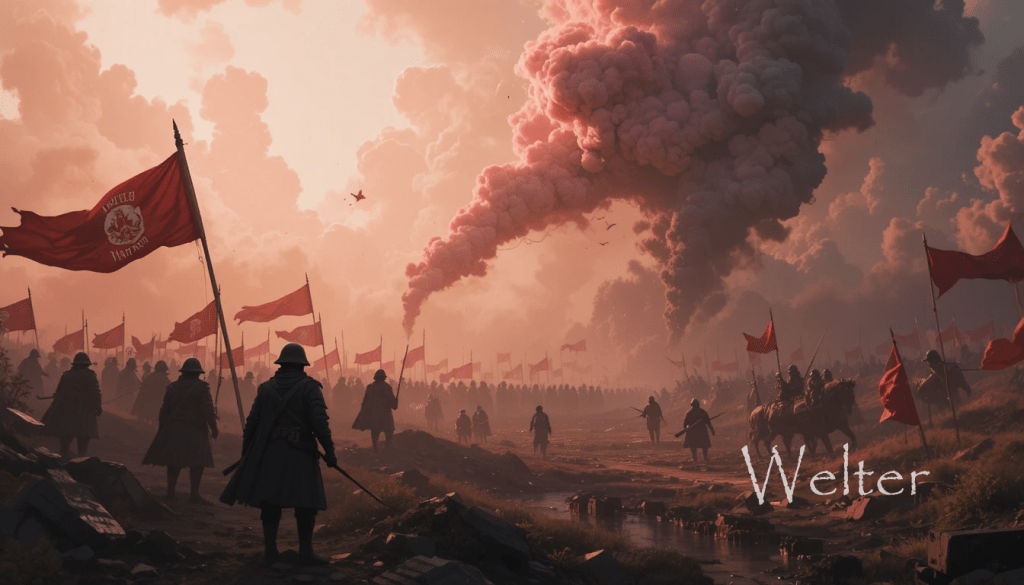
Welter
IPA Pronunciation: /ˈwɛltər/
Part of Speech: Noun, Verb
Origin
First recorded in Middle English (14th century) as welteren, meaning “to roll, to toss, to writhe,” of Germanic origin, akin to Middle Low German welteren and Old Norse velta — “to roll, to turn.”
The term has retained its physical sense of tumbling or being tossed about, while expanding over centuries into metaphorical terrains: confusion, turbulence, disorder, emotional upheaval, and complexity.
Etymology
- Proto-Germanic: waltijaną — “to roll, to turn.”
- Old Norse: velta — “to roll.”
- Middle English: welteren — “to roll or toss oneself about.”
- Related to wallow and weld in sense of motion and entanglement.
From this lineage, welter has come to signify movement through chaos — both physical and emotional — the restless flux of being caught within disorder.
Core Definitions
As a Verb
- To Roll or Toss About in Turbulence
To be tossed, tumbled, or immersed in a state of agitation or confusion.
“Waves weltered beneath the storm’s dark hand.” - To Be Immersed or Engulfed in a Condition
To exist in a state of turmoil, entanglement, or overflowing abundance.
“The city weltered in unrest and rumor.” - To Writhe or Struggle Emotionally
To move or twist under emotional strain, guilt, or ecstasy.
“He weltered in memories too vivid to bear.”
As a Noun
- A Confused Mass; Turmoil; Disorder
A seething mixture, a tangled or chaotic state of things.
“A welter of impressions crowded his mind.” - A State of Turbulent Motion or Emotion
The dynamic flux of forces — physical or psychological — in collision.
“From the welter of battle rose the smoke of fate.”
Explanation & Nuance
- Welter evokes movement without direction — the rolling chaos of waves, crowds, or thoughts.
- It suggests not mere disorder, but living turmoil, a state of energetic confusion that carries both danger and vitality.
- The word oscillates between the physical (rolling seas, wrestling bodies) and the mental (confusion, passion, intensity).
- It captures the human experience of being carried by forces larger than oneself, unable to find stillness, yet alive within the swirl.
- There is an aesthetic of tumult in welter: it names both the storm and the life within the storm.
Examples in Context
Natural / Physical:
“The ocean weltered beneath a bruised sky, its surface alive with broken light.”
Emotional:
“She weltered in conflicting desires, torn between longing and restraint.”
Social / Political:
“The nation weltered in uncertainty, caught between change and decay.”
Intellectual:
“His thoughts formed a welter of brilliance and confusion — insights colliding like sparks.”
Poetic:
“In the welter of stars, the night itself seemed to tremble.”
Symbolic Dimensions
- Motion / Turbulence – life in flux; the refusal of stillness.
- Chaos / Creation – disorder as fertile ground for transformation.
- Emotion / Conflict – the storm within the human soul.
- Flux / Becoming – Heraclitean movement: the world always in motion.
- Struggle / Immersion – surrendering to forces beyond control.
Synonyms & Near-Relations
- Turbulence – violent or irregular motion; lacks the existential tone of welter.
- Maelstrom – chaotic whirlpool; more destructive than introspective.
- Upheaval – sudden disorder; emphasizes rupture, not immersion.
- Confusion – mental disarray; lacks the kinetic quality.
- Tumult – noisy disturbance; narrower in scope.
(Welter alone unites motion, emotion, and confusion — the lived sense of being swept into the world’s restless tides.)
Cultural & Intellectual Resonance
- Literature: Poets and novelists use welter to describe the interplay of chaos and beauty — the oceanic state of being between form and dissolution.
- Psychology: Connotes emotional saturation, the overwhelming fullness of affect or memory.
- Philosophy: A symbol of flux and impermanence, echoing the thought that reality itself is a continual rolling of change.
- Art: The welter appears in expressionism and romanticism alike — the storm, the blur, the movement that resists boundaries.
- Sociology / History: Refers to periods of collective unrest, when events roll forward uncontrollably.
Takeaway
Welter is a word of motion and turmoil — the sound of life rolling through itself.
It signifies turbulent becoming, the restless mingling of forces where clarity dissolves into motion.
To “welter” is not only to be lost in confusion, but also to be alive within transformation — tossed, yet aware; submerged, yet awake.
Welter
A state of rolling tumult; the dynamic confusion through which both chaos and creation emerge.
Curious about what happened today in history? Want to learn a new word every day?
You’ll find it all—first and in one place—at The-English-Nook.com!
If you love languages, this is your space.
Enjoy bilingual short stories, fun readings, useful vocabulary, and so much more in both English and Spanish.
Come explore!
 Word of the Day - The English Nook
Leave a comment