
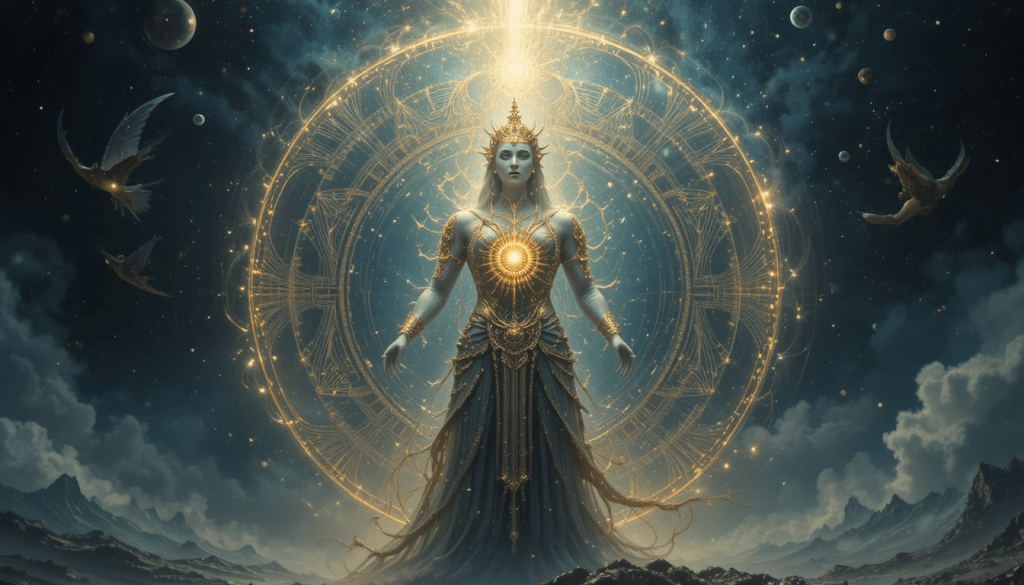
Absolara
IPA Pronunciation: /ˌæb.səˈlɑːrə/
Part of Speech: Noun (rare; neologism)
Etymology
- Absol- from Latin absolūtus — “complete, perfect, finished, freed from limitation.”
- -ara as a poetic suffix suggesting aura, radiance, vast presence, or luminous field.
Thus, Absolara means:
“the radiant presence of absoluteness” or
“a shining aura of completeness.”
Coined in metaphysical, mystical, and poetic registers, the term names the felt experience of the absolute — not as cold abstraction, but as a luminous totality that saturates perception.
Core Definitions
- Radiance of the Absolute
The aura or presence of totality, experienced as beyond fragment and beyond lack.
“Her silence was an absolara: whole, unbroken, suffused with meaning.” - Completion Made Visible
A condition where nothing more is needed, where the whole reveals itself.
“The summit revealed an absolara — earth, sky, and self bound in final clarity.” - Transcendent Field of Coherence
A metaphysical or spiritual state in which all distinctions are subsumed into unity.
“Mystics spoke of the absolara, a light that encompassed all opposites.”
Explanation & Nuance
Unlike terms of fragment or emergence, Absolara denotes the apex of wholeness — the condition where coherence is no longer fragile or partial but total and self-sufficient.
- It carries the weight of metaphysical finality (akin to the “Absolute” in philosophy).
- Yet the suffix -ara gives it a luminous, aesthetic, living quality, suggesting not rigidity but radiance.
- An Absolara is not merely a concept; it is an atmosphere, something felt, seen, or intuited as complete.
It resonates with mystical traditions, apocalyptic visions, and poetic images of total light, final harmony, eternal presence.
Extended Examples in Context
Literary:
“The poem closes with an absolara — not conclusion, but a shining completeness that gathers all fragments.”
Philosophical:
“Where syntheses remain provisional, the absolara is imagined as the ultimate horizon of thought.”
Cultural:
“In coronations and rituals of state, societies stage their absolara: the spectacle of wholeness, of perfect order embodied.”
Spiritual:
“For the mystic, the absolara is not achieved but revealed — an ever-present totality glimpsed through surrender.”
Poetic:
“The desert at night held an absolara: silence so complete it shimmered like light.”
Symbolic Dimensions
- Light – total illumination, without shadow.
- Circle – form of perfection, no beginning or end.
- Crown – emblem of completion and sovereignty.
- Mirror – pure reflection, untouched, whole.
- Ocean – vast surface that holds all within itself.
Synonyms & Near-Relations
- Absolute – pure, complete, unconditioned.
- Plenum – fullness without void.
- Totality – all-encompassing whole.
- Perfection – flawless completeness.
- Apotheosis – culmination, elevation to divine state.
- Aura – though absolara is a “total aura,” not partial.
Cultural & Intellectual Resonance
- Metaphysics: Used to describe the philosophical Absolute in more poetic, experiential terms.
- Mysticism & Religion: Resonates with visions of divine light, eternal unity, cosmic completeness.
- Art & Aesthetics: The moment a work seems flawless, unbroken, transcendent in presence.
- Political & Social Theory: Sometimes invoked critically, as the staged spectacle of “total unity” in national, ideological, or utopian visions.
Takeaway
Absolara names the aura of completeness — radiant, vast, unbroken.
- Radiant, because it glows with final presence.
- Absolute, because nothing lies outside it.
- Experiential, because it is sensed, intuited, revealed.
Absolara
A luminous totality — the radiant aura of the absolute, felt as the wholeness beyond fragment, the completion that shines.
Curious about what happened today in history? Want to learn a new word every day?
You’ll find it all—first and in one place—at The-English-Nook.com!
If you love languages, this is your space.
Enjoy bilingual short stories, fun readings, useful vocabulary, and so much more in both English and Spanish.
Come explore!
 Word of the Day - The English Nook
Leave a comment