
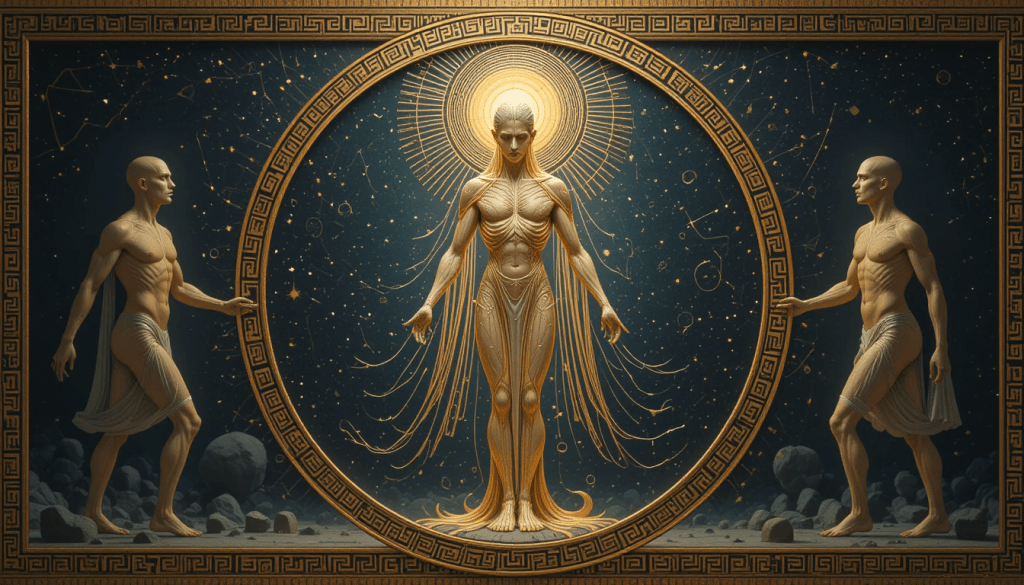
Metempsychosis
IPA Pronunciation: /ˌmɛtɛmˌsaɪˈkoʊsɪs/
Part of Speech: Noun
Etymology
- From Ancient Greekμετεμψύχωσις (metempsýchōsis):
- meta- (μετά) — “after, beyond, change”
- em- (ἐν) — “in”
- psychē (ψυχή) — “soul, spirit, breath of life”
- Literally: “the movement of the soul into another (body).”
- Adopted into Latin as metempsychosis, and into English in the 16th century, largely through translations of classical philosophy.
Core Definitions
1. Philosophical/Religious:
The transmigration or rebirth of the soul after death into a new body — human, animal, or even divine.
“In Pythagorean doctrine, metempsychosis was the eternal cycle of souls passing from body to body.”
2. Broader Figurative Sense:
The transformation or shifting of identity, essence, or being into another form.
“His poetry was a metempsychosis, a rebirth of ancient voices into modern speech.”
Explanation & Nuance
- Greek Philosophy:
- Pythagoras (6th c. BCE) taught metempsychosis — the soul is immortal, and upon death enters another body.
- Plato echoed the idea in The Republic and Phaedrus, connecting it to justice and the purification of the soul.
- Eastern Parallels: Similar to reincarnation in Hinduism and Buddhism, though not identical. Metempsychosis emphasizes transfer of the same soul, while reincarnation often includes karmic evolution.
- Christian Reception: Early Christian thinkers rejected it as heresy, though mystics and esoteric traditions occasionally entertained it.
- Literary & Mystical Use: Writers often use the term to suggest rebirth, transformation, or the persistence of spirit across ages and forms.
Examples in Context
- Philosophical: “According to Plato, metempsychosis ensures the soul’s journey through many lives toward ultimate truth.”
- Mythical: “Orpheus sang of metempsychosis, the eternal music of souls reborn.”
- Literary: “Joyce wove metempsychosis into Ulysses, asking how the soul might pass through bodies, stories, and histories.”
- Figurative: “Every revolution is a metempsychosis of ideals into new forms of society.”
Synonyms & Related Terms
- Reincarnation – close modern equivalent, though broader.
- Transmigration – literal English rendering.
- Palingenesis – rebirth, regeneration.
- Rebirth – common, simplified form.
- Avatar – (Hindu context) divine incarnation.
Cultural & Literary Resonance
- Philosophy: A cornerstone of Pythagorean, Platonic, and Neoplatonic thought.
- Mysticism: Appears in Gnostic, Hermetic, and esoteric traditions.
- Literature:
- James Joyce’s Ulysses (Leopold Bloom struggles to explain it to Molly as “when the soul… jumps into another body”).
- Romantic poets invoked it as a symbol of immortality and the cyclical nature of existence.
- Modern Thought: Sometimes used metaphorically in psychology, cultural studies, or even technology (e.g., digital “metempsychosis” of identity into avatars).
Takeaway
Metempsychosis is the doctrine of the soul’s journey — leaving one form only to be reborn in another. It is both a metaphysical vision of eternity and a poetic metaphor for transformation, continuity, and the restless wandering of identity.
Metempsychosis
The great migration of the soul — the endless passage from form to form, life to life, story to story, where nothing ends, only transforms.
Curious about what happened today in history? Want to learn a new word every day?
You’ll find it all—first and in one place—at The-English-Nook.com!
If you love languages, this is your space.
Enjoy bilingual short stories, fun readings, useful vocabulary, and so much more in both English and Spanish.
Come explore!
 Word of the Day - The English Nook
Leave a comment