
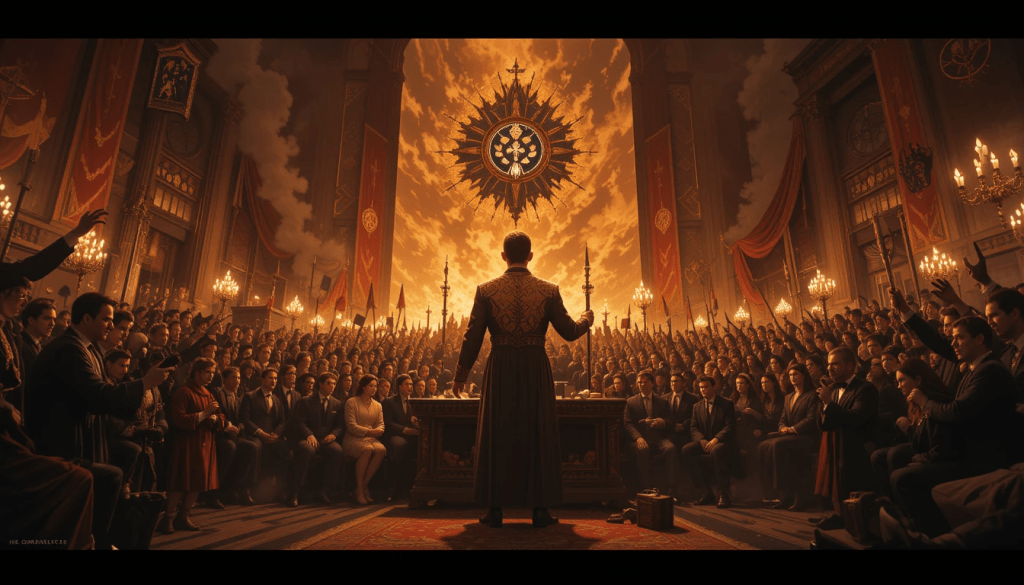
Ochlocracy
IPA Pronunciation: /ɒˈklɒkrəsi/ (British) | /ɑːˈklɑːkrəsi/ (American)
Part of Speech: Noun
Etymology
From Ancient Greek ὀχλοκρατία (okhlokratía):
- ὄχλος (okhlos) — “crowd, mob, rabble”
- -κρατία (-kratia) — “rule, power, authority”
Literally: “rule of the mob.”
- The earliest known use comes from Polybius (c. 2nd century BCE), the Greek historian and philosopher. He described ochlocracy as a degeneration of democracy within his cyclical theory of government (anacyclosis).
Core Definitions
1. Rule by the Mob (Mob Rule)
A political system in which government is overtaken by mass crowds, with decisions made by impulsive, emotional, or violent popular will rather than law or reason.
“The senate was swept aside, and ochlocracy reigned in the streets.”
2. Degeneration of Democracy
In political philosophy, ochlocracy is the corrupt form of democracy, when governance by the people becomes governance by the unruly crowd.
“Democracy, if left unrestrained, may descend into ochlocracy.”
3. Figurative Use (Modern)
Any chaotic or mob-like dominance in culture, politics, or society.
“Online debates sometimes devolve into a digital ochlocracy of outrage and noise.”
Explanation & Nuance
- Polybius’ Anacyclosis (Cycle of Government):
- Monarchy → Tyranny
- Aristocracy → Oligarchy
- Democracy → Ochlocracy
Each system, he argued, decays into its corrupted form. Ochlocracy thus represents the lowest state of democratic decay.
- Tone & Connotation:
Always negative. Unlike democracy (rule of the people), which carries noble associations, ochlocracy implies chaos, mob violence, emotional decision-making, and breakdown of order. - Difference from Related Concepts:
- Democracy = organized governance by the people, rule of law.
- Populism = political appeal to the people, sometimes dangerous but not inherently lawless.
- Anarchy = absence of government altogether.
- Ochlocracy = when the people’s collective power becomes mob violence, overriding legal institutions.
Examples in Context
- Ancient: “The collapse of Athenian democracy into ochlocracy was feared by its philosophers.”
- Revolutionary: “During the French Revolution, ochlocracy ruled — the crowd became judge, jury, and executioner.”
- Modern Figurative: “The comment section devolved into pure ochlocracy, a storm of insults without reason.”
- Political Critique: “Unchecked populism risks sliding into ochlocracy, where mob passion outweighs justice.”
Synonyms & Related Terms
- Mob rule – direct, plain equivalent.
- Demagoguery – rule by leaders who exploit mob passions.
- Tyranny of the majority – philosophical cousin (Tocqueville, Mill).
- Anarchy – disorder without governance, broader than ochlocracy.
- Rabble-rousing – the stirring of mob passions.
Cultural & Historical Resonance
- Ancient Greece & Rome: Political theorists like Polybius and Plato feared the “uneducated mob” as a destructive force, prone to demagogues.
- French Revolution: The Reign of Terror (1793–94) is often cited as an ochlocracy — when revolutionary fervor descended into mob violence.
- Modern Parallels: Discussions of social media outrage, street uprisings, and populist unrest often resurrect the term to describe unstructured, volatile democracy.
- Literature & Oratory: The word carries a thunderous gravity, used in speeches and writing to conjure the image of civilization teetering into chaos.
Takeaway
Ochlocracy is not democracy, but its collapse into chaos — a system where reason gives way to passion, institutions to mobs, and law to frenzy. It is the rule of the crowd when the crowd forgets justice.
Ochlocracy
The shadow of democracy — when the people’s voice becomes a roar, and the mob seizes the throne of reason.
Curious about what happened today in history? Want to learn a new word every day?
You’ll find it all—first and in one place—at The-English-Nook.com!
If you love languages, this is your space.
Enjoy bilingual short stories, fun readings, useful vocabulary, and so much more in both English and Spanish.
Come explore!
 Word of the Day - The English Nook
Leave a comment