
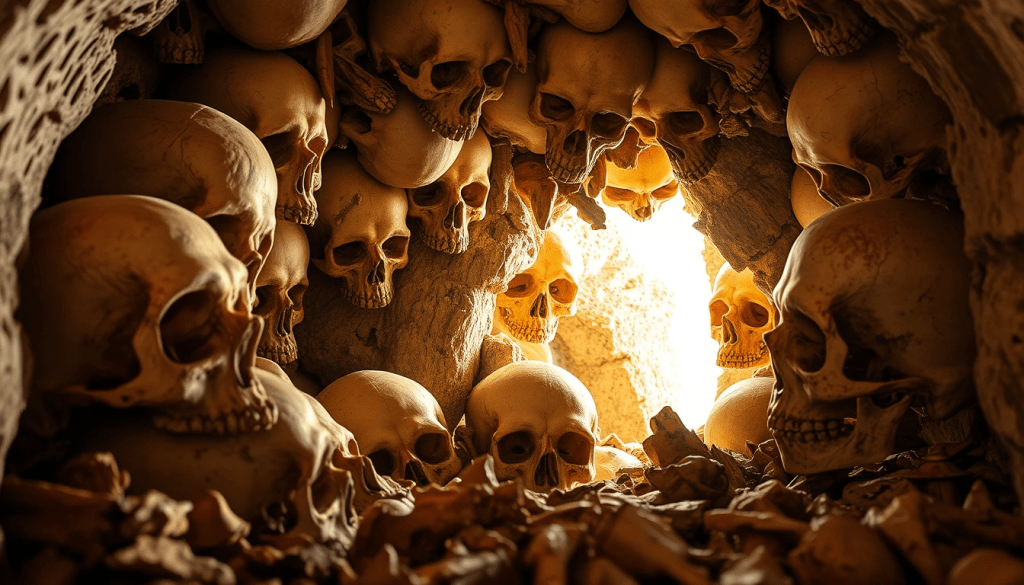
Charnel
IPA Pronunciation: /ˈtʃɑːr.nəl/
Part of Speech: Adjective | Noun (archaic/poetic)
Etymology
From Old French charnel (“fleshly, of the flesh; a place for corpses”), derived from Late Latin carnāle → from carō, carnis (“flesh, meat”).
- The same Latin root gives us carnage, carnal, and incarnation.
- By the 14th century, charnel in English came to specifically describe houses or vaults for bones and corpses — the “charnel house.”
Core Definitions
1. (Adjective) Of or Relating to the Dead; Associated with Corpses
Evoking imagery of bones, tombs, death, and decay.
“A charnel stench hung in the air of the ruined crypt.”
2. (Noun, Archaic) A Charnel House
A repository for skeletal remains, often attached to a church or cemetery.
“The monks laid the bones in the charnel after the graves were emptied.”
Explanation & Nuance
- Adjective Usage: Today, charnel is almost always used adjectivally, modifying words like house, vault, ground, stench, horror. It suggests morbid imagery — a place steeped in death and decay.
- Noun Usage (Historical): A charnel house was common in medieval Europe, when graveyards became overcrowded. Exhumed bones were stored respectfully in ossuaries or charnel vaults.
- Figurative Tone: Beyond its literal meaning, charnel can also be used metaphorically to describe anything ghastly, deathlike, or soaked in violence — e.g., “a charnel battlefield.”
Examples in Context
- Literal: “The charnel house beneath the cathedral held centuries of bones.”
- Figurative: “The war left the once-thriving city a charnel ruin.”
- Poetic: “From charnel shadows rose whispers of forgotten dead.”
- Historical: “Villagers carried the skulls to the charnel during All Souls’ rites.”
Synonyms & Related Terms
- Ossuary – a container or chamber for bones.
- Sepulchral – tomb-like, funereal.
- Funereal – solemn, related to funerals.
- Macabre – grim, death-haunted.
- Necropolis – a city of the dead, large cemetery.
- Carnal (cognate) – of the flesh (living rather than dead).
Cultural & Literary Resonance
- Medieval Europe: Charnel houses stood beside churches, functioning as repositories for bones after graves were reused. They symbolized the memento mori ethos — a reminder of mortality.
- Poetry & Literature: Poets like Milton and Wordsworth used charnel to invoke graveyard imagery and the inevitability of death. In Gothic literature, “charnel” is a word of dread, conjuring crypts, decay, and bones.
- Modern Horror & Fantasy: The term appears in Gothic horror, dark fantasy, and video games to describe grim, corpse-laden places — from “charnel pits” to “charnel vaults.”
Takeaway
Charnel is a word steeped in death, bones, and the macabre — a reminder of human mortality housed in stone vaults, whispered through Gothic arches, and echoed in fields of slaughter. It is at once architectural, visceral, and symbolic: the architecture of death and memory.
Charnel
The shadowed repository of mortality — bone-houses of memory, vaults of the dead, and the morbid poetry of flesh returned to dust.
Curious about what happened today in history? Want to learn a new word every day?
You’ll find it all—first and in one place—at The-English-Nook.com!
If you love languages, this is your space.
Enjoy bilingual short stories, fun readings, useful vocabulary, and so much more in both English and Spanish.
Come explore!
 Word of the Day - The English Nook
Leave a comment