
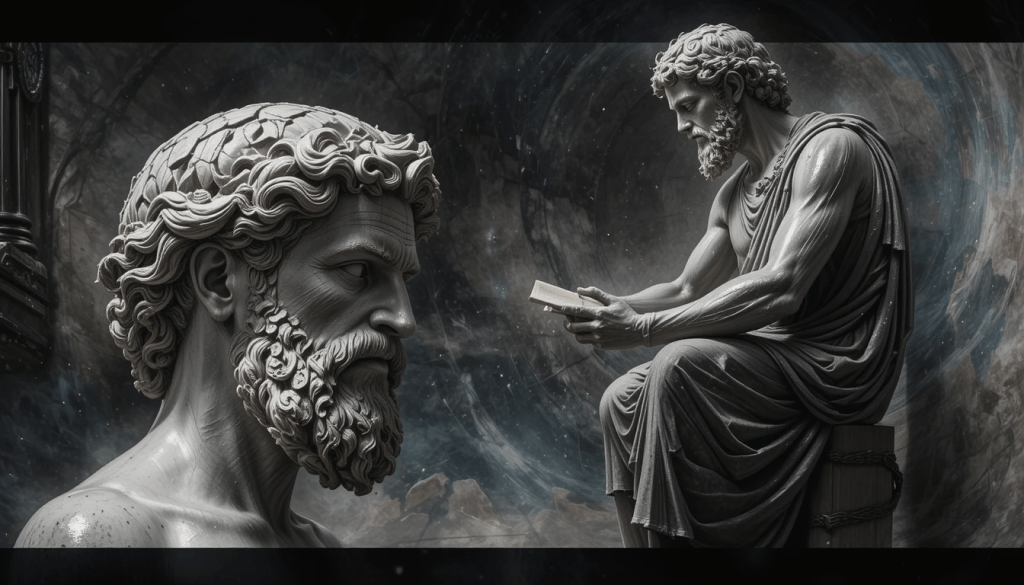
Mimesis
IPA Pronunciation: /maɪˈmiːsɪs/ or /mɪˈmiːsɪs/
Part of Speech: Noun
Etymology
From Ancient Greek μίμησις (mímēsis), meaning “imitation, representation, mimicry.” Derived from mimeisthai (“to imitate”), which is connected to mimos (“actor, mime”).
In Greek philosophy, especially in Plato and Aristotle, mimesis came to signify the representation of reality in art and literature — not merely copying, but embodying, transforming, or re-presenting the world through creative expression.
Core Definitions
1. Artistic Representation or Imitation of Reality
The act of depicting or recreating the real world in art, literature, drama, or other creative forms.
“For Aristotle, tragedy was the highest form of mimesis, imitating human action to stir catharsis.”
2. Mimicry or Imitation in Nature and Behavior
Broader than art, mimesis can also describe imitation found in the natural world or in human conduct.
“The butterfly’s wings showed mimesis of leaves to deceive predators.”
3. Philosophical / Theoretical Concept
In critical theory, mimesis is the complex relationship between art, reality, and representation — the way culture mirrors, distorts, or reinterprets the real.
“Modernists broke with classical mimesis, no longer seeking to imitate life but to fragment and reinterpret it.”
Explanation & Nuance
- Plato’s View: He was suspicious of mimesis, regarding art as a copy of a copy — since the material world itself was but a reflection of eternal Forms. Thus, art was thrice removed from truth.
- Aristotle’s View: More positive — he saw mimesis as natural to humans and central to learning. In Poetics, he argues that tragedy, as mimesis of noble action, creates catharsis (emotional purification).
- Later Aesthetics: From the Renaissance to Romanticism, mimesis became the cornerstone of art theory — the idea that art should reflect nature, human life, or universal truths.
- Modern/Postmodern Turns: Artists and theorists (Nietzsche, Benjamin, Adorno, Derrida) reinterpreted or rejected mimesis, exploring art’s autonomy, subjectivity, and its power to transform rather than merely reflect reality.
Examples in Context
- Philosophical: “Plato rejected mimesis as deception, but Aristotle embraced it as education and catharsis.”
- Literary: “The novel’s strength lay in its subtle mimesis of provincial life.”
- Natural: “The lizard displayed mimesis, blending perfectly with the rocks.”
- Modern Critical: “Cinema’s realism relies on mimesis, but its montage reveals artifice.”
Synonyms & Related Terms
- Representation – the depiction of something in art or media.
- Imitation – direct copying or mimicry.
- Simulation – reproducing or modeling reality artificially.
- Reproduction – creating a likeness of something.
- Ekphrasis – detailed artistic description (closely tied to mimetic tradition).
Cultural & Literary Resonance
- Art & Literature: Mimesis is the foundational concept for Western artistic thought — the belief that art mirrors or interprets life.
- Theatre & Performance: Rooted in Greek drama, where actors embodied characters and actions as a mimetic act.
- Philosophy & Theory: Continues to shape debates about realism, symbolism, abstraction, and postmodern critique.
- Science & Nature: The concept extends metaphorically into biology and psychology, where mimicry, imitation, and modeling are forms of mimesis.
Takeaway
Mimesis is not mere mimicry, but the deep art of reflection and transformation — how humans, nature, and culture imitate, reimagine, and reshape reality. It is the bridge between the real and the represented, between what is and what we can dream into form.
Mimesis
The eternal mirror of art and life — reflecting, distorting, and re-enchanting reality through the act of imitation.
Curious about what happened today in history? Want to learn a new word every day?
You’ll find it all—first and in one place—at The-English-Nook.com!
If you love languages, this is your space.
Enjoy bilingual short stories, fun readings, useful vocabulary, and so much more in both English and Spanish.
Come explore!
 Word of the Day - The English Nook
Leave a comment