
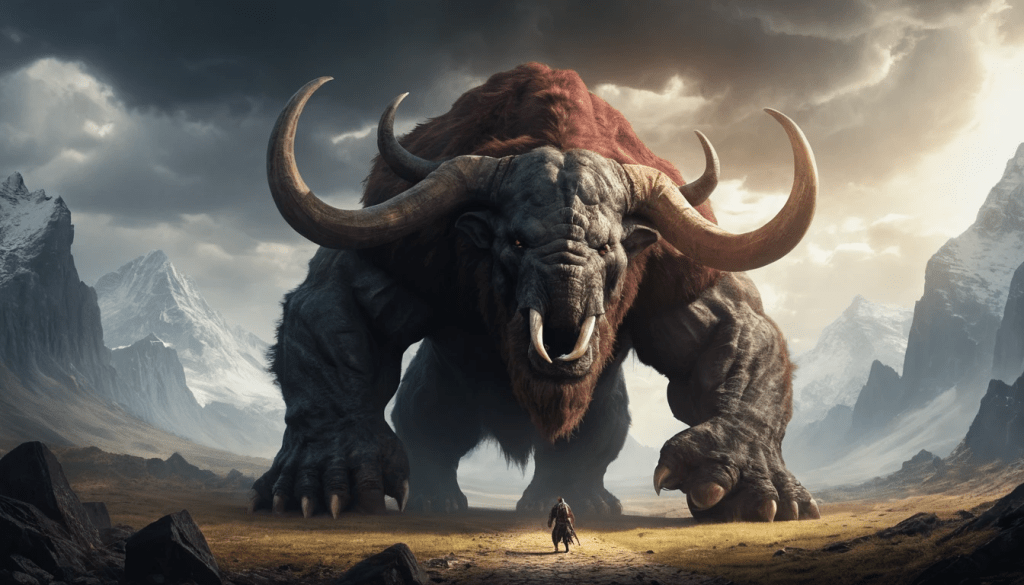
Behemoth
IPA Pronunciation: /bɪˈhiː.məθ/ or /ˈbiː.ə.mɒθ/
Part of Speech: Noun
Etymology
From Hebrew בְּהֵמוֹת (bəhemōth), the plural form of bəhēmāh meaning “beast, brute, large animal.”
- Though plural in form, in the Book of Job it is used as a singular proper noun, denoting a singular, unmatched beast — the archetypal monster of the land.
- Adopted into Latin (behemoth), then carried into Middle English, where it retained both its scriptural aura and its sense of vastness.
- Over time, it expanded into metaphorical use for anything immense, unwieldy, and unstoppable — from mythical monsters to modern megacorporations.
Core Definitions
1. The Biblical Monster of Earth
A vast, primeval beast described in Job 40:15–24:
- Herbivorous yet colossal, with strength in its loins, power in its muscles, bones “like bars of bronze,” and a tail likened to a cedar tree.
- Untamable by humans, it represents God’s creation beyond human control — a living embodiment of earthly power and mystery.
“Behold now Behemoth, which I made with thee; he eateth grass as an ox.”
2. Any Creature of Enormous Size or Power
Used poetically for any gigantic beast, whether real or imagined: whales, elephants, kaiju, or titanic myth-creatures.
“The glacier loomed like a frozen behemoth, grinding the valley into stone-dust.”
3. A Metaphor for Massive Institutions or Forces
Applied figuratively to corporations, armies, machines, or governments so vast and powerful they seem monstrous and unstoppable.
“The political behemoth crushed all opposition under its weight.”
4. Colossal Chaos-Entity (Mythic Extension)
In later Jewish apocalyptic traditions, Behemoth is paired with Leviathan (the sea-monster) and Ziz (the sky-beast), forming a triad of chaos-creatures — each ruling land, sea, and sky. Some legends foretell their apocalyptic battle, after which their flesh will feed the righteous.
Explanation & Nuance
- Behemoth vs. Leviathan: Behemoth is earthbound power — solid, immovable, massive. Leviathan is fluid chaos of the seas. Together they embody primal domains humanity cannot master.
- Tone & Register: Awe-inspiring, biblical, mythic, and metaphorical. In modern speech, “behemoth” instantly conveys immensity.
- Cultural Shift: From literal beast → to metaphor for sheer size → to modern slang for corporations, industries, or cultural giants.
Examples in Context
- Biblical:
“Behemoth drinks up a river and hastens not: he trusteth that he can draw up Jordan into his mouth.” - Poetic:
“Mountains moved like behemoths beneath the glacier’s weight.” - Figurative:
“The tech behemoth expanded until it spanned half the globe.” - Mythic / Fantasy:
“From the dust plains rose the Behemoth, whose breath toppled trees and whose tread cracked the earth.”
Synonyms & Related Terms
- Colossus – a giant or monumental figure.
- Titan – a godlike giant from Greek myth.
- Juggernaut – an unstoppable, crushing force.
- Goliath – a mighty adversary of overwhelming size.
- Leviathan – the sea-born counterpart to Behemoth.
Cultural Resonance
- Scriptural: A creature beyond human mastery, serving as a reminder of God’s majesty and humanity’s smallness.
- Medieval Lore: Folded into apocalyptic myth as one of the three world-monsters.
- Literary Tradition: Appears in Milton’s Paradise Lost (“the brute Behemoth, biggest born of earth”) and countless later works.
- Modern Use: Titles of novels, bands, war machines, and corporate critiques — always signaling something immense, monstrous, and overwhelming.
- Pop Culture: A favorite name for video-game bosses, fantasy monsters, and heavy metal aesthetics, where it suggests primal brute strength.
Takeaway
Behemoth is more than just a “big thing.”
It is the mythic archetype of immensity — the earth’s monstrous weight, the immovable mass of chaos, the shadow of overwhelming scale.
Whether in scripture, literature, or metaphor, it represents what is vast beyond control, terrifying in scope, and awe-inspiring in power.
Behemoth
The colossal beast of earth — mountain-born, river-drinker, a living monument to the unfathomable might of creation.
Curious about what happened today in history? Want to learn a new word every day?
You’ll find it all—first and in one place—at The-English-Nook.com!
If you love languages, this is your space.
Enjoy bilingual short stories, fun readings, useful vocabulary, and so much more in both English and Spanish.
Come explore!
 Word of the Day - The English Nook
Leave a comment