
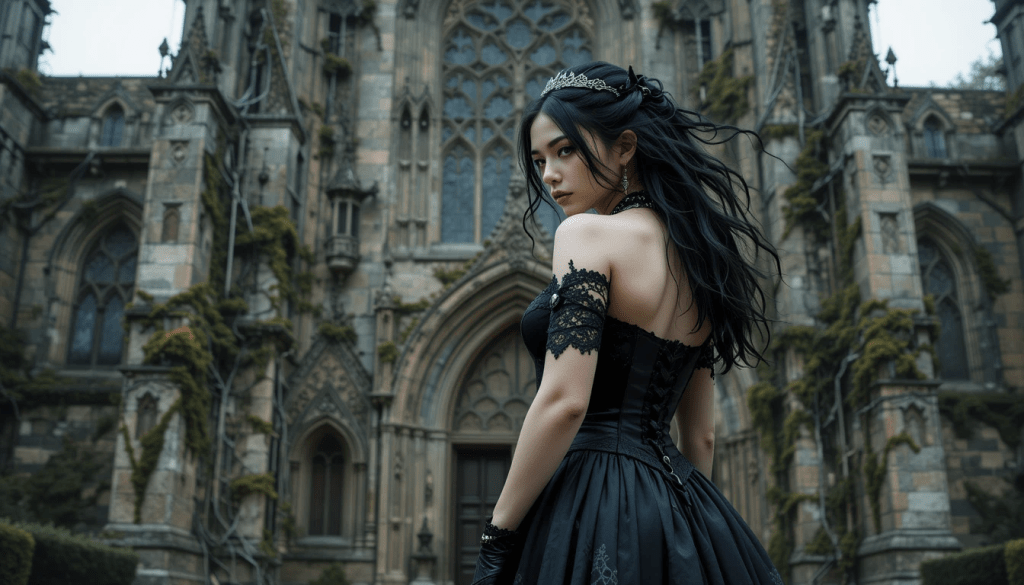
Gothic
IPA Pronunciation: /ˈɡɒθ.ɪk/
Part of Speech: Adjective (sometimes Noun)
Etymology
From Late Latin Gothicus → “of the Goths” (the East Germanic peoples who helped bring about the fall of Rome).
The Goths themselves likely derived their name from Gutþiuda (“people of the Goths”).
Over centuries, the word Gothic expanded beyond the ethnonym:
- In the Renaissance, it was used pejoratively by Italians to describe the architecture of Northern Europe — “barbarian” compared to classical Rome.
- In the 18th century, it gained a new meaning in literature: the “Gothic novel” — dark, mysterious, medieval, filled with castles, ghosts, and ruin.
- By the modern era, Gothic embraced an entire aesthetic of darkness, mystery, and otherworldly beauty.
Core Definitions
1. Pertaining to the Goths
- Anything relating to the ancient Gothic tribes, their language, or their historical role in Europe.
- Example: “The Gothic invasions reshaped the destiny of Rome.”
2. Medieval / Architectural
- Referring to the style of architecture that flourished in Europe from the 12th to 16th centuries: pointed arches, ribbed vaults, flying buttresses, stained glass.
- Once dismissed as “barbaric,” now revered as sublime expressions of the sacred.
- Example: “The cathedral soared heavenward in Gothic splendor.”
3. Literary & Artistic
- A genre marked by mystery, horror, ruins, and the sublime; pioneered by Horace Walpole’s The Castle of Otranto (1764), developed by Ann Radcliffe, Mary Shelley, and Edgar Allan Poe.
- Example: “Her Gothic tales wove shadow and storm into romance and dread.”
4. Modern Aesthetic / Subculture
- Dark, dramatic, and often romantic style in fashion, music, and identity. Black clothing, pale skin, silver jewelry, themes of melancholy, death, and beauty.
- Example: “The club filled with Gothic music and spectral elegance.”
Symbolism & Cultural Resonance
- Barbarian Power: Gothic first symbolized the tribes who humbled Rome, embodying the outsider and the world’s end.
- Sublime Darkness: In art and literature, Gothic invokes mystery, the supernatural, the ruinous beauty of decay.
- Romantic Melancholy: To be Gothic is to revel in shadow, passion, and the haunted spaces of the soul.
- Cultural Rebellion: The Gothic subculture reclaims darkness as beauty, standing against the mundane, the shallow, and the overly bright.
Examples in Context
- Historical: “The Gothic tongue preserves fragments of a vanished people.”
- Architectural: “Notre-Dame is the supreme example of French Gothic design.”
- Literary: “Poe perfected the Gothic tale of terror.”
- Modern: “She wore her Gothic identity proudly, every detail a hymn to shadows.”
Synonyms & Related Terms
- Medieval – but with less emphasis on darkness.
- Baroque – ornate and dramatic, though lighter in mood.
- Macabre – grim, grotesque, death-centered.
- Romantic – emotional, sublime, often overlapping with Gothic.
- Grotesque – distorted, strange, uncanny.
In Literature, Art, and Culture
- Architecture: Chartres, Cologne, Notre-Dame, Westminster Abbey — stone rising like frozen prayers.
- Literature: From Walpole to Shelley to Lovecraft, Gothic fiction embodies terror and beauty entwined.
- Art: Gothic painting and sculpture embraced elongated forms and spiritual intensity.
- Music & Subculture: From Bauhaus and The Cure to cyber-goth and Victorian goth fashion, it remains an evolving countercultural identity.
Takeaway
Gothic is a word of transformations:
- From the Goths, destroyers of Rome.
- To architecture, spires and shadows piercing heaven.
- To literature, a realm of castles, storms, and spectral dread.
- To modern identity, a celebration of beauty in darkness.
It is at once barbaric and divine, ruinous and sublime, shadowed and transcendent.
Gothic
The art of shadows — born of barbarians, raised in cathedrals, reborn in ruins, still alive in black lace and silver moonlight.
Curious about what happened today in history? Want to learn a new word every day?
You’ll find it all—first and in one place—at The-English-Nook.com!
If you love languages, this is your space.
Enjoy bilingual short stories, fun readings, useful vocabulary, and so much more in both English and Spanish.
Come explore!
 Word of the Day - The English Nook
Leave a comment