
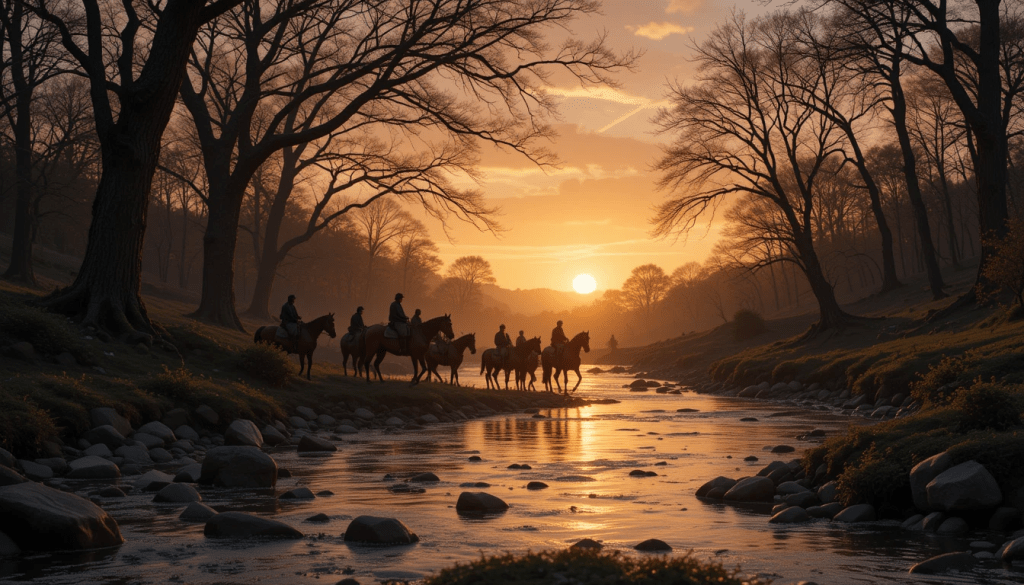
Ford
IPA Pronunciation: /fɔːrd/ (forrd)
Part of Speech: Noun (also Verb)
Etymology
From Old English ford (“shallow place in a river”), directly from Proto-Germanic furduz (cf. Old High German furt, Old Norse fjǫrðr), related to the Proto-Indo-European root per- (“to lead, to pass over, to cross”). This ancient linguistic lineage reflects the ford’s timeless role in human movement, settlement, and storytelling. Place names like Oxford (“oxen ford”), Hereford, and Stafford bear witness to its historical centrality.
Core Definitions
1. Shallow Water Crossing (Geographical)
A natural point in a river, stream, or tidal channel where the water is shallow enough for people, animals, or vehicles to cross without swimming or the use of a bridge.
“The caravan reached the ford at dusk, the water barely touching the camels’ knees.”
2. The Act of Crossing (Verb)
To traverse a river or stream by wading, riding, or driving through it at a shallow point.
“We forded the icy river before nightfall.”
Historical & Cultural Significance
- Ancient Infrastructure: Before bridges became common, fords were essential connectors in trade routes and migration paths. They often dictated the location of settlements, markets, and military garrisons.
- Military Strategy: Fords were strategic chokepoints; to hold or destroy a ford was to control an army’s mobility. Famous battles, from medieval skirmishes to Civil War campaigns, were decided at fords.
- Economic Hubs: Towns near fords became centers of commerce, where merchants and travelers would gather, making them cradles of cultural exchange.
- Folklore & Myth: In many cultures, a ford in a river could mark the border between the mortal world and the realm of spirits — a place where one “crosses over” in more than the physical sense.
Symbolism & Literary Use
- Thresholds & Transitions: The ford is a liminal space — not fully land, not fully water — representing moments of decision, risk, and transformation.
- The Test: In epic tales, crossing a ford often marks the hero’s courage or resolve, as they must brave unpredictable waters without certainty of safety.
- The Passage Between Realms: In myth and fantasy, a ford can become the crossing point between life and death, known and unknown, waking and dreaming.
Examples in Context
- Historical: “Caesar’s legions forded the Thames under a hail of arrows, pressing on toward the enemy stronghold.”
- Literary: “She paused at the moonlit ford, knowing that once she crossed, nothing would be the same again.”
- Everyday: “The jeep stalled halfway through the ford, its wheels sinking into the silt.”
Related Terms
| Term | Connection |
|---|---|
| Furt (German) | Linguistic cognate; shallow crossing |
| Wade | To move through water on foot |
| Causeway | Artificial raised crossing over wet ground |
| Ferry | Watercraft-based transport across a channel |
| Bridge | Man-made structure for crossing water |
Cultural Resonance
The ford is not merely a feature of the landscape — it is an ancient meeting point between necessity and nature’s design. For millennia, it has been where trade flourished, armies clashed, lovers parted, and legends were born. It appears in sagas and chronicles as a quiet stage for decisive acts, a place where human will meets the flowing persistence of water.
Takeaway
A ford is more than just a geographical feature — it is a natural point of connection, a reminder that even barriers have places of passage. It speaks to human ingenuity, exploration, and the timeless need to cross from here to there.
Ford
A place where the river yields, and the traveler tests both current and destiny — a threshold between shores, between moments, between worlds.
Curious about what happened today in history? Want to learn a new word every day?
You’ll find it all—first and in one place—at The-English-Nook.com!
If you love languages, this is your space.
Enjoy bilingual short stories, fun readings, useful vocabulary, and so much more in both English and Spanish.
Come explore!
 Word of the Day - The English Nook
Leave a comment