
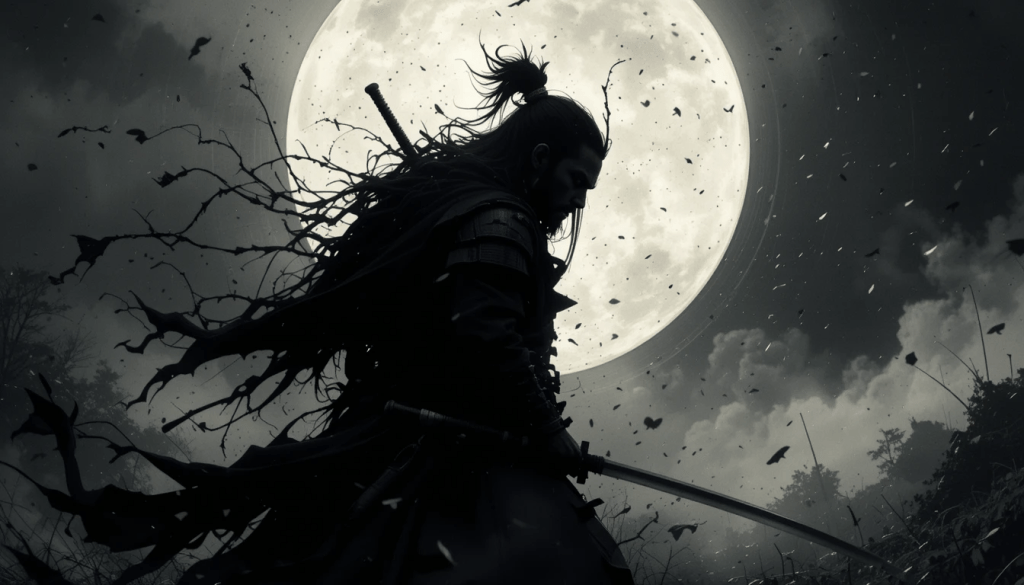
Ronin
IPA Pronunciation: /ˈroʊ.nɪn/
Part of Speech: Noun
Etymology
From Japanese 浪人 (rōnin) — literally meaning “wave man” (rō 浪 = wave, nin 人 = person), referring to a person adrift, like a wave on the sea. Originally applied to samurai who had lost their master or lord, either through death or disgrace.
Core Definition
1. A Masterless Samurai
In feudal Japan, a ronin was a samurai without a master, often due to the death of their lord or a loss of honor that stripped them of their status. Once bound by bushidō (the samurai code), the ronin wandered honorless, disenfranchised, and adrift, surviving as mercenaries, bodyguards, or even outlaws.
“The ronin roamed the countryside, his blade sharp, but his purpose dulled.”
Extended & Symbolic Definitions
2. A Rootless, Wandering Warrior or Outcast
Beyond historical context, ronin has evolved to describe anyone who drifts without allegiance, home, or direction — a lone figure guided only by personal conviction or survival.
“He was a corporate ronin now—untethered, unclaimed, answering to no banner but his own.”
Historical Context
During Japan’s Edo period (1603–1868), a rigid social structure tied samurai to their feudal lords (daimyō). When a samurai’s lord died or dismissed him, the warrior became a ronin — a state seen as shameful or dishonorable, a fall from the rigid ideal of loyalty and service.
However, some ronin—like the famed 47 Ronin—gained renown for their loyalty, vengeance, and tragic nobility, becoming folk heroes who defied the notion that status determined honor.
Cultural Resonance
Today, ronin symbolizes:
- Autonomy in the face of abandonment
- Individualism in a conformist world
- Displacement — the cost of loyalty, the pain of exile
- Resilience — enduring without protection or allegiance
In modern Japan, “ronin” can also refer to students who are between schools, especially those who failed university entrance exams and are preparing to try again — metaphorically “wandering” before their next allegiance is formed.
Examples in Context
- “A ronin of the digital age, she turned down every offer, chasing her own code.”
- “They fought like ronin—bound not by flag, but by belief.”
- “His story was one of deracination: a ronin in every sense, severed from both family and tradition.”
In Literature and Film
- Akira Kurosawa’s iconic films (Yojimbo, Seven Samurai) explored the moral complexities and existential loneliness of the ronin.
- The Ronin archetype appears in westerns, sci-fi, and noir—the lone gunman, the exile, the rogue protector.
- Frank Miller’s graphic novel Ronin places the figure in a dystopian cyberpunk setting.
- In Star Wars, Jedi like Obi-Wan Kenobi and Ahsoka embody ronin-like traits—former warriors without masters, surviving on the fringes.
Related and Companion Terms
| Term | Meaning |
|---|---|
| Samurai | A warrior bound by duty and honor to a lord |
| Bushidō | The “way of the warrior”; samurai moral code |
| Exile | Being barred or removed from one’s place or community |
| Vagabond | A wanderer without home or allegiance |
| Outlaw | One who lives beyond the bounds of law or society |
Contrasts and Antonyms
| Term | Meaning |
|---|---|
| Retainer | A loyal servant or warrior in service to a lord |
| Vassal | One sworn to a superior in a feudal system |
| Loyalist | One who maintains allegiance despite change |
| Institutionalist | One tied to hierarchy or formal systems |
Takeaway
Ronin is more than a historical figure—it is an archetype of the forsaken, the wandering soul, the principled outcast. Whether noble, fallen, or merely surviving, the ronin walks the path of solitude—without master, but not without purpose.
Ronin:
One who walks alone. A warrior without banner, without lord—bound only to the wind, his blade, and the silence of the path.
 Word of the Day - The English Nook
Leave a comment