
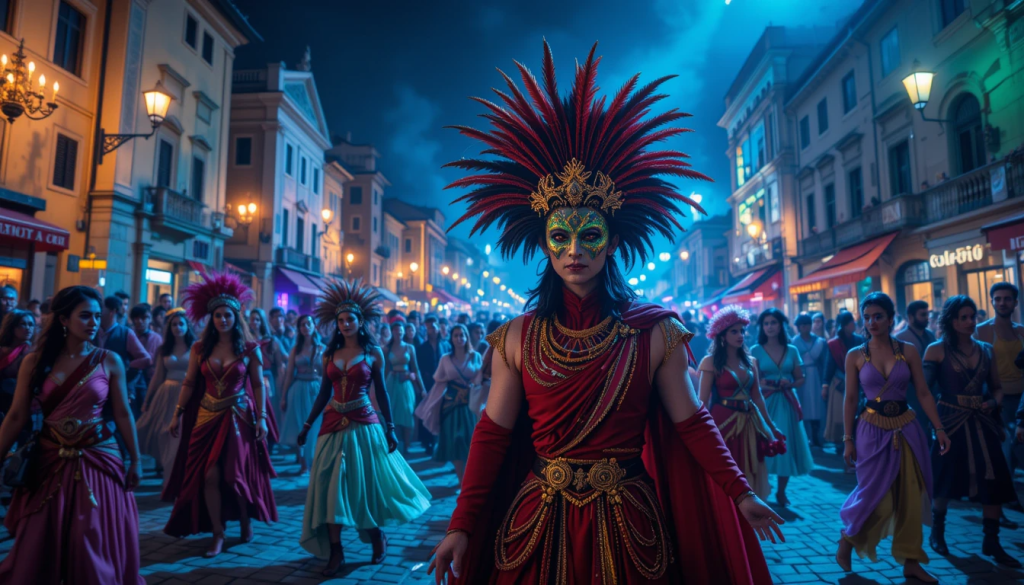
Saturnalia
IPA Pronunciation: /ˌsætəˈneɪliə/ or /ˌsætərˈneɪljə/
Part of Speech: Noun
Etymology
From Latin Saturnalia, the name of an ancient Roman festival held in honor of the god Saturn (Saturnus), the deity of time, sowing, and liberation. The term derives from Saturnus + the suffix -alia, denoting a festal observance.
Definitions
1. An Ancient Roman Festival of Reversal and Revelry
A major Roman holiday celebrated in mid-December, Saturnalia honored Saturn, bringing days of merriment, gift-giving, feasting, and temporary subversion of social order. Slaves were served by their masters, laws were relaxed, and societal norms were gleefully overturned.
“During Saturnalia, the city became ungovernable joy.”
2. A Period of Wild Celebration or Excess (Figurative)
Used figuratively to describe any time of riotous festivity, chaotic joy, or exuberant indulgence, especially when societal rules are briefly cast aside.
“The carnival was a modern Saturnalia, with masks, mischief, and music in the streets.”
Historical and Cultural Context
Saturnalia was celebrated December 17–23 and included:
- Public banquets and sacrifices at the Temple of Saturn in the Roman Forum
- Gambling, role-reversal, and masquerade
- The Lord of Misrule — a mock king or jester chosen to preside over the chaos
- The suspension of war and business
- Exchange of gifts, especially candles (cerei) and small figurines (sigillaria)
It was a festival of inversion, where order gave way to spontaneity, reflecting a longing for the mythical Golden Age, when Saturn ruled and all lived in peace and equality.
Symbolism and Resonance
Saturnalia represents:
| Concept | Meaning |
|---|---|
| Inversion | Temporary upheaval of the social order |
| Liberation | A symbolic release from duty, hierarchy, and routine |
| Excess | Joyful abandon; indulgence in food, drink, and laughter |
| Return to Eden | Echo of the Golden Age: simplicity, equality, delight |
| Shadowed Joy | A brief holiday from darkness, during winter’s peak |
Its themes echo into Christmas, Carnival, and Mardi Gras—all later traditions borrowing Saturnalia’s tone of jubilant suspension.
Examples in Context
- “The office party devolved into a miniature Saturnalia—champagne, karaoke, and a dance-off between the interns and the CEO.”
- “In the dim flicker of torchlight, the Saturnalia began—feast, song, and the reversal of fate.”
- “He saw Saturnalia not as decadence, but as sacred disobedience—ritualized joy in the heart of winter.”
Related and Companion Words
| Word | Meaning |
|---|---|
| Bacchanal | A drunken revel or party, from the rites of Bacchus |
| Carnival | A season of festivity and indulgence before Lent |
| Mischief Night | A modern echo of social inversion and prankery |
| Feast | A celebration of food and gathering |
| Liminality | The threshold space where roles are blurred or reversed |
| Solstice | The darkest day, often marked by fire and festivity |
Modern Usage and Influence
- Christmas traditions like gift-giving, merrymaking, and even the use of candles and evergreen decorations echo Saturnalia.
- It influences works from Shakespeare to Terry Pratchett, symbolizing joyful chaos.
- In psychology and anthropology, Saturnalia is studied as a ritual of cultural release, a pressure valve for society.
Antonyms and Contrasts
- Ordinance – Regulation, law, structure
- Sobriety – Seriousness or restraint
- Asceticism – Denial of worldly pleasures
- Hegemony – The persistence of rigid hierarchy
Takeaway
Saturnalia is not merely a holiday of indulgence—it’s a mythic rebellion, a ritualized inversion of reality, a laughter-soaked memory of a world before rules. It speaks to the human need for joy, equality, and release amid structure and cold.
Saturnalia:
A candle against the longest night; a carnival at the edge of empire. When Saturn laughs, and mortals dance in the ruins of order.
 Word of the Day - The English Nook
Leave a comment