
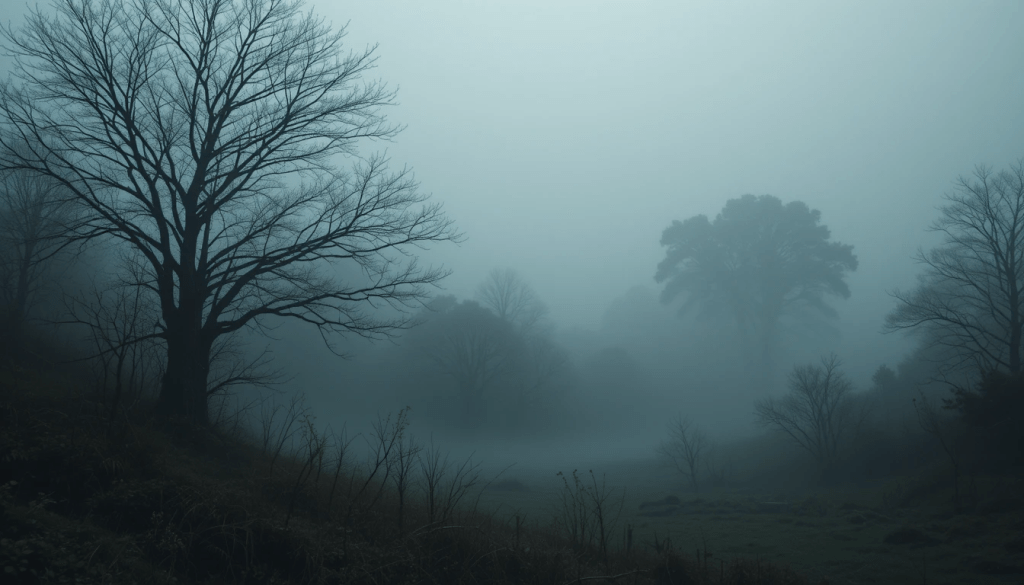
Caligo
IPA Pronunciation: /ˈka.lɪ.ɡoʊ/
Part of Speech: Noun (Latin); adopted into poetic English usage
Etymology
From Latin caligo, meaning “darkness,” “mist,” “fog,” or “obscurity.” The verb form caligāre means “to be dark or obscure.” In Roman texts, caligo was used both literally (e.g., a physical fog or smoke) and figuratively (e.g., mental or spiritual darkness).
Definitions
1. Thick Darkness or Mist (Literal)
A heavy fog, vapor, or veil of gloom that obscures vision; an enveloping physical darkness often associated with mystery, danger, or the unknown.
“The caligo rolled in from the moors, swallowing the trees in shapeless shadow.”
2. Spiritual or Mental Obscurity (Figurative)
An inward clouding of perception, reason, or soul; a descent into confusion, depression, moral ambiguity, or existential blindness.
“In grief he wandered through a caligo of the heart—where no light, no answer, could reach him.”
3. Cosmic or Mythic Shadow
In some classical and mythological frameworks, caligo embodies primordial darkness—a chaotic veil before the emergence of order or light, akin to Nyx in Greek myth or the shadowy void of creation myths.
“From the caligo of preexistence came the shaping of the stars.”
Cultural and Literary Significance
Caligo is a word steeped in atmosphere. It evokes:
- The edge of awareness, where clarity dissolves
- The unknown forest, the haunted dreamscape
- The unseen forces behind veils of mist
- The spiritual eclipse, when faith falters and doubt reigns
It often appears in literature, fantasy, and philosophy to express a world—or soul—shrouded in uncertainty or loss.
Examples in Context
- “A caligo clung to the battlefield, mingling the smoke of cannon with the breath of death.”
- “She felt a caligo settle over her thoughts, as though her mind were drifting in a cold, uncharted sea.”
- “The alchemists wrote of caligo as the veil that must be passed through before illumination.”
Symbolism and Allegory
| Context | Meaning |
|---|---|
| Mythological | The darkness before creation; a veil before the divine |
| Psychological | Depression, mental fog, internal confusion |
| Spiritual | A dark night of the soul; separation from clarity or grace |
| Artistic | The chiaroscuro of emotion; beauty in shadow and ambiguity |
In alchemical, esoteric, and Gnostic traditions, caligo may represent the nigredo phase—a necessary descent into shadow before renewal.
Related and Companion Words
| Word | Meaning |
|---|---|
| Tenebris | Latin for “shadows” or “gloom” |
| Miasma | A murky, oppressive atmosphere |
| Obfuscation | The act of darkening or making unclear |
| Murk | Dimness or thick darkness |
| Penumbra | A partial shadow; twilight edge of illumination |
| Stygian | Deep, infernal darkness, as of the river Styx |
Antonyms and Contrasts
- Lux – Latin for “light”
- Claritas – Brightness, clarity, radiance
- Lucidity – Mental sharpness and illumination
- Illumination – Literal or metaphorical enlightenment
Takeaway
Caligo is more than mist—it is the metaphorical twilight between what is seen and what is hidden, the soul’s passage through shadow, the fog of unknowing that surrounds moments of crisis, loss, or transformation. Whether physical or metaphysical, caligo invites us to dwell in the dark—and perhaps, to find meaning there.
Caligo:
A veil of ancient mist, a hush before the awakening. The dark in which the stars are born.
 Word of the Day - The English Nook
Leave a comment