
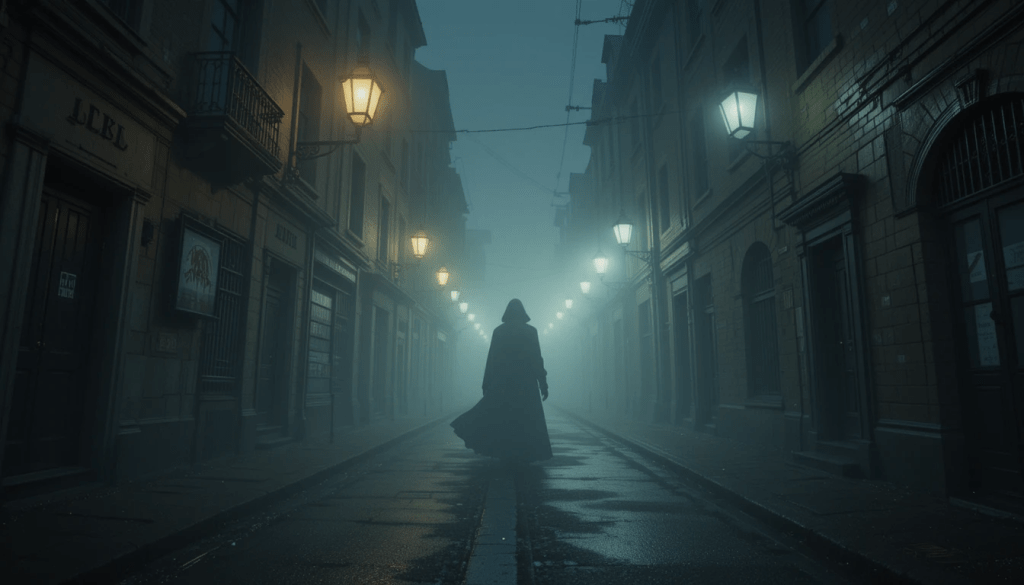
Noctivagant
IPA Pronunciation: /ˌnɒk.tɪˈveɪ.ɡənt/
Part of Speech: Adjective
Etymology
From Latin nocti- (“night”) and vagari (“to wander”), thus literally meaning “wandering at night.” The word is rarely used in everyday speech but thrives in poetic, gothic, and literary registers—carrying with it an aura of mystery, solitude, and the sublime.
Definitions
1. Wandering at Night
Describes a person, creature, or spirit that roams or travels under the cover of darkness—often slowly, aimlessly, or contemplatively.
“The noctivagant figure slipped through the fog-drenched alleyways, a whisper in the dark.”
2. Of or Relating to Nighttime Wandering (Figurative)
Used metaphorically to describe behaviors, moods, or inner states associated with sleeplessness, solitude, or restlessness during the night.
“Her thoughts grew noctivagant—drifting far and wide beneath the hush of stars.”
Atmospheric & Poetic Use
Noctivagant evokes a landscape of:
- Moonlight and shadow
- Silent streets and open skies
- Dreamers, wanderers, and watchers of the night
It belongs in the company of words like nocturne, lone, selenic, and tenebrous—words that dwell in the liminal spaces of twilight and after.
Symbolism & Literary Weight
Noctivagant speaks to:
- Loneliness or chosen solitude
- Mystery, secrecy, or introspection
- Restlessness of the body or the soul
- A seeking spirit—one drawn to silence, starlight, or the unknown
It resonates with characters who walk at the edges of the world—philosophers, insomniacs, poets, wolves, ghosts, and flâneurs.
“The city slept, but he remained noctivagant, tracing invisible maps beneath the constellations.”
Examples in Context
- “Noctivagant habits pulled her from the warmth of her bed into the quiet embrace of the moonlit forest.”
- “Their love was a noctivagant thing—born beneath streetlamps and nurtured in whispered midnights.”
- “Noctivagant souls often find poetry where others find only dark.”
Related & Companion Words
| Word | Meaning |
|---|---|
| Nyctophilia | Love of darkness or night |
| Vagrant | A wanderer without fixed destination |
| Insomniac | One unable to sleep, often wandering mentally or physically |
| Liminal | Occupying a position at a threshold or boundary |
| Nocturne | A musical or poetic piece inspired by night |
| Selcouth | Rare and strange, yet beautiful |
Antonyms and Conceptual Opposites
- Diurnal – Active during the day
- Sedentary – Still, unmoving
- Homebound – Tied to place
- Noctiphobic – Fearful of the night
Cultural and Archetypal Resonance
Throughout literature and myth, the noctivagant is a recurring archetype:
- The wandering knight or ronin, searching through shadow
- The romantic flâneur, drifting beneath lamplight
- The haunted spirit, doomed to pace between worlds
- The seeker, whose truth lies not in sunlight but in stars
From moonlit verses of Keats to the drifting noir detectives of Raymond Chandler, the noctivagant embodies that timeless figure who finds their purpose (or unravels it) in the depth of night.
Takeaway
Noctivagant is more than a description of someone walking at night—it is a mood, a myth, and a metaphor. It captures the silent drama of moving through the world when all else sleeps—the romance of the road under stars, the mind that stirs when the world is still, the soul that seeks its path in darkness.
Noctivagant:
A shadow-drifter, a moon-walker, a silent traveler through the velvet hours—guided not by the sun, but by the pull of mystery, memory, and the quiet music of the night.
 Word of the Day - The English Nook
Leave a comment