
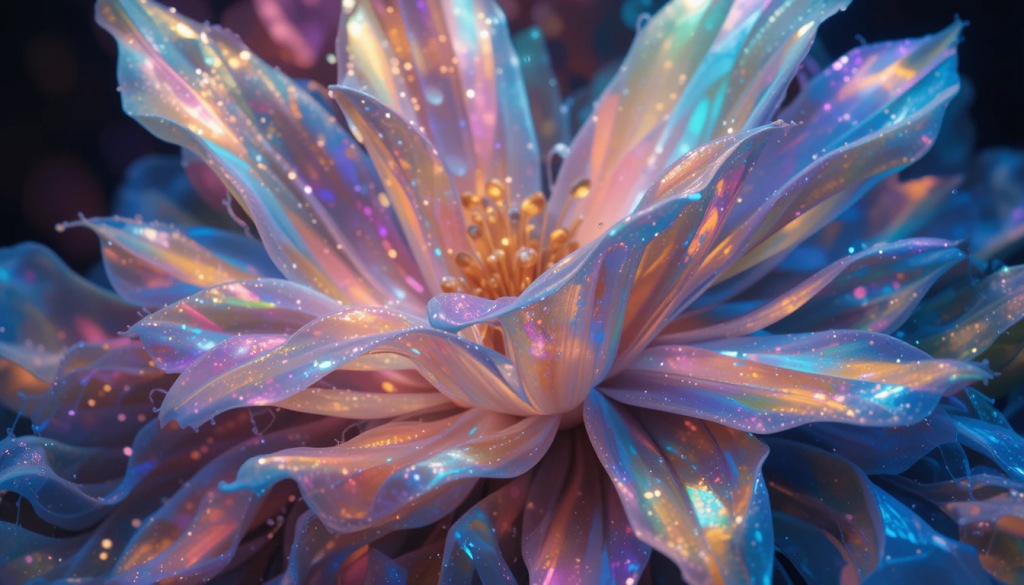
Iridescence
IPA Pronunciation: /ˌɪr.ɪˈdɛs.əns/
Part of Speech: Noun
Plural: Iridescences (rare)
Etymology
From Latin īris, meaning “rainbow,” and the suffix -escence, denoting a process or state. The term literally means “the quality of being like a rainbow.” Related to Iris, the Greek goddess of the rainbow and messenger of the gods — a divine link between heaven and earth.
Definitions
1. A Display of Lustrous, Rainbow-Like Colors that Change with Angle or Light
A shimmering optical phenomenon in which surfaces reflect a spectrum of colors that shift depending on the viewer’s position or the light source.
“The soap bubble swirled with iridescence, a fleeting galaxy of color.”
2. A Quality of Vivid or Changing Beauty (Figurative)
Used metaphorically to describe something possessing multidimensional charm, complexity, or emotional brilliance.
“Her thoughts were cloaked in iridescence — brilliant, elusive, ever-shifting.”
Scientific Explanation
Iridescence arises from interference of light waves reflecting off layered or structured surfaces (such as thin films, scales, or feathers). It’s not caused by pigmentation but by the physical structure of a surface that splits light into its component wavelengths.
Occurs In:
- Nature:
- Peacock feathers
- Butterfly wings (e.g., Morpho species)
- Beetle carapaces
- Seashells and mother-of-pearl (nacre)
- Oil slicks, bubbles, and water films
- Artificial Objects:
- CDs/DVDs
- Soap films
- Holograms
Examples in Context
- “The dragonfly’s wings shimmered with an iridescence that caught the morning light like fire.”
- “In her voice was an iridescence of feeling — laughter and grief intertwined.”
- “The artist layered pigments to mimic the iridescence of moonstone.”
Synonyms and Related Terms
| Literal Sense | Figurative Sense |
|---|---|
| Pearlescence | Radiance |
| Opalescence | Multidimensionality |
| Sheen | Nuance |
| Luster | Brilliance |
| Glow | Enchantment |
Antonyms
- Dullness
- Flatness
- Monotony
- Opaqueness
- Drabness
Symbolism and Cultural Resonance
Mythic & Aesthetic
Iridescence has long been associated with the magical, the sacred, and the ethereal. From divine armor in myth to fairy wings in folklore, it represents ephemeral beauty, transcendence, and the hidden complexity beneath appearances.
Metaphorical Power
Emotionally and symbolically, iridescence speaks to:
- The complexity of identity
- The ever-shifting nature of truth or perception
- Beauty found in change, ambiguity, or transience
“Like iridescence, the self is not a fixed thing, but a prism of light reacting to life’s angle.”
Literary and Artistic Usage
- Poets and novelists use “iridescence” to describe characters, feelings, or moments too rich for simple color or tone.
- Visual artists use layered textures and interference paints to evoke the quality of changing light.
- In music, it can metaphorically capture a piece that shimmers with tonal shifts or emotional complexity.
Takeaway
Iridescence is nature’s alchemy of light — a miracle of physics transformed into poetry. It reflects how beauty can be fragile, fluid, and dependent on how we look. In both science and art, it represents the dazzling between-states: neither here nor there, but always becoming.
Iridescence:
The breathless shimmer of a moment not meant to last — color born from light and angle, a prism caught in motion.
 Word of the Day - The English Nook
Leave a comment