
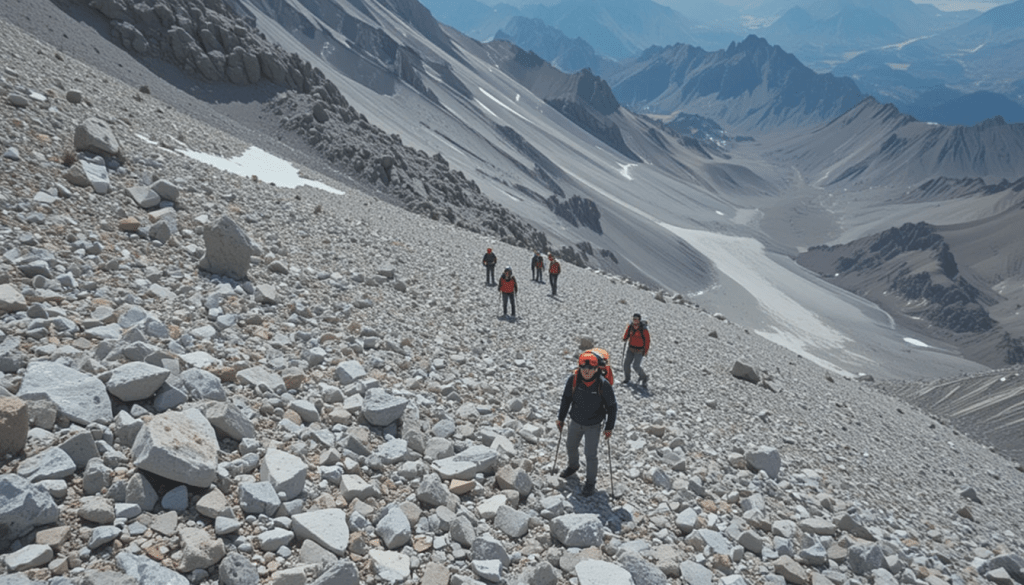
Scree
IPA Pronunciation: /skriː/
Part of Speech: Noun
Plural: Screes
Etymology
From Old Norse skritha meaning “landslide” or “collapse,” related to the verb skríða—“to glide, creep, or slide.” The term entered English via Scots and northern dialects, especially in mountainous or glacial landscapes.
Definitions
1. An Accumulation of Loose, Broken Rock Fragments at the Base of Cliffs, Mountain Slopes, or Valleys
Scree refers to the debris field of shattered rock, typically found at the foot of steep inclines, created by erosion, frost weathering, or gravity-driven rockfall.
“We crossed the unstable scree, boots sinking into the shifting stone.”
2. A Slope or Field Composed Entirely of Such Loose Rock
Also used to describe the actual geological feature—a slope formed by and covered with scree.
“The path veered upward across a scree slope glinting under the sun.”
Formation & Geology
Scree is a product of geomorphic processes, most often:
- Freeze-thaw cycles: Water enters cracks in rock, freezes, expands, and causes pieces to fracture off.
- Gravity: Broken fragments tumble down and settle in cone-shaped formations.
- Weathering: Chemical or physical breakdown of rock over time.
Scree is typically found in highland, alpine, or glaciated regions, and is a key feature of talus slopes (another term often used interchangeably, though “talus” is more common in North America).
Types of Scree
- Coarse Scree: Larger boulders, often hazardous to cross
- Fine Scree: Small pebbles and gravel, behaving almost like dry sand
- Talus Cones: Fan-shaped accumulations spreading from a single source
- Rock Glaciers: Scree intermixed with ice, slowly flowing downhill over time
Examples in Context
- “Climbers struggled over the unstable scree, where each step threatened to unearth a miniature landslide.”
- “Below the fortress, a long scree slope marked centuries of crumbling stone.”
- “The glacier had retreated, leaving a field of raw scree in its wake.”
Symbolic and Poetic Resonance
Scree is both raw and transient, a symbol of:
- Decay and erosion — the gradual disintegration of even the most steadfast structures
- Instability — the danger of footing on uncertain ground
- Persistence — nature’s way of reclaiming, weathering down, reshaping the ancient
“Her thoughts were like a slope of scree—shifting, unstable, always on the edge of falling into silence.”
It’s a landscape of transition, caught between form and formlessness, where cliffs become rubble, and permanence crumbles into impermanence.
Related Terms
| Term | Description |
|---|---|
| Talus | A scree slope, especially in North American terminology |
| Debris Field | A broader term for any natural scattering of rocks or fragments |
| Colluvium | Loose, unconsolidated sediments that accumulate at slope bases |
| Rockfall | The process that often produces scree |
| Moraine | Glacially deposited rock debris, sometimes mingling with scree |
Cultural and Environmental Significance
Scree plays a role in:
- Alpine ecology: Offering niches for hardy plants like mosses, lichens, and alpine flowers
- Hazard zones: Areas of rockfall risk in mountaineering or hiking
- Archaeology: Scree slopes can preserve or hide artifacts over centuries
- Symbolism in literature: The fragility beneath strength, the slow collapse of greatness
Takeaway
Scree is the language of crumbling mountains—a landscape in flux, where stone meets gravity, and erosion becomes art. It is both path and peril, decay and dynamism—a place where time expresses itself through the fall of rock.
Scree:
A slope of broken time, where ancient cliffs whisper down into dust and silence, stone by falling stone.
 Word of the Day - The English Nook
Leave a comment