
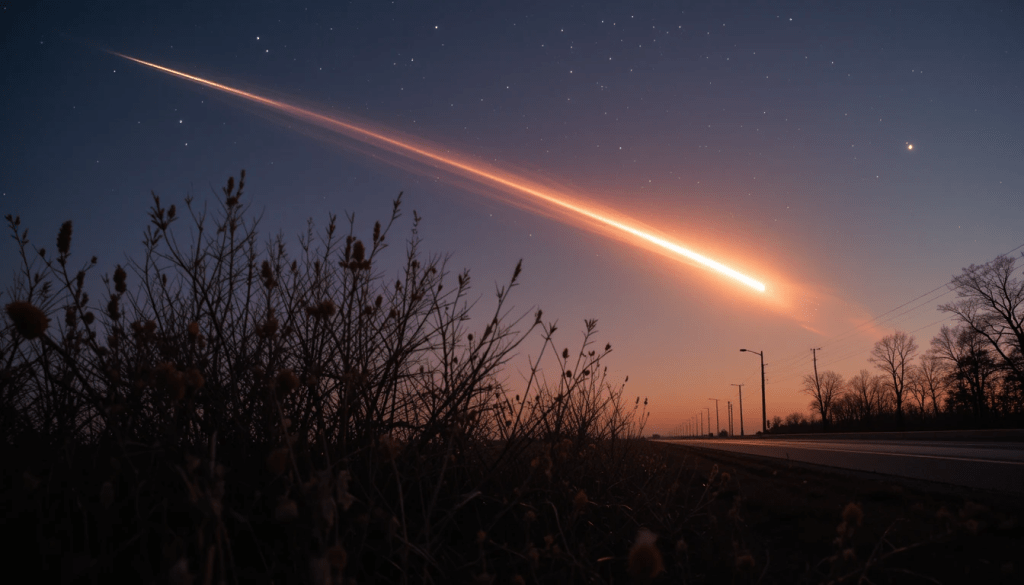
Bolide
IPA Pronunciation: /ˈboʊ.laɪd/
Part of Speech: Noun
Plural: Bolides
Etymology: From French bolide, derived from Latin bolis (missile), and Greek bolis (a weapon thrown, a dart or flash), from ballein — “to throw.” The word has always suggested something fast, fiery, and celestial.
Definitions
- A Brilliant Meteor That Explodes in the Atmosphere:
A very bright fireball, often accompanied by a flash, sonic boom, or fragmentation as it hurtles through Earth’s atmosphere. Bolides are often meteoroids that disintegrate before reaching the ground. “A bolide streaked across the twilight sky, its flare fading into ghostly silence.” - (Astronomy) An Exceptionally Luminous and Explosive Meteor:
Distinguished from regular meteors by its extraordinary brightness, visible trail, and sometimes even the audible detonation that follows its break-up in the sky. “The observatory recorded the bolide’s entry—its flash was visible across three states.” - (Literary / Poetic) A Symbol of Fiery Descent, Sudden Impact, or Celestial Drama:
Used metaphorically to describe something that appears suddenly, burns brightly, and vanishes with explosive force—a life, an event, or an idea. “He entered her world like a bolide—blazing, magnificent, and gone before morning.”
Tone and Connotation:
Celestial, Dramatic, Brief, Radiant, Violent, Sublime
The term “bolide” conjures images of skyfire, cosmic speed, and heavenly omens—a moment when the heavens throw a spark into the world.
Examples in Context
- “The bolide detonated over the desert with the force of a small bomb, rattling windows and hearts.”
- “Legends told of gods arriving in bolides—flames falling from the firmament.”
- “A bolide is nature’s most fleeting firework: magnificent and unrepeatable.”
- “She was a bolide in the firmament of my life—bright, wild, and irretrievably gone.”
Scientific Usage
Astronomers and planetary scientists define a bolide as a meteor brighter than magnitude -14, often resulting in a visible airburst. Notable bolides include:
- The Chelyabinsk Bolide (2013): Exploded over Russia, releasing energy equivalent to ~470 kilotons of TNT.
- The Tunguska Event (1908): Believed to be a bolide that flattened a vast Siberian forest.
- Fireball Classifications: A bolide is a subclass of fireballs—with bolides often leading to potential meteorite recovery.
Cultural and Poetic Resonance
“Bolide” has inspired fascination across:
- Literature – as a symbol of transience and awe-inspiring destruction
- Science fiction – where bolides bring alien life, doom, or interstellar drama
- Mythology – associated with omens, sky-gods, and divine intervention
In poetry and prose, the bolide often stands as a cosmic metaphor: for love, catastrophe, revelation, or transformation.
Related Terms and Concepts
| Term | Relation |
|---|---|
| Meteor | A streak of light from a space rock entering the atmosphere |
| Fireball | A particularly bright meteor; all bolides are fireballs, but not vice versa |
| Airburst | An explosion in the atmosphere caused by a bolide’s breakup |
| Meteorite | The remnants of a meteor that survive and reach Earth’s surface |
| Comet | A celestial body made of ice and dust; different from a bolide but sometimes confused when seen blazing in the sky |
| Asteroid | Larger rocky body in space; some bolides originate as fragments of asteroids |
Modern Applications and Awareness
- Astronomical observation: Tracked using global fireball networks and atmospheric sensors.
- Military and satellite tracking: Bolides are so powerful, they’re often detected by defense systems.
- Popular science & culture: Frequently dramatized in documentaries, sci-fi films, and apocalyptic thrillers.
Takeaway:
A bolide is a celestial blaze—a sudden streak of fire across the heavens, fierce and fleeting. It arrives without warning, rupturing the silence of the stars, leaving behind awe, myth, or craters. It is both heaven’s messenger and the universe’s wild dart, hurled in incandescent fury toward our sky.
Bolide:
A luminous harbinger of heaven’s velocity—burning bright, vanishing bold, and echoing long after it is gone.
 Word of the Day - The English Nook
Leave a comment