
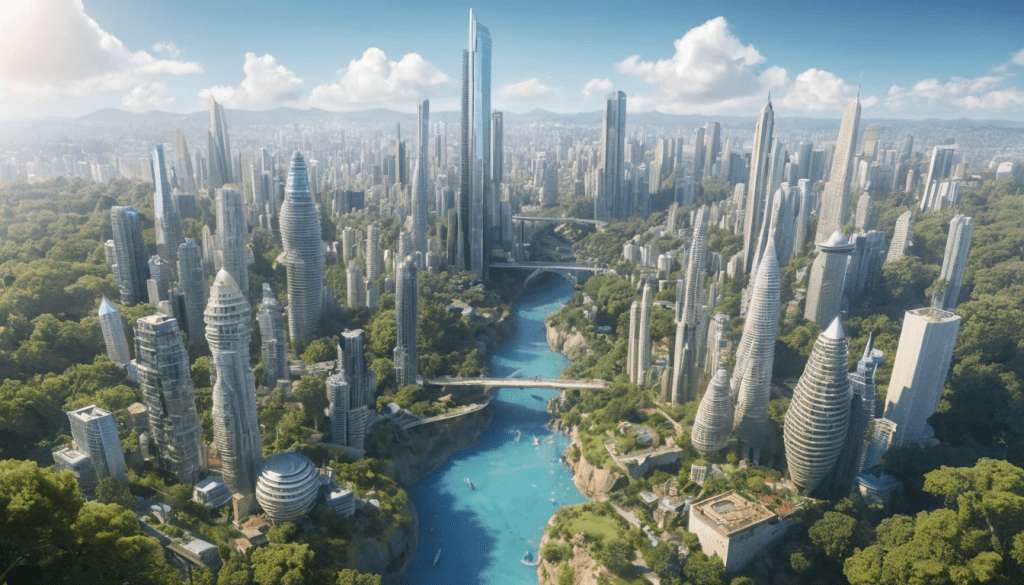
Heterotopia
IPA Pronunciation: /ˌhɛtəroʊˈtoʊpiə/
Part of Speech: Noun
Plural: Heterotopias
Adjective: Heterotopian
Etymology:
From Greek:
- heteros (ἕτερος) – other, different, or another
- topos (τόπος) – place
Literally: “Other place” or “place of difference”
The term was redefined and popularized by Michel Foucault, the French philosopher, in his 1967 lecture “Des Espaces Autres” (“Of Other Spaces”), where he theorized heterotopia as a conceptual counterpoint to utopia and real space.
Definitions
- A Real Place That Exists Outside Conventional Space:
A heterotopia is a physical location that functions in ways fundamentally different from ordinary spaces. It reflects, distorts, inverts, or critiques the society that surrounds it. - A Site of Contradiction, Juxtaposition, or Otherness:
Heterotopias are places where norms are suspended, inverted, or layered — they are zones of paradox, where multiple, often conflicting meanings or realities coexist. - (Medicine – Obsolete):
In early medical usage, heterotopia referred to the displacement of an organ or tissue to an abnormal location — a meaning metaphorically echoed in Foucault’s usage.
Tone and Connotation
Philosophical, Spatial, Subversive, Liminal, Reflective
The term evokes a sense of estrangement, of being in a space that is simultaneously real and symbolic — a mirror held up to reality, warped yet truthful.
Examples in Context
- Philosophical (Foucaultian):
“The cemetery is a heterotopia — it exists in society yet functions with its own logic of memory, death, and timelessness.” - Literary:
“The library in Borges’s story is a heterotopia — infinite, ordered, and impossible.” - Cultural/Architectural:
“The museum is a heterotopia of accumulated time — a space that suspends objects outside their original contexts.” - Everyday:
“The airport is a modern heterotopia: transitory, rule-bound, globally connected, yet strangely placeless.”
Types of Heterotopias (Foucault’s Framework)
Foucault outlined six principles describing how heterotopias function:
| Principle | Description |
|---|---|
| Crisis heterotopias | Spaces reserved for individuals in moments of crisis (e.g., boarding schools, honeymoon suites) |
| Deviant heterotopias | Spaces for those whose behavior deviates from the norm (e.g., prisons, psychiatric hospitals) |
| Heterotopias of juxtaposition | Spaces where incompatible elements are placed together (e.g., gardens, theme parks) |
| Heterotopias of time | Sites that accumulate or suspend time (e.g., museums, libraries, cemeteries) |
| Heterotopias of ritual/purification | Spaces that are accessed through rites or transitions (e.g., saunas, temples, military barracks) |
| Spaces with multiple layers of meaning | Spaces that open and close to certain individuals, changing meaning depending on context |
Synonyms and Related Concepts
- Liminal space – a threshold zone, between states or realities
- Utopia – a perfect, imagined ideal space (contrasted with heterotopia)
- Dystopia – a flawed or nightmarish imagined space
- Non-place (Marc Augé) – transient, anonymous spaces like airports or malls
- Carnival (Bakhtin) – a time/space of inverted social order and temporary chaos
- Counter-site – a space opposing or subverting dominant norms
Cultural and Theoretical Resonance
Heterotopia is a potent tool for:
- Urban theory – to understand spaces like gated communities, shopping malls, or refugee camps
- Literary criticism – analyzing surreal or layered settings
- Architecture – designing layered or symbolic spaces
- Art – creating environments that reflect or question reality
Foucault’s concept challenges the idea that space is neutral — it asserts that space is socially constructed, ideologically loaded, and can resist or reproduce power structures.
Modern Examples of Heterotopia
| Space | Why it’s Heterotopian |
|---|---|
| Theme Parks | Simulated realities, idealized representations |
| Cemeteries | Sacred, outside time, yet central to culture |
| Hospitals | Places of healing, separation, regulation |
| Festivals | Temporary inversion of norms, ritual space |
| Ships | Mobile microcosms, isolated from landbound society |
| Zoos | Condensed, curated representations of nature |
| The Internet | Simultaneously everywhere and nowhere; layered identity and reality |
Takeaway
Heterotopia invites us to recognize that space is not merely geographic — it is symbolic, ideological, and cultural. These “other spaces” function like mirrors, reflecting and distorting society, inviting contemplation, inversion, or escape.
They are both within and beyond the world we know, places that contain otherness — and in doing so, reveal truths hidden in plain sight.
Heterotopia:
A real space of layered meaning — strange, structured, sacred, or subversive — where the ordinary is turned inside out.
 Word of the Day - The English Nook
Leave a comment