
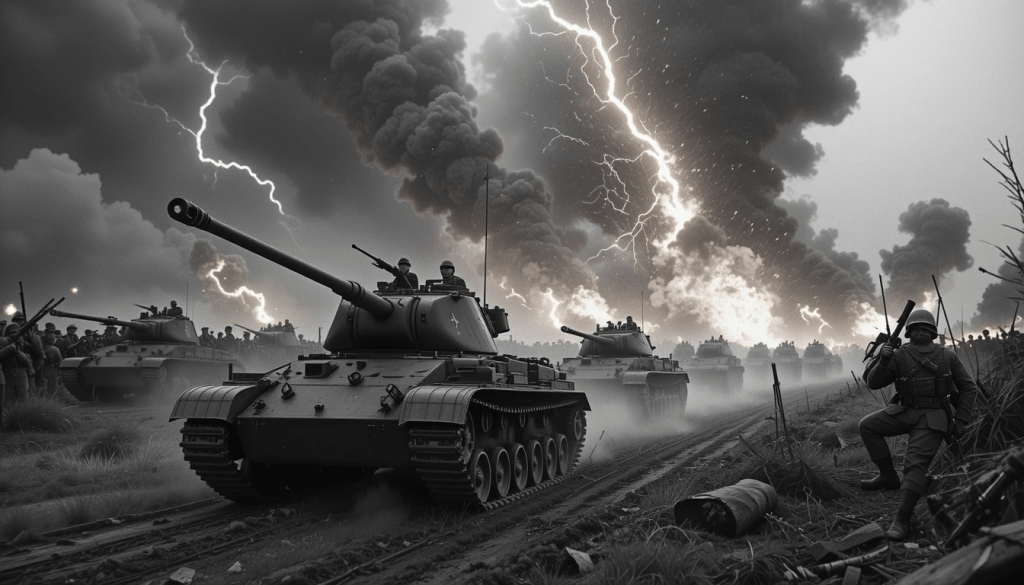
Blitzkrieg
IPA Pronunciation: /ˈblɪts.kriːɡ/
Part of Speech: Noun
Alternative Forms: blitz (colloquial or shortened variant)
Plural: blitzkriegs
Etymology:
From German, literally meaning “lightning war”—a compound of Blitz (“lightning”) + Krieg (“war”). The term was popularized during the early stages of World War II to describe a military strategy characterized by rapid, overwhelming attacks, aiming to paralyze the enemy before they could mount a defense.
Though the term emerged in the 1930s, it carries the linguistic echo of ancient strategies: speed as shock, movement as destruction, and momentum as victory.
Definitions
- Military Strategy:
A swift, intense military offensive intended to achieve a quick and decisive victory by disorienting and overwhelming the enemy, often combining air power, mechanized infantry, and coordinated ground assault. - Figurative Usage:
Any sudden, intense campaign or onslaught—whether verbal, emotional, political, or commercial—executed with calculated speed and impact.
Atmosphere and Symbolic Weight
Shock and Awe, Encapsulated:
Blitzkrieg is not merely speed—it is speed as a weapon. It is strategy that turns time into force, collapsing resistance by arriving too fast for reaction. In a blitzkrieg, preparation becomes impossible, and defense is a luxury never afforded.
Precision Wrapped in Chaos:
Despite its apparent ferocity, blitzkrieg is a methodical fury. Its violence is orchestrated like a storm, harnessing velocity, surprise, and coordination to fracture enemy morale before a line is even drawn.
Examples in Context
- Military / Historical:
“The German army launched a blitzkrieg across the Polish border in 1939, a devastating fusion of tanks, aircraft, and shock tactics.” - Figurative / Cultural:
“The marketing team unleashed a blitzkrieg of social media ads, flooding every platform in a matter of hours.” - Psychological / Metaphorical:
“Her words struck with the force of a blitzkrieg—sharp, relentless, and impossible to answer.”
Related Terms and Synonyms
| Term | Type | Nuance / Contrast |
|---|---|---|
| Shock and awe | Military/Psychological | A modern doctrine of overwhelming force and spectacle. |
| Onslaught | General | Heavy, sustained attack; may lack the speed and coordination. |
| Incursion | Military | A sudden invasion; typically smaller in scale. |
| Assault | Tactical | A violent attack; lacks the emphasis on speed or planning. |
| Campaign | Strategic | A broader, more prolonged series of actions. |
| Lightning strike | Figurative | Sudden and unexpected action; often single, not sustained. |
Historical Context
- World War II Origins:
Blitzkrieg emerged as a revolutionary military tactic during the early Nazi campaigns, particularly in Poland (1939) and France (1940). It involved combined arms warfare—tanks (Panzer divisions), mobile infantry, and Luftwaffe air support—striking in a tightly choreographed surge. - Objective:
To destabilize and encircle the enemy swiftly, bypassing entrenched positions, avoiding prolonged conflict, and forcing rapid surrender. - Effect:
Psychological terror, logistical breakdown, and shattered command structures. Blitzkrieg wasn’t just military—it was momentum turned into existential threat.
Cultural and Figurative Resonance
In Language:
Today, blitzkrieg is invoked beyond the battlefield. It appears in journalism, marketing, politics, and art to signify relentless, high-impact campaigns delivered in record time. In each context, it still carries the echo of its origins: intensity, surprise, and domination.
In Psychology:
The word evokes emotional overwhelm—a “blitzkrieg of feeling” might describe being hit with a storm of grief, passion, or revelation, so sudden and total that thought is suspended.
In Popular Culture:
- Blitzkrieg Bop by the Ramones: a punk anthem that captures the urgency and explosive energy of the term.
- In games, films, and books, the concept often appears as a narrative or tactical motif for powerful, high-risk engagements.
Takeaway
Blitzkrieg is not just a tactic—it’s a philosophy of force, a way of making velocity lethal. Whether describing military conquest, a media barrage, or an emotional upheaval, it speaks to the moment when power arrives too fast to resist, and everything changes in an instant.
Blitzkrieg:
The art of striking like lightning—before the sky even darkens.
 Word of the Day - The English Nook
Leave a comment