
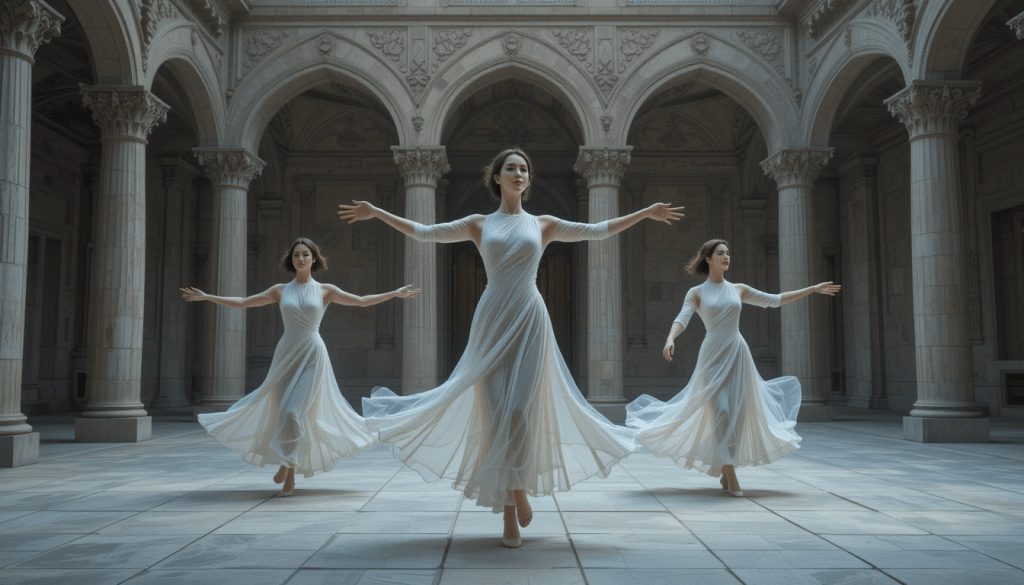
Eurythmy
IPA Pronunciation: /juːˈrɪθ.mi/
Part of Speech: Noun
Alternative Spellings: Eurhythmy, Eurhythmie (archaic or artistic variants)
Etymology:
From Greek εὔρυθμος (eúrhythmos), meaning “well-proportioned,” composed of εὖ (eu, “well”) + ῥυθμός (rhythmos, “rhythm, measured flow or movement”). The word entered English via German in the early 20th century, particularly through anthroposophical and artistic circles.
—At its root, eurythmy means beautiful rhythm—a harmony made visible through motion.
Definitions
- Graceful, Harmonious Movement
A quality of measured beauty in motion, often used to describe movement that flows in balance and accordance with inner or musical rhythm. - An Art Form Combining Movement and Speech
In the context of anthroposophy, eurythmy is a performance art that renders spoken language or music visible through choreographed motion, seeking to embody the soul’s rhythm in physical form. - Aesthetic Order or Rhythm in Any Medium (Figurative)
The presence of balance, proportion, and elegance in anything that flows—architecture, poetry, design, thought.
Atmospheric and Symbolic Meaning
The Dance of Inner and Outer Harmony:
Eurythmy is not mere movement—it is motion imbued with meaning, geometry in breath, the visible language of soul. It is the poetry of presence, where motion is not just performed, but spoken without voice.
A Philosophy in Form:
Eurythmy expresses the ideal unity between form and force, where beauty is not decoration but truth in balance—a cosmic echo within the human frame. It is where structure becomes serenity, and rhythm becomes revelation.
Movement with Intention:
In eurythmy, every gesture has purpose, every curve carries resonance. It reflects the ancient idea that beauty is symmetry made alive, and that true expression arises from alignment between inner feeling and outward flow.
Examples in Context
- Artistic / Literal:
“Her hands moved with such eurythmy, it felt as though the music itself had become flesh.” - Anthroposophical / Esoteric:
“In eurythmy, the dancer channels not just sound but speech itself, rendering vowels and consonants as sacred gesture.” - Architectural / Figurative:
“The temple’s design was pure eurythmy—every column, every arch speaking a silent rhythm of grace.” - Philosophical / Symbolic:
“To live with eurythmy is to move in harmony with the unseen rhythms of the cosmos.”
Contexts of Use
1. Anthroposophical Movement & Education
Developed by Rudolf Steiner in the early 20th century, eurythmy is a core practice in Waldorf education and spiritual performance art. It aims to unify the spiritual, emotional, and physical aspects of the human being through expressive, non-verbal language.
2. Art and Dance
Outside Steiner’s system, the term is also used to describe any graceful and proportionate movement, especially in modern dance, mime, or kinetic sculpture.
3. Aesthetics, Architecture, and Poetry
Used figuratively, eurythmy describes the pleasing symmetry and flow found in structures, verses, or ideas—where form feels as though it was shaped by rhythm rather than mere design.
Related Terms and Synonyms
| Term | Nuance |
|---|---|
| Rhythm | The underlying beat or pulse; essential but not inherently beautiful. |
| Harmony | A state of pleasing agreement; often used in music or metaphor. |
| Proportion | Mathematical or aesthetic balance of parts. |
| Elegance | Graceful beauty, especially with simplicity and effectiveness. |
| Symmetry | Exact balance of elements; more rigid than eurythmy’s fluid nature. |
| Choreography | Structured movement; technical, not necessarily expressive or soulful. |
In Myth, Cosmos, and Thought
- Platonic Aesthetics:
Plato considered harmony and proportion essential to beauty. Eurythmy, then, becomes the physical embodiment of his ideal forms. - Hermetic and Esoteric Philosophy:
As the ancients believed the universe to be constructed of sacred geometry and divine rhythm, eurythmy becomes a kind of ritual movement that echoes the harmonies of the spheres. - Waldorf Spirituality:
In the spiritual-educational worldview of Steiner, eurythmy is not performance but spiritual speech—a healing, harmonizing force that aligns human will with cosmic order.
Takeaway
Eurythmy is more than rhythm—it is rhythm revealed, beauty in balance, and motion with meaning. Whether in dance, design, or daily life, it invites us to move, create, and live with intentional grace—to become the gesture of the music, the form of the invisible, the poetry of being.
Eurythmy:
A luminous rhythm in motion—the choreography of soul, the geometry of grace.

 Word of the Day - The English Nook
Leave a comment