
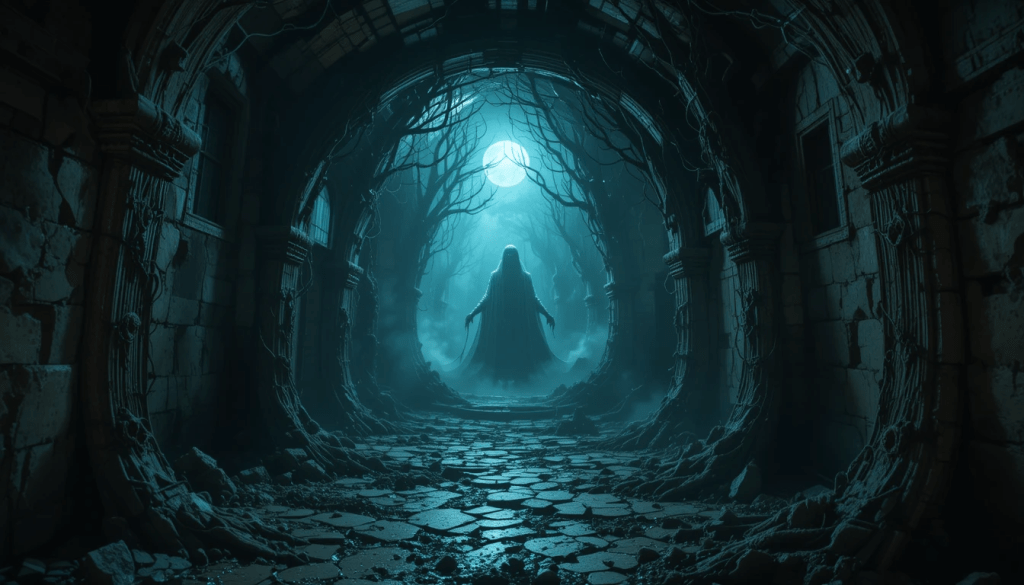
Eldritch
IPA Pronunciation: /ˈɛl.drɪtʃ/
Part of Speech: Adjective
Etymology:
Originating in Middle English, possibly from elf + riche (“realm” or “kingdom”), meaning “of the fairy realm” or “from beyond this world.” Another possibility is from the Scots word elriche, meaning “strange, unnatural, otherworldly.”
—In all roots, it implies something outside the boundaries of the normal world—hauntingly foreign, uncanny, or unwholesomely mysterious.
Definitions
- Weird, eerie, or uncanny in an unearthly way
Often describing sounds, lights, sensations, or visions that inspire a deep, instinctual sense of the unnatural. - Otherworldly or supernatural in a disturbing sense
Refers to phenomena or presences that do not align with natural law—alien, arcane, and unknowable. - Deeply strange or unclassifiable
Suggests a kind of abnormality that resists explanation—eldritch things are not merely unfamiliar, but existentially unsettling.
Atmospheric and Symbolic Significance
The Language of the Unknowable:
Eldritch is a word used to name the things for which we have no name—to signal a breach in the familiar world. It belongs to the liminal, the forbidden, the impossible, and the sacredly terrifying.
Cosmic Horror and the Sublime:
In Lovecraftian literature, eldritch often describes entities or forces so alien that merely perceiving them risks madness. These are not monsters in the traditional sense, but errors in reality—whispers of truths beyond comprehension.
Folk and Faerie Origins:
Earlier uses of eldritch connected it with the fae, the wild hunt, or ancient spirits of the land. These were not benevolent beings, but capricious, dangerous, alien to human morality and logic.
Examples in Context
- Literary / Descriptive:
“An eldritch green light pulsed beneath the frozen lake, flickering like the heartbeat of something dreaming below.” - Psychological / Figurative:
“There was something eldritch in his smile—an echo of a memory that had never belonged to her.” - Supernatural / Cosmic Horror:
“The book was bound in leather that writhed when touched. The symbols on its cover radiated an eldritch geometry that defied Euclidean space.” - Soundscape / Environmental:
“A long, eldritch howl pierced the night, neither animal nor man.”
Related Terms and Synonyms
| Term | Tone | Notes |
|---|---|---|
| Uncanny | Neutral-creepy | Eerily familiar or subtly wrong |
| Weird | Strange-mild | Odd or inexplicable, often mundane |
| Arcane | Esoteric-mystic | Known only to a few; obscure, hidden knowledge |
| Otherworldly | Neutral-wondrous | Ethereal or alien, often awe-inspiring rather than horrifying |
| Unhallowed | Dark-religious | Profaned, blasphemous, or cursed |
| Anomalous | Scientific-strange | Statistically or logically inexplicable |
Cultural and Genre Resonance
- Gothic & Weird Fiction:
Eldritch is a foundational descriptor in classic horror and the “weird tale” genre, particularly in the work of H.P. Lovecraft, Algernon Blackwood, and William Hope Hodgson. - Fantasy and RPGs:
In games like Dungeons & Dragons, “eldritch” powers, beings, or horrors represent magic from nonhuman or interdimensional sources—knowledge too dangerous to wield without cost. - Folk Tradition & Fairy Lore:
The original meaning often described the eerie glamour of fae creatures—beautiful, powerful, but inhuman and unfathomable.
Takeaway
Eldritch is not just a synonym for creepy or strange. It is a threshold word—one that marks the crossing from the natural into the unnatural, the known into the unknowable. It names the moment when the world ceases to make sense, when the veil is lifted, and when something ancient, wrong, and powerful peers back at you.
A sound that should not echo. A shape that should not move. A knowledge that should not exist.
And yet, it does.
 Word of the Day - The English Nook
Leave a comment