
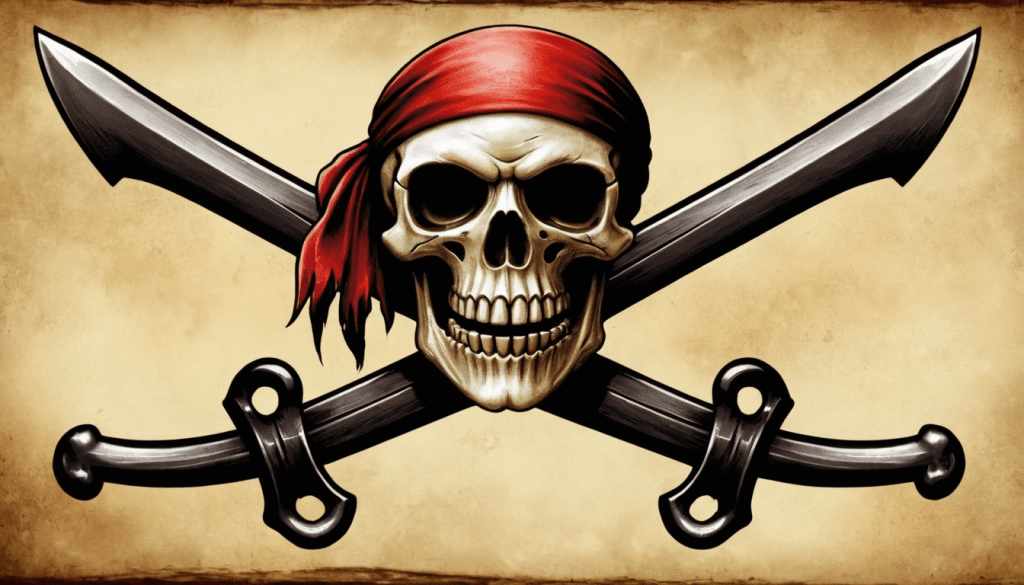
Jolly Roger
IPA Pronunciation: /ˈdʒɒl.i ˈrɒdʒ.ər/
Part of Speech: Noun
Etymology: First recorded in the early 18th century, the term Jolly Roger likely evolved from the French joli rouge (“pretty red”), possibly referring to an early red flag flown by pirates. Others believe it may relate to Old Roger, a nickname for the Devil in English folklore—evoking the ominous and menacing aura of piracy.
Definitions
- A Pirate’s Emblematic Flag
A black flag, traditionally emblazoned with a white skull and crossbones or similar menacing imagery, signifying the presence of pirates and the imminent threat of violence or death. - A Universal Symbol of Rebellion and Lawlessness
More broadly, the Jolly Roger has become an icon of defiance, adventure, and the spirit of freedom that challenges authority and conventional norms.
Historical Roots and Evolution
Birth of a Fearsome Symbol:
The Jolly Roger rose to infamy during the so-called Golden Age of Piracy (circa 1650–1730). Pirates—who operated outside of maritime law—needed more than brute force to secure plunder. They employed terror and psychological warfare, and the Jolly Roger was the perfect tool: a stark, instantly recognizable symbol of impending violence and ruthless reprisal for resistance.
Varied Designs, Singular Purpose:
Though the skull and crossbones remains the most iconic form, actual pirate flags came in many designs:
- Hourglasses—to remind victims that their time was running out.
- Skeletons and Demons—to evoke supernatural fear.
- Weapons—crossed swords, spears, or bleeding hearts, each reinforcing the promise of deadly force.
- Red Flags (Bloody Banners)—signaling “no quarter given,” meaning no mercy would be shown.
Notable Pirates and Their Flags:
- Blackbeard (Edward Teach) flew a flag depicting a horned skeleton toasting the Devil, brandishing a spear at a bleeding heart.
- Calico Jack Rackham popularized the classic skull-and-crossed-swords design, which became an enduring emblem of piracy.
Psychological Warfare on the High Seas
The Jolly Roger was a tool of intimidation as much as identity. For lightly armed merchant ships, the sight of it—snapping in the wind, stark against the sea—often compelled surrender without a fight. Pirates knew that preserving life and ship was easier (and more profitable) than risking a costly battle. In this way, the Jolly Roger became the harbinger of pirate conquest—its very presence often enough to secure victory.
Cultural Resonance and Modern Legacy
Over centuries, the Jolly Roger has transcended its blood-soaked origins to become a potent cultural symbol. It conjures images of:
- Daring and Adventure: The spirit of swashbuckling freedom, a romanticized world of rogue sailors and lost treasure.
- Rebellion and Defiance: A badge of refusal to submit to authority, celebrated in literature, film, and popular culture.
- Brotherhood and Identity: A symbol of belonging to a secretive, self-governing band that answers only to itself.
From pirate-themed festivals to sports teams and rock bands, the Jolly Roger has become shorthand for an adventurous, fearless attitude—a nod to the outlaw archetype who sails against the tide.
Examples in Context
- Historical:
“As the merchant vessel approached, the lookout’s cry of ‘Jolly Roger!’ sent shivers down the crew’s spines—there would be no mercy today.” - Literary:
“The black flag flapped ominously in the storm, the skull’s grin daring the world to challenge its dominion over the waves.” - Pop Culture:
“Emblazoned with a Jolly Roger, the punk band’s logo declared their music to be a fearless anthem for the disenchanted.”
Related Terms and Synonyms
- Black Flag: A general term for pirate banners, synonymous with Jolly Roger in many contexts.
- Buccaneer Standard: Another historical name for pirate flags.
- No Quarter Flag: A red variant, symbolizing no mercy would be shown.
Philosophical and Symbolic Significance
At its core, the Jolly Roger represents a paradox: a symbol of death that also embodies life lived beyond the bounds of the ordinary. It is both warning and invitation—beckoning those who would embrace danger, challenge convention, and taste the exhilarating freedom of the sea.
Takeaway
The Jolly Roger is more than a relic of the high seas—it is a timeless emblem of rebellion, adventure, and the refusal to bow to any master. It reminds us of the allure and peril of life lived outside the law—where death may wait, but glory beckons.
Jolly Roger: The flag of freedom’s outlaws, unfurling in defiance of the world.
 Word of the Day - The English Nook
Leave a comment