
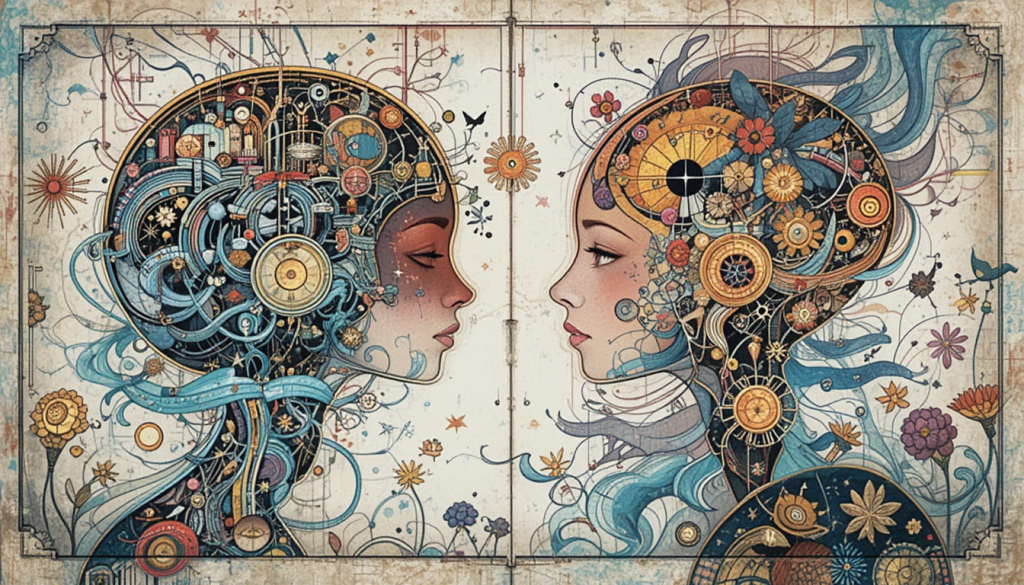
Mentalese
IPA Pronunciation: /ˌmɛn.təˈliːz/
Part of Speech: Noun
Etymology: A modern term coined by cognitive scientists and philosophers to describe an imagined “language of thought.” Formed by analogy to natural languages (like “Japanese” or “Chinese”), the term combines mental (relating to the mind) and the suffix -ese (denoting a language or dialect).
Definitions
- The Hypothetical Language of Thought
Mentalese refers to the idea that thinking takes place in an internal, symbolic “language” that underlies natural languages. This hypothetical medium of thought is said to be the mind’s native format for representing ideas, concepts, and reasoning before they are translated into spoken or written words. - A Cognitive Framework or Internal Code
More broadly, mentalese can be described as the internal representational system of the mind: a set of symbols and structures by which we encode, process, and manipulate mental content.
Explanation and Background
The concept of mentalese gained prominence with the work of philosopher Jerry Fodor in the 1970s and 1980s. In his influential book The Language of Thought (1975), Fodor argued that humans (and possibly other intelligent beings) think in a structured mental language—a “language of thought” that predates and underpins spoken languages.
Key Aspects of Mentalese:
- Innateness: Mentalese is posited as an innate cognitive capacity, not learned like natural languages but hardwired into the brain’s architecture.
- Symbolic Representation: Mentalese comprises symbols (like words or logical operators) and syntactic rules that govern how these symbols combine—much like grammar in spoken language.
- Universal and Non-Linguistic: Unlike spoken languages, mentalese is thought to be universal and not tied to any particular culture or language community.
Theoretical Context
Relation to Cognitive Science and AI:
Mentalese is part of a computational or information-processing view of the mind. It aligns with the idea that thinking involves manipulating mental representations—akin to how a computer processes code.
Debates and Alternatives:
Not all cognitive scientists accept the idea of mentalese. Critics argue that thought might be more directly tied to perception, embodiment, or dynamic processes—rather than a static, language-like code. Alternatives to the mentalese view include:
- Connectionism: Thoughts emerge from networks of neural activity, not symbolic representations.
- Embodied Cognition: Thinking is shaped by the body’s interactions with the world, not by an abstract code.
Examples in Context
- Philosophical:
“According to Fodor, our mental processes operate in mentalese, an internal language that structures our reasoning before it becomes speech.” - Everyday Thought:
“Even if you don’t say it out loud, you might silently ‘hear’ a sentence in your head—mentalese is thought to be the deeper structure behind such inner monologues.” - AI Analogy:
“Artificial intelligence systems often use internal representations akin to mentalese to process information before producing natural-language output.”
Related Concepts and Synonyms
- Language of Thought: Another term for mentalese, emphasizing the idea that thinking itself is structured like a language.
- Cognitive Architecture: The underlying systems and processes of the mind, of which mentalese is one hypothetical component.
- Internal Representation: The way information is structured in the mind, whether as images, symbols, or something else.
Cultural and Philosophical Significance
The idea of mentalese invites reflection on what it means to think. It asks us to consider whether our thoughts are fundamentally different from our spoken words—or if language is merely the tip of a deeper mental iceberg. It also raises questions about artificial intelligence, animal cognition, and the universality of thought across cultures.
Takeaway
Mentalese proposes that beneath our spoken and written words lies a universal, internal language of thought—a mental code that enables us to reason, imagine, and understand the world. Whether literal or metaphorical, mentalese remains a powerful idea for exploring the deep structure of human cognition.
Before you find the words, your brain’s already talking—in Mentalese.
 Word of the Day - The English Nook
Leave a comment