
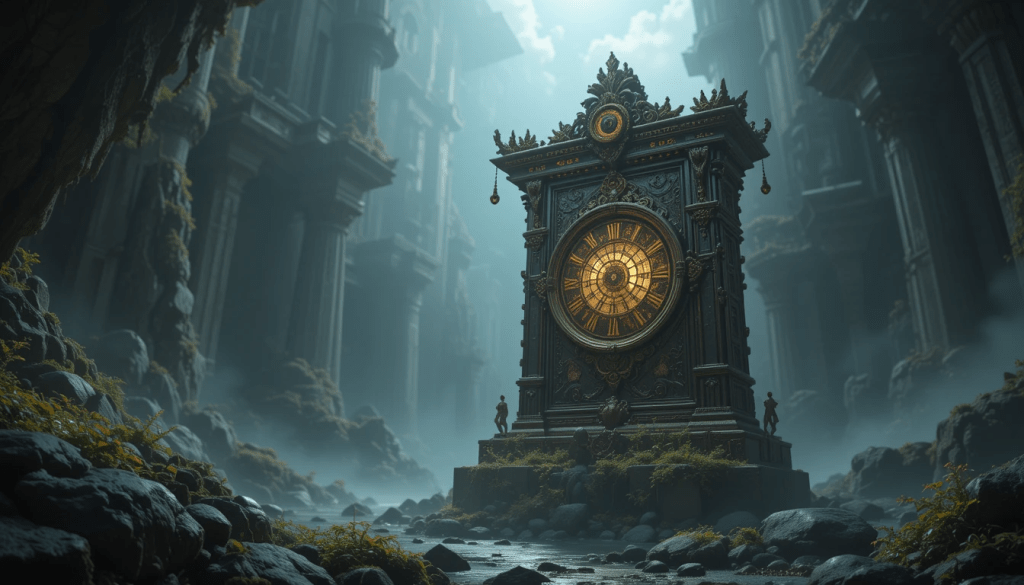
Aeon
IPA Pronunciation: /ˈiː.ɒn/ or /ˈiː.ən/
Part of Speech: Noun
Etymology: Derived from the Ancient Greek aiōn (αἰών), meaning “age,” “eternity,” or “lifetime.” This term journeyed through Latin as aevum, arriving in Middle English while preserving its core sense of an immeasurable or indefinite span of time.
Definitions
- An Indefinitely Long Period of Time
A duration so immense that it defies easy comprehension or quantification, often used to evoke a poetic, mythical, or philosophical sense of boundless time. - A Geological or Cosmological Era
In scientific disciplines such as geology and cosmology, an aeon (or eon) denotes a vast unit of time, frequently spanning billions of years, that marks significant milestones in the history of Earth or the cosmos. - Philosophical or Spiritual Eternity
In various philosophical, mystical, or theological contexts, an aeon represents a timeless age or an eternal cycle—reflecting profound concepts of cyclical existence, spiritual transcendence, or the infinite nature of the cosmos.
Explanation
Literal and Everyday Usage:
In everyday language, “aeon” is frequently employed as a vivid metaphor to describe something that feels interminably long or timeless. For instance:
- “It felt like aeons before the storm finally subsided.”
- “She waited for what seemed like aeons for a reply.”
This usage highlights the word’s evocative quality, imbuing everyday experiences with a sense of grandeur or mythic duration.
Scientific Context:
In geology, an aeon is the largest recognized division of geological time, encompassing multiple eras and marking foundational chapters in Earth’s development. Examples include:
- Hadean Aeon – the Earth’s formative years.
- Archean Aeon – the emergence of early life.
- Proterozoic Aeon – the rise of complex organisms.
- Phanerozoic Aeon – the era of visible life, spanning from 541 million years ago to the present.
Cosmologists may also refer to aeons to describe epochs in the universe’s evolution, contemplating cycles of cosmic birth, death, and rebirth.
Philosophical and Spiritual Significance:
In Gnostic and other mystical traditions, aeons are conceptualized as emanations or divine entities—timeless and beyond the confines of mortal existence. Here, an aeon might symbolize a spiritual realm, a cosmic order, or the cyclical nature of all creation. Philosophers such as Plotinus and mystics across cultures have engaged with the idea of aeons to explore the nature of eternity and the soul’s place within it.
Examples in Context
- Figurative:
“The ancient stones have borne witness to aeons of history, unbroken by the march of time.” - Geological:
“The Earth’s crust has been reshaped over countless aeons by the slow dance of tectonic plates.” - Philosophical:
“He meditated on the aeon of the cosmos, seeking meaning beyond the fleeting span of mortal life.” - Literary:
“Their love endured the aeons, transcending the mortal coil and echoing in the silent corridors of eternity.”
Related Terms and Synonyms
- Eon: Alternative spelling, often used interchangeably.
- Epoch: A distinct period marked by notable events or developments.
- Era: A significant span in history or prehistory, often associated with major cultural or geological shifts.
- Age: A stretch of time characterized by particular features, figures, or cultural movements.
- Infinity: The boundless and immeasurable aspect of time, space, or existence.
Cultural and Poetic Resonance
The word “aeon” carries a sense of awe and timeless wonder, evoking visions of endless deserts, ancient stars, and the cyclical heartbeat of the cosmos. It has inspired poets, philosophers, scientists, and dreamers alike to explore the grand sweep of time and our fleeting place within it. Whether in literature, myth, or science fiction, “aeon” often becomes a doorway to cosmic contemplation and existential reflection.
Takeaway
An aeon is more than just an abstract measurement of time; it is a window into the immensity of existence itself—an invitation to ponder the grand, flowing river of time that sweeps across the universe and our place within its currents.
Aeon: The infinite breath of the cosmos, echoing through the ages, carrying whispers of creation and the eternal dance of existence.
 Word of the Day - The English Nook
Leave a comment