
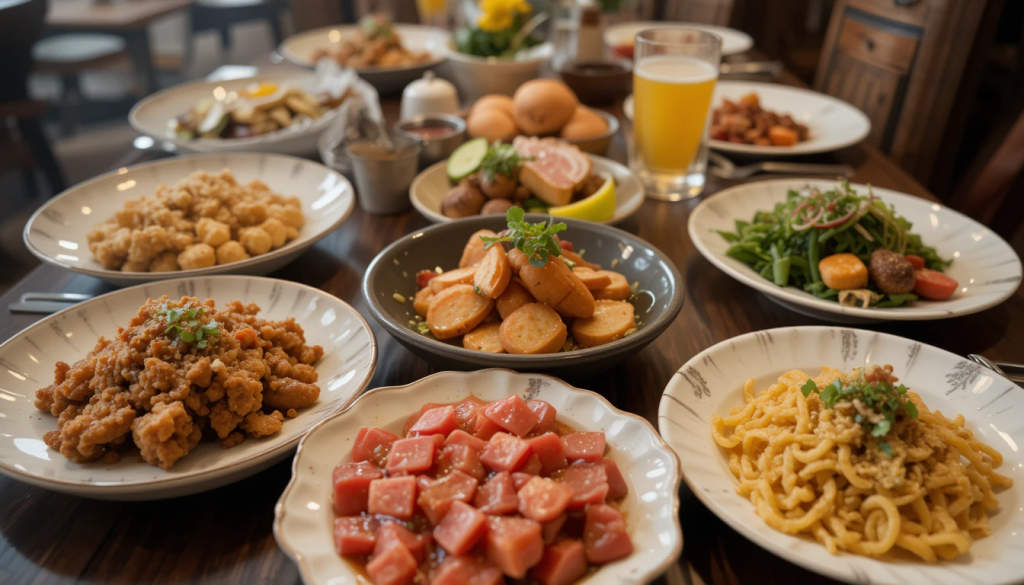
Medley
IPA Pronunciation: /ˈmɛd.li/
Part of Speech: Noun
Etymology: From Middle English medle (meaning “mixture” or “confusion”), which came from Old French mesler (“to mix”), itself from Vulgar Latin misculare, rooted in the Latin miscere (“to mix”).
Definitions:
- A Varied Mixture of Elements:
A diverse collection or assortment of different components, often creating a rich or complex whole. - A Musical Composition:
In music, a piece that combines several melodies or themes, typically from different songs, played one after another or blended together. - A Sporting Contest:
In certain sports (e.g., swimming or relay races), a medley refers to a race or performance involving a sequence of different styles or techniques.
Explanation:
Literal and Everyday Meaning:
Medley broadly refers to any mixture, whether of flavors, colors, sounds, or ideas. It emphasizes the presence of diversity and the blending of distinct parts to form an interesting or harmonious whole. In culinary contexts, for example, a vegetable medley might feature various roasted or sautéed vegetables that complement one another’s flavors.
Musical Application:
In music, a medley is an arrangement that seamlessly transitions between different tunes or themes. Medleys are often used to highlight popular songs in a concert, to pay homage to a particular artist, or to create a fresh narrative by linking pieces together. They showcase creativity and versatility, drawing from multiple sources to produce a new, cohesive work.
Sports Usage:
In sports, the term medley is most commonly seen in swimming, where an individual or team performs different strokes in a set order: butterfly, backstroke, breaststroke, and freestyle. This variation tests an athlete’s adaptability and skill in multiple styles, much like a musical medley tests the performer’s range and versatility.
Examples in Context:
- Culinary Use:
“The chef prepared a colorful medley of roasted vegetables, combining carrots, parsnips, and beets.” - Musical Use:
“The band played a lively medley of 80s hits that had the entire crowd dancing.” - Sports Use:
“She excelled in the individual medley, showcasing her skill in all four swimming strokes.” - Figurative Use:
“His artwork was a medley of styles, weaving together surrealism and expressionism in a single canvas.”
Related Terms and Synonyms:
- Potpourri: A fragrant mixture of dried flowers and spices, also used figuratively for any mixed assortment.
- Mélange: A French-derived term meaning a mixture or medley.
- Patchwork: An assemblage of different elements, often in a quilt or metaphorical sense.
- Amalgam: A blend or fusion of distinct components, typically referring to materials or ideas.
- Hodgepodge: A jumble or disorganized mixture of varied items.
Cultural and Artistic Resonance:
The idea of a medley celebrates diversity and synthesis. In art and culture, medleys reflect the power of collaboration and the creativity that emerges from combining seemingly disparate elements. Medleys can evoke a sense of nostalgia when blending familiar melodies or spark curiosity when juxtaposing unexpected styles.
Moreover, medleys often play a role in ceremonial and celebratory contexts, symbolizing unity and festivity through their dynamic, engaging nature.
Takeaway:
A medley is more than just a mixture — it is a deliberate, artful blend that highlights the richness of diversity. Whether in music, sports, food, or ideas, medleys remind us that when distinct elements come together, they can create something greater and more vibrant than the sum of their parts.
Medley: Where diversity doesn’t clash—it composes.
 Word of the Day - The English Nook
Leave a comment