
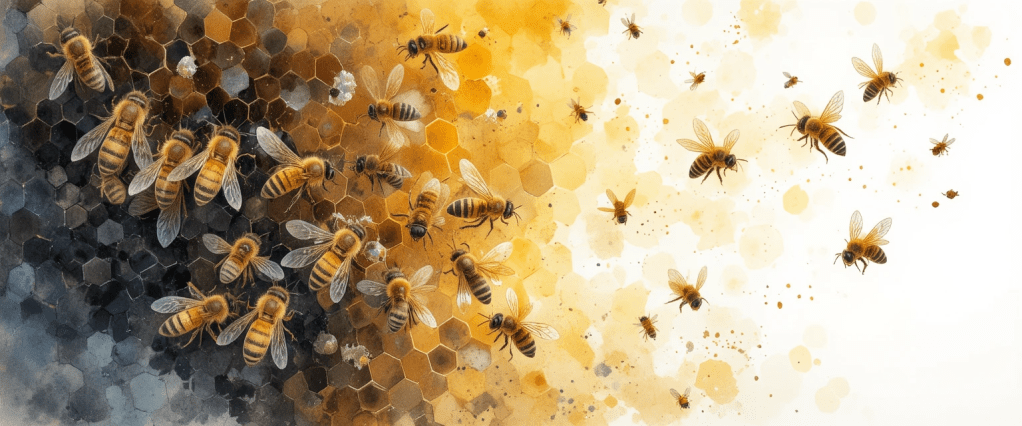
Eusociality
IPA: /ˌjuːˌsəʊ.ʃiˈæl.ə.ti/
(Noun)
Definition:
A complex social structure found in certain animal species, characterized by cooperative brood care, overlapping generations within a colony, and a division of labor between reproductive and non-reproductive individuals.
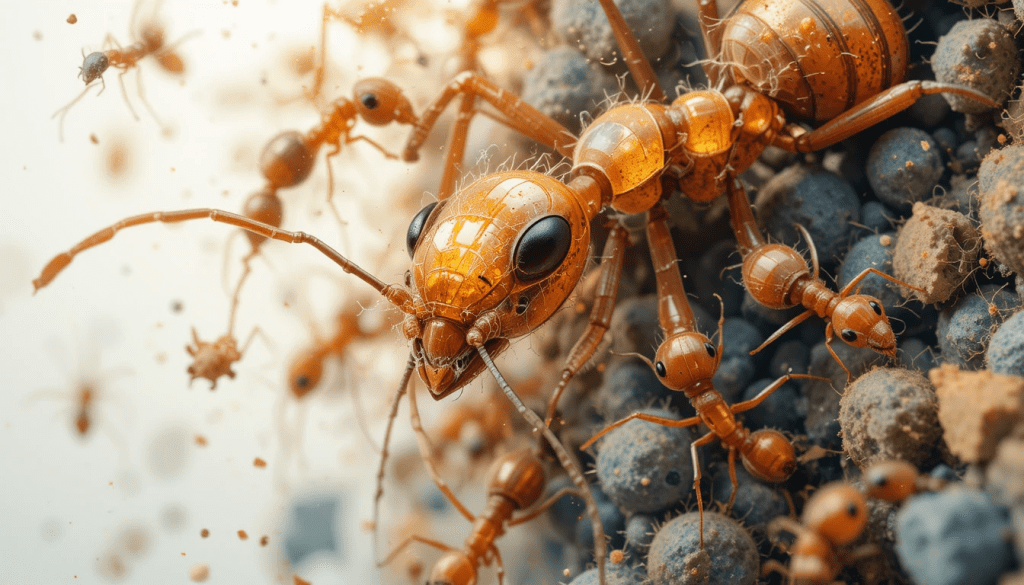
- Example: “Ants are one of the most well-known examples of eusociality, where sterile workers serve a single reproducing queen.”
Biological and Evolutionary Significance:
Eusociality represents the most advanced level of organization in animal social behavior. The term was introduced by entomologist Suzanne Batra in the 1960s and later popularized and expanded by E.O. Wilson, a pioneer in sociobiology. It describes an extreme form of social living where the needs of the group outweigh those of the individual. Eusocial systems are based on deep evolutionary adaptations, including genetic, behavioral, and environmental factors that promote the survival and efficiency of the group as a whole.
This structure is particularly dominant among certain insect orders such as Hymenoptera (ants, bees, wasps) and Isoptera (termites). However, rare instances of eusociality are also observed in crustaceans like snapping shrimp and in mammals such as the naked mole-rat and Damaraland mole-rat, making the phenomenon particularly intriguing to evolutionary biologists.
Key Traits:
- Reproductive Division of Labor: One or a few individuals (typically queens) are solely responsible for reproduction, while the majority perform tasks such as defense, foraging, and brood care.
- Overlapping Generations: Multiple generations coexist within the same colony, allowing elders to assist in raising younger kin.
- Cooperative Brood Care: Individuals care for offspring that are not their own, often without the possibility of direct reproductive return.
- Caste System: Many eusocial species develop specialized morphologies for different tasks (e.g., soldier ants, worker bees), reinforcing their roles within the colony.
Contextual Usage:
- Zoological: “The naked mole-rat’s eusociality challenges assumptions about mammalian social evolution.”
- Evolutionary Theory: “Eusociality presents a paradox in Darwinian terms — individuals sacrifice reproduction for the good of the colony.”
- Behavioral Ecology: “Researchers study eusocial insects to better understand altruism and kin selection.”
Related Concepts:
- Altruism
- Kin selection
- Colony (biology)
- Superorganism
- Social hierarchy
Interesting Note:
In eusocial species, the colony can be seen as a “superorganism,” where each individual functions like a cell in a larger body. This collective strategy enables remarkable feats, such as intricate nest construction, coordinated foraging, and powerful colony defense mechanisms. In fact, eusocial insects make up a disproportionately large share of the world’s insect biomass, highlighting their ecological success.
Some theories suggest that eusociality may arise more readily in species with haplodiploid sex-determination systems (like bees and ants), where females share more genes with their sisters than with their own potential offspring. This genetic structure may help explain the evolution of extreme cooperation.
Takeaway:
Eusociality reflects one of nature’s most successful social strategies — a model of life where the collective triumphs over the individual. It is an evolutionary marvel, offering insight into cooperation, altruism, and the complex interdependence that underlies some of the most dominant animal societies on Earth.
Originally published on May 3, 2025, on The-English-Nook.com.
In a world of survival of the fittest, eusociality proves the strongest thrive together.
“Tap like and join the hive — together, we thrive.” 🐝🔗
 Word of the Day - The English Nook
Leave a comment