
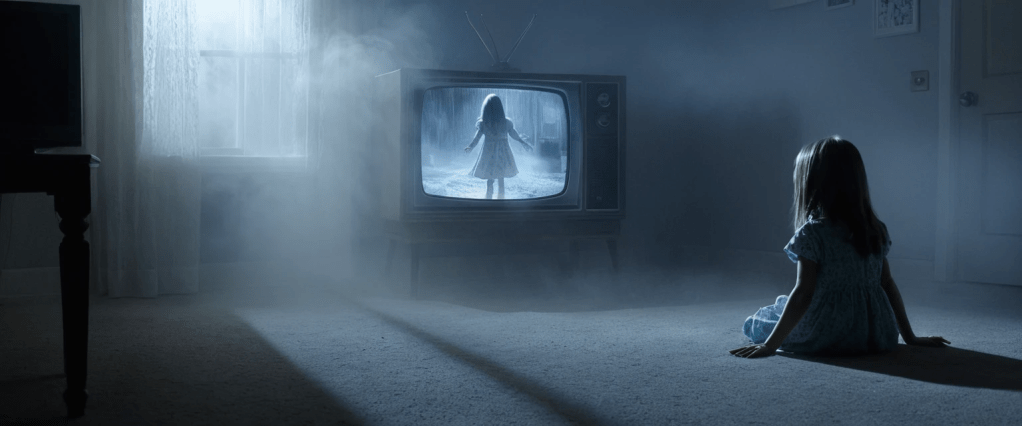
Poltergeist
IPA Pronunciation: /ˈpɒl.tə.ɡaɪst/
(Noun)
Definition:
A poltergeist is a type of supernatural entity or force believed to cause physical disturbances in the environment, such as objects being moved or thrown, unexplained noises, electrical interference, or spontaneous fires. Unlike apparitions or ghosts that are typically seen, poltergeists are often invisible and are associated with noisy, chaotic, and sometimes violent activity.
- Example: “The family claimed a poltergeist haunted their home, regularly shattering dishes and slamming doors without warning.”
Etymology & Origins:
- Derived from German, from poltern meaning “to make noise” or “to rattle,” and Geist meaning “spirit” or “ghost.”
- Literally: “Noisy ghost”.
- Entered English usage in the mid-19th century through popular folklore, spiritualist writings, and reports of haunting phenomena.
Historical and Cultural Context:
1. Folkloric Tradition:
- Poltergeist legends date back centuries in European folklore, particularly in Germanic, British, and Scandinavian traditions.
- Unlike traditional ghosts tied to specific individuals or places, poltergeists are often portrayed as unpredictable forces that latch onto people—especially adolescents or emotionally distressed individuals—rather than remaining fixed to haunted locations.
2. Notable Historical Cases:
- The Bell Witch (Tennessee, USA, 1817–1821): One of the most infamous alleged poltergeist hauntings, involving physical attacks, disembodied voices, and movement of objects.
- The Enfield Poltergeist (London, 1977–1979): Documented by reporters and paranormal investigators, this case involved furniture moving, levitation, and mysterious knockings—later adapted into media like The Conjuring 2.
Common Characteristics:
- Auditory Phenomena: Knocking, banging, footsteps, voices, whispers.
- Object Manipulation: Items being moved, levitated, thrown, or broken.
- Physical Effects: Unexplained scratches, pushes, temperature drops, or foul odors.
- Electronic Disturbances: Flickering lights, radios turning on/off, electronics malfunctioning.
- Ephemeral Nature: Poltergeist activity tends to intensify and then fade over a period ranging from days to months.
Psychological and Scientific Interpretations:
- Psychokinesis Hypothesis: Some parapsychologists suggest that poltergeist activity may be the result of unconscious psychokinetic energy, particularly from pubescent children or emotionally distressed individuals.
- Fraud and Suggestion: Skeptics argue that most poltergeist cases are either hoaxes or misinterpretations fueled by mass hysteria, confirmation bias, or natural causes like plumbing noises, drafts, or vibrations.
- Sleep Paralysis & Hypnagogia: Some phenomena attributed to poltergeists—such as voices or movement—may occur during altered states of consciousness.
In Popular Culture:
- Film and Literature: The 1982 film Poltergeist by Tobe Hooper (produced by Steven Spielberg) cemented the term in popular imagination. The term also appears in horror novels, ghost stories, and urban legends.
- Gaming and Paranormal Media: Poltergeists often feature as spectral antagonists in video games, paranormal television shows, and folklore-themed series.
Synonyms and Related Concepts:
- Noisy Ghost
- Manifesting Spirit
- Haunting Presence
- Disruptive Entity
- Psi Phenomenon (in parapsychological studies)
Differentiation from Other Supernatural Beings:
| Entity | Visible? | Physical Interaction? | Rooted in Location? |
|---|---|---|---|
| Ghost | Sometimes | Rarely | Usually |
| Spirit | Rarely | Depends on tradition | Often |
| Poltergeist | No | Frequently (noises, motion) | Often attached to people |
| Demon | No/Yes | Frequently (aggressive) | Variable |
Takeaway:
A poltergeist is more than just a ghost — it is an entity of chaos, manifesting not through eerie silence but through disruption and noise. Whether viewed through the lens of folklore, psychology, or pop culture, the concept of the poltergeist serves as a powerful symbol of unseen disturbances, often reflecting emotional unrest, social fears, or the human need to explain the inexplicable.
Originally published on April 23, 2025, on The-English-Nook.com.
Not every haunting whispers—some throw chairs. Meet the poltergeist: chaos with a ghostly edge.
“Tap like before it taps back…” 👻🫣
 Word of the Day - The English Nook
Leave a comment