
Falchion
IPA Pronunciation: /ˈfɔːl.tʃən/ or /ˈfæl.tʃən/
(Noun)
Definition:
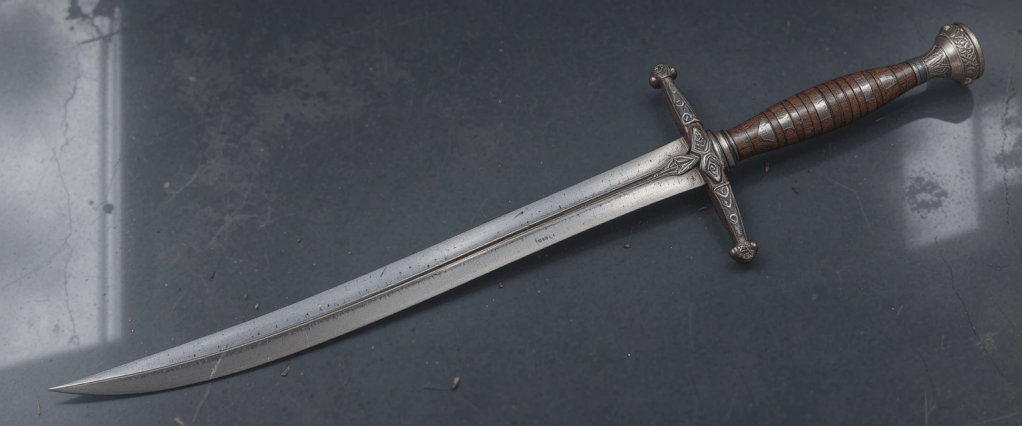
A falchion is a type of one-handed, single-edged sword with a slightly curved blade, historically used in Europe during the High to Late Middle Ages. Unlike double-edged longswords, the falchion combines the cutting power of an axe with the versatility of a sword, making it especially effective in slashing combat against lightly armored foes.
- Example: “The knight carried a falchion at his side, its curved blade gleaming in the torchlight.”
Etymology and Origins:
The word falchion derives from the Old French fauchon, which in turn stems from faucher (“to mow” or “to cut down”), itself rooted in the Latin falx, meaning “sickle” or “scythe.” The name and design suggest its early association with agricultural tools, and its deadly efficiency in slicing motions.
The falchion first appeared in the 12th century, often in the hands of knights, mercenaries, and foot soldiers alike. While not as ornate as some ceremonial swords, it was prized for its pragmatic function on the battlefield.
Design and Characteristics:
- Blade: Broad, slightly curved or straight-edged with a convex cutting edge. Often tapering to a point.
- Edge: Single-edged (unlike longswords), optimized for powerful cuts rather than thrusts.
- Length: Generally between 30–40 inches (76–102 cm).
- Weight: Typically light, around 2–3 pounds (0.9–1.4 kg), allowing fast maneuvering.
- Hilt: Similar to contemporary arming swords, often featuring a crossguard.
- Tip Style: May be rounded, clipped, or pointed, depending on design.
- Back of Blade: Often flat or spine-like, occasionally flared for weight distribution.
Some variations (like the “cusped” falchion) featured a flare or “clipped” spine near the tip, giving them a distinctive, almost cleaver-like profile.
Historical Context and Use:
- Time Period: Primarily 12th–16th centuries in Europe.
- Regions: Used throughout Western and Central Europe, particularly by French, English, and German soldiers.
- Users: Knights, men-at-arms, and occasionally common soldiers.
- Purpose: Ideal for infantry combat, excelling at cutting through light armor, mail, or flesh. Less suited for plate armor.
Falchions were sometimes depicted in medieval art or seen on effigies of knights, suggesting both battlefield and ceremonial use.
Famous Examples:
- The Conyers Falchion (England): A real medieval falchion associated with local legend — allegedly used to slay the “Sockburn Worm,” a mythical beast.
- Depictions in manuscripts like the Maciejowski Bible (13th century), which illustrate several soldiers wielding falchion-like blades.
Modern Cultural Appearances:
- Video Games: Commonly appears in fantasy settings (e.g., Fire Emblem, Dark Souls, The Elder Scrolls).
- Movies & Fantasy: Often seen in the hands of rugged warriors, outlaws, or dark knights.
- Historical Reenactment & HEMA: Replicated by enthusiasts studying medieval European martial arts.
Synonyms and Related Terms:
- Messer
- Sabre (in form, but not lineage)
- Scimitar (similar curvature but different origin)
- Arming sword (contemporary double-edged counterpart)
Antonyms:
- Estoc (a narrow thrusting sword)
- Rapier (thin, double-edged thrusting weapon)
- Zweihänder (a massive, two-handed greatsword)
Example Sentences:
- “The falchion’s wide blade made it ideal for cleaving through the ranks of lightly armored foes.”
- “Though overshadowed by longswords in modern media, the falchion was respected for its brutal simplicity.”
- “He traded in his rapier for a falchion, favoring its weight and arc for forest skirmishes.”
Interesting Facts:
- Though often associated with Europe, the falchion shares similarities with weapons from other cultures, such as the kopis (Ancient Greece), dao (China), and kukri (Nepal).
- Only a few historical examples survive, but literary and artistic references suggest it was more widespread than surviving artifacts imply.
- The falchion blurred the line between tool and weapon, much like the seax and machete.
Takeaway:
The falchion stands as a testament to battlefield pragmatism — a weapon forged not for elegance, but for efficiency in the brutal clash of steel. With roots in tools of the harvest and the deadliness of the battlefield, it represents a fascinating intersection of form, function, and medieval ingenuity.
Originally published on April 19, 2025, on The-English-Nook.com.
From harvest to havoc—the falchion cut its way from field to battlefield with ruthless precision.
“One like for every time you cut through doubt with clarity and courage.” 🛡️🔥
 Word of the Day - The English Nook
Leave a comment