

Helios
IPA: /ˈhiː.li.ɒs/ (English), /hé.li.os/ (Classical Greek)
(Proper Noun / Mythological Figure)
Definition:
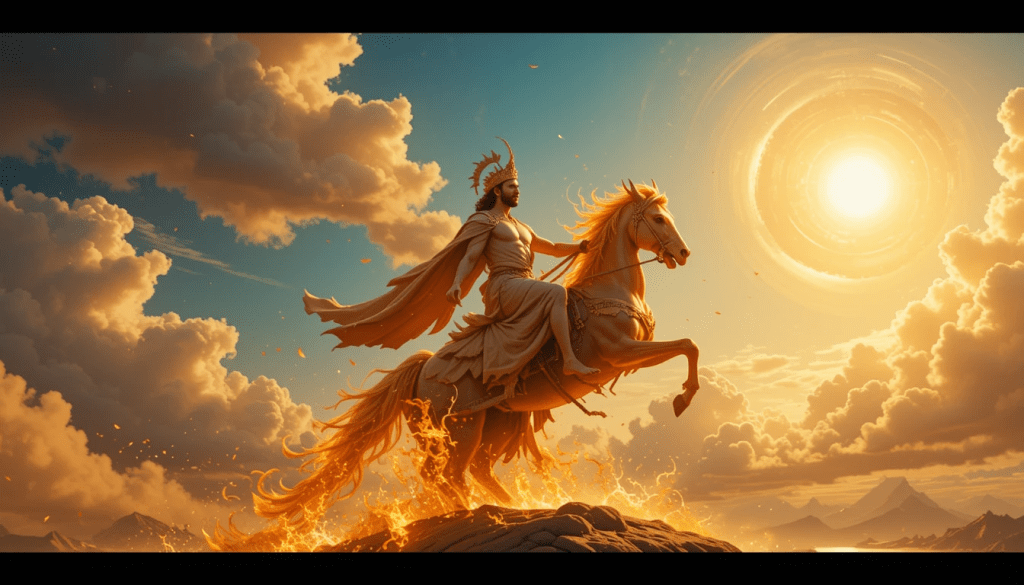
Helios is the ancient Greek personification of the Sun, often depicted as a radiant god who drove a fiery chariot across the sky each day, bringing daylight to the world. In mythology, Helios is a Titan, a celestial being of immense power and presence, revered for his all-seeing nature and eternal voyage from east to west.
Etymology:
- From Ancient Greek Ἥλιος (Hḗlios) meaning sun.
- Rooted in the Proto-Indo-European sóh₂wl̥ (“sun”), which also gave rise to Latin sol (hence solar) and Sanskrit sūrya.
Mythological Role:
- Solar Charioteer:
Each morning, Helios rises from the eastern edge of the world, driving his golden chariot—pulled by fire-breathing steeds—across the sky until nightfall, when he descends into the western Oceanus to begin the journey anew beneath the world. - All-Seeing Witness:
As the ever-present sun, Helios was believed to see all that occurred on earth. He was frequently invoked in oaths and witnessed divine contracts.- Example: In the myth of Aphrodite and Ares, it is Helios who sees their secret affair and reveals it to Hephaestus.
- Guardian of Sacred Cattle:
On the island of Thrinacia, Helios kept sacred cattle, which were protected by his daughters and were not to be harmed. When Odysseus’ crew slaughtered them, Helios demanded retribution from Zeus, resulting in the ship’s destruction. - Father and Progenitor:
Helios fathered notable children, including Circe (the sorceress in The Odyssey), Aeëtes (king of Colchis), and the Heliades (his daughters, who mourned Phaethon’s death).
Symbolism and Cultural Significance:
- The Sun as a Deity:
Helios represents light, truth, vitality, and the unstoppable cycle of day and night. His daily passage is symbolic of time, rebirth, and celestial order. - Observer of Truth and Justice:
In some traditions, Helios was invoked in legal and moral contexts, as his gaze was impartial and omnipresent, symbolizing objective judgment and divine oversight. - Precursor to Apollo:
Over time, particularly in later Greek and Roman periods, the worship of Helios was syncretized with that of Apollo, who came to embody the sun’s intellectual and healing powers, though Helios retained his distinct chariot imagery in classical art and literature.
Helios in Literature & Art:
- Homer’s Odyssey – Helios’s cattle and divine wrath are pivotal to Odysseus’s journey.
- Ovid’s Metamorphoses – The tragic tale of Phaethon, Helios’s mortal son, who attempts to drive the solar chariot and fails catastrophically, scorching the earth.
- Euripides’ Medea – Helios provides his granddaughter Medea with a chariot drawn by dragons to flee Corinth.
- Visual Depictions:
Often shown as a youthful god with a radiant crown, sometimes driving a chariot or surrounded by solar rays. In Roman mosaics and temples, Helios was frequently adorned with a halo of light, prefiguring later Christian iconography of divine illumination.
Modern Legacy and Influence:
- Astronomy:
- The prefix helio- appears in terms like heliocentric (sun-centered solar system), heliosphere, and heliotropism.
- Helium, the chemical element, was named after Helios when it was first discovered in the solar spectrum.
- Art and Literature:
- Helios remains a powerful poetic symbol of illumination, clarity, and divine strength.
- Writers and artists evoke Helios to convey blinding insight, cosmic permanence, and the awe of nature.
- Colossus of Rhodes:
- One of the Seven Wonders of the Ancient World, this towering statue honored Helios and stood at the entrance of the harbor of Rhodes, embodying the brilliance and pride of the city-state.
Associated Concepts:
- Solar deity, Chariot of the Sun, Titan gods, Celestial motion, Divine observation, Fire and light symbolism
Related Deities:
- Apollo (Greek) – Later associated with the sun, prophecy, and reason
- Sol (Roman) – The Roman counterpart, especially Sol Invictus
- Ra (Egyptian) – Sun god and creator deity
- Surya (Hindu) – Solar deity riding a chariot drawn by horses
Interesting Facts:
- The name Helios still appears in solar technology branding and scientific terms today.
- In some ancient texts, Helios was believed to sail in a golden cup beneath the ocean at night, returning east for dawn.
- The Heliades, his mourning daughters, were said to have turned into poplar trees, and their tears became amber.
Takeaway:
Helios is more than a sun god—he is a symbol of radiance, unwavering truth, and cosmic rhythm. His golden path across the heavens illuminates myth and meaning alike, casting light not only on the world but on the enduring human need to understand time, nature, and divinity. In every rising sun, Helios endures — timeless, watchful, and ever aflame.
Originally published on April 13, 2025, on The-English-Nook.com.

Helios and the Light of Poetic Language ☀️
Just as Helios illuminated the world each day, poetic vocabulary shines a light on hidden emotions and thoughts. Learning terms like stanza, metaphor, or alliteration in English doesn’t just expand your vocabulary—it brightens your ability to express, feel, and connect.
¿Quieres descubrir cómo escribir con luz propia?
Lee el texto y deja que tu poesía despierte con el sol del lenguaje.
Vocabulario de Poesía en Inglés
Before Apollo stole the spotlight, Helios lit the sky—one chariot ride at a time.
“One like to awaken the dawn — Helios sees you.” 🌅👁️
 Word of the Day - The English Nook
Leave a comment