
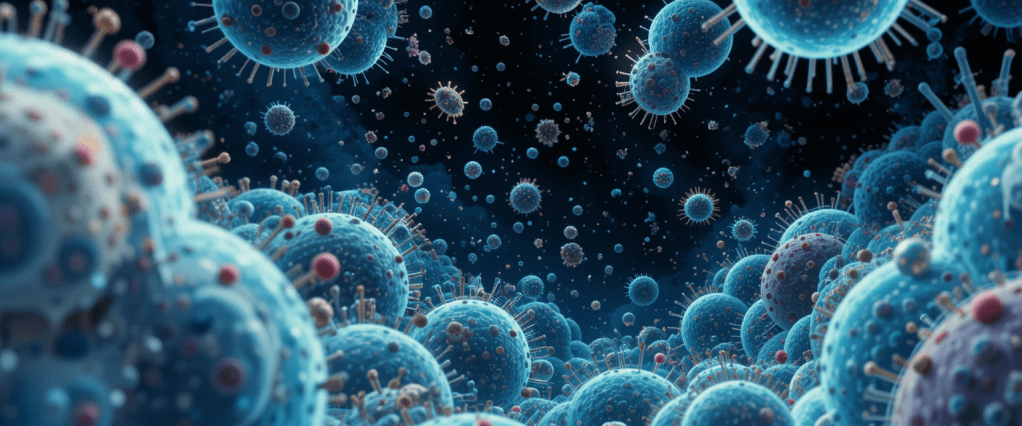
Binary Fission
IPA: /ˈbaɪ.nɛr.i ˈfɪʃ.ən/
(Noun)
Definition:
A form of asexual reproduction in which a single-celled organism divides into two genetically identical daughter cells.
This is the most common method of reproduction among prokaryotes (like bacteria and archaea), and also occurs in some single-celled eukaryotes (such as amoebae).
- Example: “The bacterial colony expanded rapidly due to binary fission, doubling in size every few hours.”
Etymology:
From Latin:
- “Binary” – from binarius, meaning “consisting of two”
- “Fission” – from fissio, meaning “a splitting or cleaving”
Together, the term literally means “splitting into two.”
Process Overview:
- DNA Replication:
The cell’s genetic material (usually a single, circular chromosome in prokaryotes) is duplicated so that each new cell will have a complete copy. - Cell Elongation:
The cell grows in size, and the two DNA molecules move to opposite ends (poles) of the cell. - Septum Formation:
A septum or cell wall begins to form down the middle of the elongated cell. - Cytokinesis:
The cell membrane pinches inward, fully separating the cell into two identical daughter cells.
Biological Context:
- In Bacteria: Binary fission is the primary reproductive strategy, allowing for rapid population growth. Under ideal conditions, some species can divide every 20 minutes.
- In Protists and Algae: Certain single-celled eukaryotes also reproduce this way, though their division may involve more complex structures such as nuclei and organelles.
- Example: “Escherichia coli reproduces via binary fission, an efficient method for fast replication in nutrient-rich environments.”
Key Characteristics:
| Feature | Description |
|---|---|
| Type of Reproduction | Asexual |
| Offspring | Genetically identical clones |
| Energy Efficiency | High; no gametes or mating needed |
| Speed | Often very fast under optimal conditions |
| Mutation Impact | Mutations are quickly passed on and can lead to rapid evolution |
Synonyms and Related Terms:
- Asexual reproduction
- Prokaryotic cell division
- Clonal division
- Fissiparity (general term for splitting)
Antonyms / Contrasting Concepts:
- Sexual Reproduction – involves gametes, genetic recombination
- Budding – offspring grows out of the parent body (e.g., yeast)
- Mitosis – similar but occurs in eukaryotic cells with more complex organelles
Examples in Context:
- “After only a few hours in the petri dish, the bacteria had undergone multiple rounds of binary fission.”
- “Because binary fission creates clones, genetic diversity in bacteria largely depends on mutations and horizontal gene transfer.”
- “Binary fission in protists such as Amoeba proteus involves mitotic division of the nucleus followed by cytoplasmic splitting.”
Scientific Significance:
- Microbial Growth: Fundamental for understanding infection rates, microbial ecology, and antibiotic resistance.
- Medical Applications: Knowledge of binary fission is vital for microbiology, pharmaceuticals, and disease control.
- Evolutionary Insight: Shows how simple organisms proliferate and adapt via rapid reproduction and mutation.
- Biotechnology: Engineered bacteria used in industry (e.g., insulin production) rely on binary fission to replicate modified genes.
Interesting Facts:
- Binary fission is extremely efficient: A single bacterium can, under perfect conditions, give rise to millions of cells within 24 hours.
- Binary ≠ Mitosis: Though both involve cellular division, binary fission occurs in prokaryotes without a nucleus, whereas mitosis occurs in eukaryotic cells with a defined nucleus.
- Environmental Triggers: Conditions like temperature, nutrients, and pH levels affect the rate and success of binary fission.
- Genetic Variation Still Happens: Though binary fission produces clones, bacteria can still exchange genes via conjugation, transformation, and transduction—methods collectively known as horizontal gene transfer.
Takeaway:
Binary fission is nature’s streamlined blueprint for reproduction in the microbial world. By simply duplicating DNA and dividing in two, organisms like bacteria and some single-celled eukaryotes achieve extraordinary reproductive efficiency. This elegant simplicity, paired with rapid mutation, allows life to persist and adapt in the most extreme and varied environments on Earth.
Originally published on April 6, 2025, on The-English-Nook.com.
Binary Fission & Propósito: A Division Worth Reading
Binary fission isn’t just cell science—it’s a spark for storytelling. In this charming tale, Amelina, an ameba with dreams and discipline, finds sisterhood and meaning through division.
🧬💫 Read the full story in Spanish and see how even single-celled lives can split into something greater.
Amelina y el Milagro de la Bipartición
One cell, one split—millions of copies. Binary fission is life on fast-forward.
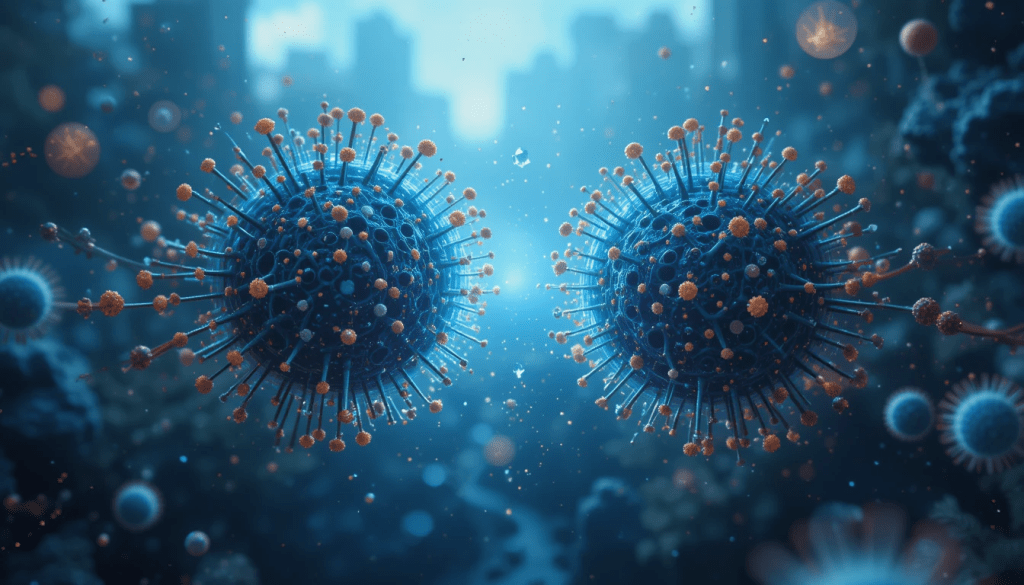
“Like this and feel the rhythm of origin — one becomes two, two becomes everything.” 🔬💫
⚡⚡
 Word of the Day - The English Nook
Leave a comment