
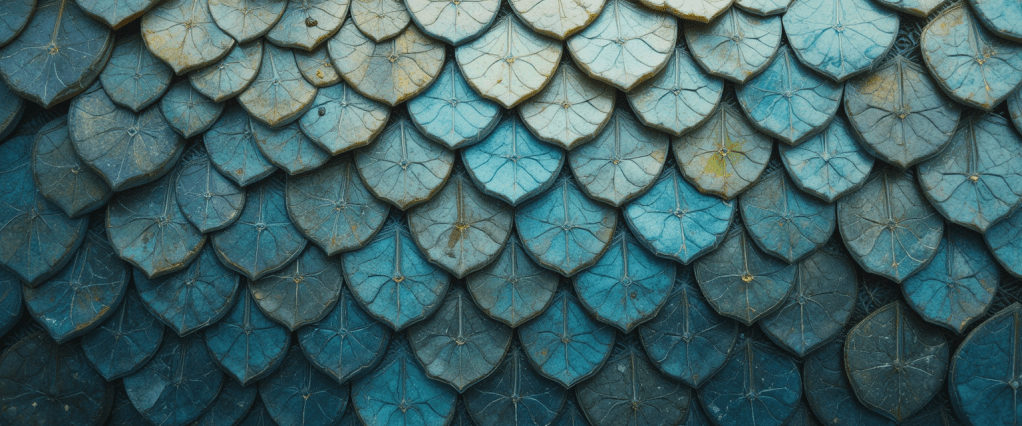
Squamation
IPA: /skweɪˈmeɪʃən/
(Noun)
Definitions:
- The Arrangement or Presence of Scales: The pattern, distribution, and structure of scales on the skin of fish, reptiles, and certain mammals.
- Example: “The scientist examined the squamation of the lizard to determine its species.”
- A Process of Scale Formation: The biological development of scales as part of an organism’s protective or structural adaptation.
- Example: “During embryonic development, squamation begins in a specific sequence, varying across different species.”
- Scaling or Flaking in a Non-Biological Context: The shedding or pattern of layers resembling scales, often used metaphorically or in dermatology.
- Example: “The old paint had a squamation-like texture, peeling away in fine, overlapping layers.”
Expanded Explanation:
Etymology and Origins:
The term squamation originates from the Latin word squama, meaning “scale.” The suffix -ation implies a process or condition, making squamation literally mean “the state of having or forming scales.” The concept has been used in biological sciences for centuries to classify and describe animals based on their scale structures.
- Example: “In Latin taxonomy, squamation is a key feature used to differentiate species within reptilian and piscine families.”
Types and Contextual Uses:
- Zoological Squamation: Refers to the specific patterns and textures of scales in animals, playing a crucial role in classification.
- Example: “Fish exhibit various types of squamation, from cycloid to ctenoid scales, which provide different hydrodynamic advantages.”
- Herpetological Squamation: The study of scale arrangement in reptiles, often used in identifying species and evolutionary adaptations.
- Example: “The snake’s squamation was analyzed to understand its camouflage properties in desert environments.”
- Medical and Dermatological Squamation: In some contexts, squamation is used to describe a scaly or flaky condition of the skin.
- Example: “Certain skin disorders, such as ichthyosis, involve abnormal squamation leading to excessive scaling and dryness.”
- Geological and Material Science Squamation: Used metaphorically to describe the scale-like layering of rocks, minerals, or other surfaces.
- Example: “The rock formation had a squamation effect, resembling reptilian skin due to years of erosion.”
Synonyms and Related Terms:
- For Biological Scaling: Scaled pattern, scale arrangement, dermal plating
- For Skin and Texture: Flaking, peeling, exfoliation
- For Layered Surfaces: Strata, lamination, texturing
Antonyms:
- For Smoothness: Unscaled, sleek, polished
- For Lack of Layers: Uniform, continuous, unbroken
Examples in Context:
- “The ichthyologist recorded the fish’s squamation patterns to determine its evolutionary lineage.”
- “Certain snake species exhibit keeled squamation, giving them a rougher texture compared to smooth-scaled varieties.”
- “Lizards shed their skin in patches, often revealing new squamation underneath.”
- “The ancient shield bore an ornate squamation pattern, resembling overlapping dragon scales.”
Cultural and Scientific Significance:
- Evolutionary Biology: The study of squamation helps scientists understand evolutionary adaptations, such as protective armor in reptiles and improved swimming efficiency in fish.
- Herpetology & Ichthyology: Squamation is a defining characteristic used to classify species within reptilian and fish families.
- Dermatology: In medicine, squamation is associated with conditions affecting the outer layers of human skin, such as psoriasis and ichthyosis.
- Art & Design: The concept of squamation influences architectural textures, fashion, and armor designs inspired by reptilian and fish scales.
Interesting Facts:
- Sharks Have Unique Squamation: Their skin is covered in dermal denticles, which reduce drag and increase speed in water.
- Crocodiles & Armadillos Feature Protective Squamation: Their thick, bony scales (osteoderms) provide extra defense against predators.
- Certain Dinosaurs Exhibited Squamation: Fossil evidence suggests some species had both scales and feather-like structures.
- Human Skin Can Exhibit Squamation: Conditions like ichthyosis cause excessive scaling, resembling reptilian skin patterns.
Takeaway:
Squamation is more than just the presence of scales—it represents a crucial biological adaptation, a key classification tool in zoology, and even a metaphor for layered textures in geology, medicine, and design. Whether found in fish, reptiles, or artistic inspiration, squamation highlights the intricate, protective, and sometimes beautiful patterns of nature.
Originally published on March 24, 2025, on The-English-Nook.com.

Squamation and Old English: A Glimpse into Linguistic Roots
Old English words like wyrm (dragon) and draca (dragon) reveal the deep connection between language and mythology. The term squamation, from Latin squama (scale), reflects the scaly, armored nature often attributed to dragons in Anglo-Saxon lore. These words not only link us to mythical creatures but also highlight how language evolved from nature and folklore, offering insight into the early cultural world that shaped modern English.
Exploring the Beauty of Old English: 100 Words to Connect with the Past
Squamation: where nature’s scales meet science, art, and evolution!
“Hit like and feel every scale align — squamation style!” 🐍💫
 Word of the Day - The English Nook
Leave a comment