
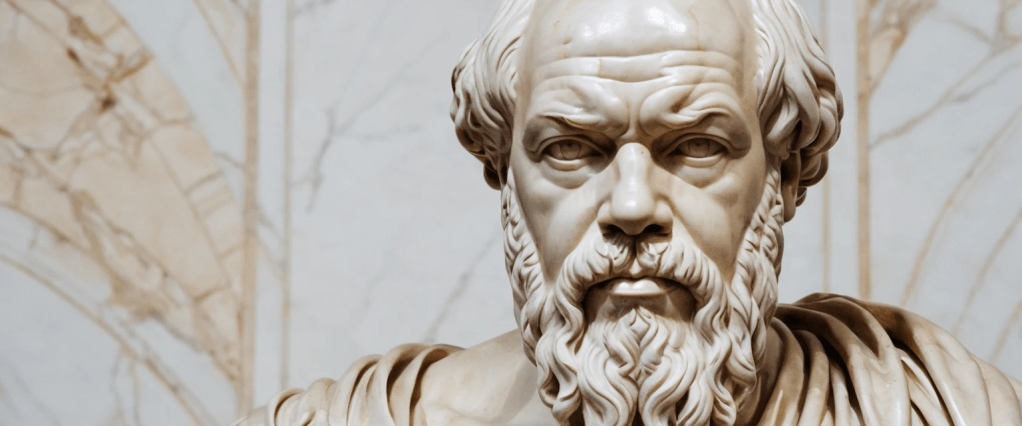
Socratic
IPA: /səˈkrætɪk/ or /soʊˈkrætɪk/
(Adjective)
Definitions:
- Relating to Socrates or His Philosophy: Pertaining to the methods, teachings, or philosophical principles of Socrates, the classical Greek philosopher.
- Example: “The professor employed a Socratic approach to teaching, encouraging students to think critically.”
- Characterized by Questioning as a Means of Learning: A method of inquiry and debate based on asking and answering questions to stimulate critical thinking and expose contradictions.
- Example: “During the discussion, she used the Socratic method to help her peers refine their arguments.”
Explanation:
Etymology and Linguistic Origins:
The term Socratic is derived from the name of the Greek philosopher Socrates (c. 469–399 BCE), who was known for his method of engaging in dialogue through relentless questioning to examine moral and philosophical concepts. His ideas were recorded by his student Plato and continue to influence philosophical thought and education today.
- Example: “Plato’s dialogues provide the primary source of what we know about Socratic philosophy.”
The Socratic Method:
- Philosophical Dialogue: The Socratic method involves a series of questions and answers designed to challenge assumptions and deepen understanding. This technique is widely used in law, education, and debate.
- Example: “Law schools often use the Socratic method to teach students how to construct logical arguments.”
- Pedagogical Application: Educators employ Socratic questioning to encourage students to think independently rather than memorize facts.
- Example: “The teacher’s Socratic approach prompted students to question their preconceived notions.”
Historical and Cultural Significance:
- Socrates’ Trial and Legacy: Socrates was sentenced to death for allegedly corrupting the youth of Athens and disrespecting the gods, yet his legacy endured through his teachings, which shaped Western philosophy.
- Example: “Socrates’ refusal to flee his execution is a cornerstone of discussions on ethics and civic duty.”
- Influence on Later Philosophers: Socratic reasoning laid the foundation for later philosophers such as Plato, Aristotle, and thinkers from the Enlightenment period.
- Example: “Renaissance scholars revived Socratic ideas in their pursuit of reason and humanism.”
Modern Applications of the Socratic Approach:
- Legal Studies: Law schools frequently adopt Socratic questioning to train students in logical reasoning and case analysis.
- Example: “The Socratic dialogue in courtrooms helps expose contradictions in a witness’s testimony.”
- Psychology and Therapy: The Socratic method is used in cognitive-behavioral therapy (CBT) to help patients examine their thought patterns.
- Example: “The therapist employed Socratic questioning to help the patient challenge irrational fears.”
- Artificial Intelligence and Ethics: The Socratic method is increasingly referenced in discussions on AI, particularly in how machines might be programmed to simulate human reasoning.
- Example: “AI developers explore Socratic principles in designing conversational learning models.”
Synonyms and Related Terms:
- For Questioning Methods: Dialectical, inquisitive, maieutic (relating to eliciting knowledge through questioning)
- For Philosophical Reasoning: Analytical, logical, critical-thinking based
Antonyms:
- For Passive Learning: Didactic, instructional, rote-learning
- For Dogmatic Thinking: Unquestioning, absolute, authoritarian
Examples in Context:
- “The debate team captain used Socratic questioning to dismantle the opposing argument.”
- “The teacher’s Socratic discussions pushed students to examine their ethical stances.”
- “A Socratic approach in science helps uncover deeper truths beyond surface-level observations.”
- “She admired the Socratic tradition of probing inquiry and philosophical skepticism.”
- “His conversational style was deeply Socratic, always questioning and never settling for easy answers.”
Interesting Facts:
- Socrates Never Wrote Anything: Unlike his student Plato, Socrates left no written records; his teachings survive only through accounts by others.
- Socratic Paradoxes: Socrates is famous for paradoxical statements, such as “I know that I know nothing,” which emphasizes intellectual humility.
- The Socratic Method in Politics: Many political theorists argue that Socratic questioning is essential for a functioning democracy, as it fosters informed decision-making.
- Socratic Irony: A rhetorical technique in which Socrates pretended ignorance to encourage others to reveal their own flawed reasoning.
- Famous Socratic Figures: Figures like Thomas Jefferson and John Stuart Mill were influenced by Socratic ideals of discourse and reasoning.
Takeaway:
The term Socratic encapsulates the legacy of Socrates, one of history’s most influential philosophers. Whether applied in law, education, psychology, or ethics, the Socratic method remains a powerful tool for fostering intellectual growth, sharpening reasoning, and challenging assumptions. By questioning deeply, seeking truth, and embracing inquiry, the Socratic approach continues to shape human understanding and discourse across generations.
Originally published on February 23, 2025, on The-English-Nook.com.

The Socratic Path to Learning Spanish
True learning begins with curiosity, with questions that spark deeper understanding. The Socratic method—questioning, reasoning, and reflecting—can guide you on your journey to mastering Spanish. Are you ready to explore, challenge, and grow in your language learning? Step into the world of Spanish with a mind eager to discover!
Easy Things to Learn When Studying Spanish
True wisdom isn’t about having answers—it’s about asking the right questions.

“Hit like and spark a dialogue worth having!” 🗣️✨
 Word of the Day - The English Nook
Leave a comment