
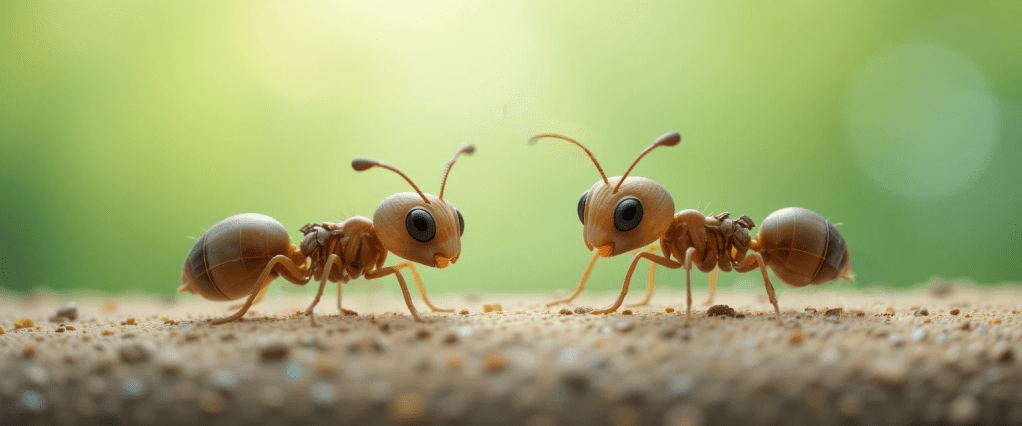
Myrmecology
IPA: /mɜːr.mɪˈkɒl.ə.dʒi/
(Noun)
Definitions:
- The Scientific Study of Ants: A specialized branch of entomology dedicated to the study of ants, their behavior, social structures, ecology, and evolution. It encompasses various subfields such as taxonomy, physiology, ethology, and ecology, making it a multidisciplinary science.
- Example: “Her research in myrmecology led to groundbreaking discoveries about ant colony communication and their impact on biodiversity.”
Expanded Explanation:
Etymology and Linguistic Origins:
Derived from the Greek words myrmex (meaning “ant”) and -logia (meaning “study of”), myrmecology formally emerged as a distinct scientific discipline in the 19th century, though observations of ants date back to ancient civilizations.
- Example: “The term ‘myrmecology’ was first used in the late 19th century as scientists began to systematically study ant behavior, recognizing their extraordinary social organization.”
Significance in Science and Ecology:
Myrmecology is a crucial field in ecological and behavioral research because ants play significant roles in ecosystems. Their interactions with other species, impact on soil structure, and influence on food chains make them key subjects of study.
- Colony Organization: Ants exhibit one of the most advanced social structures among insects, with clearly defined castes (workers, soldiers, queens, drones, etc.). Their ability to coordinate as a superorganism fascinates scientists.
- Communication Methods: Ants use pheromones, tactile signals, and sound vibrations to relay information about food sources, danger, and nest locations.
- Ecological Impact: Ants contribute to soil aeration, seed dispersal, pest control, and decomposition, benefiting ecosystems worldwide.
- Co-evolution: Many plants and insects have evolved in tandem with ants, forming mutualistic relationships such as ant-plant symbiosis.
- Example: “Myrmecologists have found that ants can navigate using the Earth’s magnetic fields, celestial cues, and visual landmarks, demonstrating a remarkable sense of direction.”
Cultural and Historical Perspectives:
- Ancient Studies: The observation of ants dates back to Aristotle and Pliny the Elder, who documented their foraging and nesting behaviors. In various mythologies, ants have been symbols of diligence, cooperation, and strategy.
- Modern Research: Myrmecology gained scientific traction with the work of figures like William Morton Wheeler and E.O. Wilson, whose research shaped our understanding of insect societies and their broader implications for biological organization.
- Symbolism: Ants have long been used metaphorically in literature and philosophy to illustrate industriousness, discipline, and social cooperation.
- Example: “E.O. Wilson’s work in myrmecology revolutionized the study of social insects, drawing parallels between ant colonies and human societies in terms of division of labor and cooperation.”
Synonyms:
- Ant science, formicology (less common), myrmecography (descriptive study of ants)
Antonyms:
- General entomology (broader study of insects), acarology (study of mites and ticks)
Examples in Context:
- “Myrmecology has revealed how ants farm fungus, much like humans cultivate crops, demonstrating an ancient form of agriculture within insect communities.”
- “A myrmecologist spends years observing ant colonies to understand their foraging behavior and their influence on surrounding ecosystems.”
- “The discovery of a ‘supercolony’ spanning multiple continents was a major breakthrough in myrmecology, challenging traditional views on species boundaries.”
Interesting Facts:
- Supercolonies: Some ant species form vast networks across entire continents, such as the Argentine ant supercolony, one of the largest known cooperative groups in the animal kingdom.
- Ant Wars: Certain species wage organized wars, raiding rival nests, enslaving captives, and even using chemical warfare to dominate other colonies.
- Human Applications: Research in myrmecology has influenced diverse fields such as robotics, artificial intelligence, network algorithms, and swarm intelligence, with ants serving as models for efficient problem-solving.
- Longevity: Some queen ants can live for decades, far surpassing the lifespans of most insects.
Takeaway:
Myrmecology is a vital scientific discipline that uncovers the intricate world of ants, revealing their profound impact on ecosystems, their highly evolved social structures, and their influence on technology and human understanding of cooperation and organization. As one of the most successful insect groups on Earth, ants continue to captivate researchers, providing endless insights into behavior, evolution, and adaptation. Whether in the Amazon rainforest, urban jungles, or underground tunnels, myrmecology remains a field of dynamic discovery and significance.
Originally published on February 20, 2025, on The-English-Nook.com.
Learning Spanish Through Myrmecology
If you’re learning Spanish, dive into the tale of an ant who thought it could do everything alone—only to discover the true power of working together. A perfect story to practice your Spanish while uncovering the wisdom of nature. Will you join the journey? Read it on my page!
El Sueño de Argos, la Hormiga Invencible
From underground empires to AI inspiration—ants rule more than just the dirt!
“Drop a like and join the colony—strength in numbers!” 🐜🏗️
 Word of the Day - The English Nook
Leave a comment