
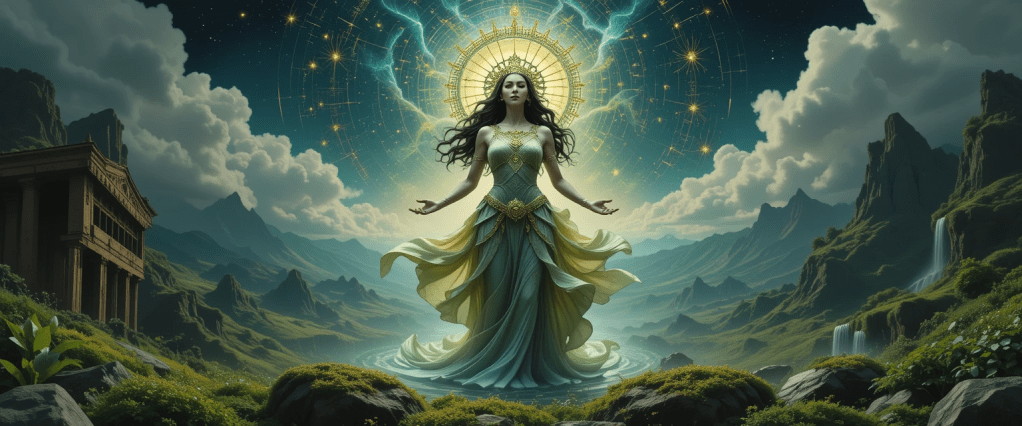
Gaia
IPA: /ˈɡaɪ.ə/ or /ˈɡeɪ.ə/
(Noun)
Definitions
- Primordial Earth Goddess in Greek Mythology: In ancient Greek religion and mythology, Gaia (or Gaea) is the personification of the Earth and one of the primordial deities who gave birth to the Titans and other gods.
- Example: “According to Hesiod’s Theogony, Gaia emerged from Chaos and became the mother of all life.”
- The Living Earth Concept: A modern interpretation of Gaia as a self-regulating, living entity that maintains the conditions necessary for life on Earth. This idea is central to the Gaia Hypothesis, developed by scientist James Lovelock.
- Example: “The Gaia Hypothesis suggests that Earth’s biosphere acts like a vast, interconnected organism.”
- Symbol of Nature and Environmental Awareness: Gaia is often used to represent ecological consciousness, sustainability, and the interconnectedness of life.
- Example: “Many environmental movements honor Gaia as a symbol of the need to protect and respect our planet.”
Expanded Explanation
1. Gaia in Mythology
Gaia is one of the oldest and most powerful deities in Greek mythology. She is considered the mother of the Titans, the Gigantes (giants), and many other divine beings. Born from Chaos, she gave birth to Uranus (the sky), with whom she later had many children, including Cronus and Rhea. Gaia played a crucial role in many myths, including the overthrow of Uranus and the war against the Titans.
Key Myths Involving Gaia:
- Birth of the Titans: Gaia and Uranus had twelve Titans, including Cronus, who later overthrew Uranus with Gaia’s help.
- The Gigantomachy: Gaia gave birth to the giants (Gigantes) to challenge the Olympian gods.
- Mother of Monsters: She was also the mother of Typhon, a fearsome monster who battled Zeus.
Gaia was revered in ancient Greek religious practices, with temples and sanctuaries dedicated to her, such as at Delphi, where she was worshiped before Apollo.
2. The Gaia Hypothesis
Developed by British scientist James Lovelock in the 1970s, the Gaia Hypothesis proposes that Earth and its biological systems function as a single, self-regulating entity. According to this theory:
- The biosphere interacts with the atmosphere, oceans, and land to maintain conditions favorable for life.
- Natural processes like the carbon cycle, temperature regulation, and oxygen levels are balanced through feedback mechanisms.
- Life and the planet are interconnected in a way that resembles a living organism.
Though initially controversial, aspects of the Gaia Hypothesis have influenced environmental science and ecological thought.
3. Gaia in Modern Culture and Environmentalism
- Symbol of Environmentalism: Gaia is frequently invoked in discussions about climate change, conservation, and sustainability. Many environmental groups use her name to promote ecological awareness.
- Literature and Science Fiction: Authors such as Isaac Asimov and Arthur C. Clarke have referenced Gaia in their works, often as a metaphor for planetary consciousness.
- Spiritual and New Age Movements: Some spiritual traditions embrace Gaia as a divine force of nature, emphasizing harmony with the Earth.
Etymology
The name Gaia (Γαῖα) comes from ancient Greek, meaning “Earth” or “land.” It is closely related to the Greek word ge (γῆ), which also means “earth” and forms the root of words like geography, geology, and geometry (which originally meant “earth measurement”).
Synonyms & Related Terms
- Mythological Equivalents: Terra (Roman), Pachamama (Incan), Mother Earth, Prithvi (Hindu), Danu (Celtic)
- Scientific & Environmental Terms: Biosphere, Ecosystem, Nature, Earth System
Antonyms
- Destruction of Nature: Industrialization, Pollution, Deforestation, Climate Crisis
- Opposing Mythological Figures: Uranus (Sky), Tartarus (Underworld), Chaos (Void)
Examples in Context
- Mythological Use:
- “In ancient Greek myths, Gaia was both a nurturing mother and a force of vengeance against those who upset the balance of nature.”
- “The temple of Gaia was a place where early Greeks sought prophecies about the future.”
- Scientific Use (Gaia Hypothesis):
- “Some scientists believe that Earth’s climate self-regulates, much like a living organism—a key idea behind the Gaia Hypothesis.”
- “The balance of oxygen and carbon dioxide in the atmosphere is an example of Gaia’s natural regulation.”
- Modern Environmental Use:
- “Many activists consider Gaia a symbol of our responsibility to protect the planet.”
- “The festival celebrated Gaia through eco-friendly initiatives and workshops on sustainable living.”
Interesting Facts
- Gaia’s Role in Astrology: Some astrologers associate Gaia with deep connections to nature, grounding energy, and the balance of ecosystems.
- NASA’s Use of the Gaia Concept: The European Space Agency (ESA) named a space observatory Gaia, launched in 2013, to map the stars and help us understand the cosmos—linking the ancient concept of Gaia with modern exploration.
- Influence on Pop Culture: Gaia appears in video games (Final Fantasy, God of War), films (Captain Planet, Avatar), and literature (The Earthsea Series by Ursula K. Le Guin).
Takeaway
Gaia is a concept that spans mythology, science, and culture, symbolizing both the Earth as a nurturing mother and a dynamic, self-regulating system. From her role in ancient Greek religion to the influential Gaia Hypothesis, she represents the interconnectedness of life and the responsibility to maintain balance with nature. Whether viewed as a deity, a scientific principle, or an environmental icon, Gaia continues to inspire awe, reverence, and a deeper appreciation for our planet.
Originally published on January 29, 2025, on The-English-Nook.com.
From ancient myths to modern science, Gaia reminds us—Earth isn’t just our home, it’s alive!
The Earth whispers its gratitude with every like—listen closely. 🍃🌎
 Word of the Day - The English Nook
Leave a comment