
IPA: /ˈhoʊ.ləˌfɔrm/
(Noun)
Definition:
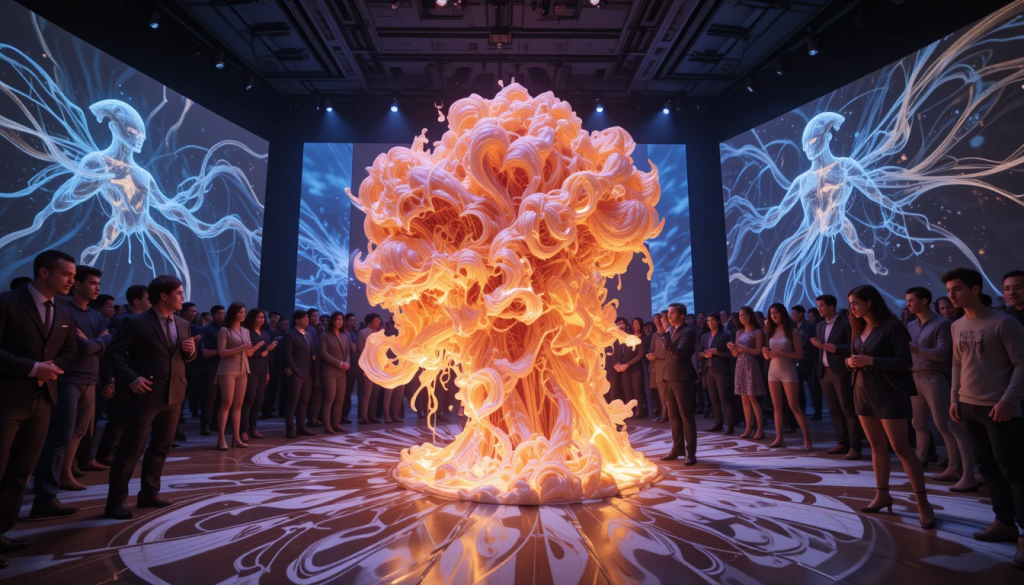
A holoform is a three-dimensional visual representation, often created using holography or advanced projection techniques. It provides a lifelike and detailed depiction of an object, person, or scene that appears to exist in space without a physical presence. The term can extend to interactive and dynamic holographic forms used in various fields, including entertainment, education, science, and communication.
Detailed Explanation:
A holoform is more than a simple image; it is a sophisticated integration of light, optics, and computational technology that creates the illusion of depth and realism. Unlike traditional images, which are limited to two dimensions, a holoform captures and projects spatial data, allowing viewers to experience a full, immersive 3D appearance.
In advanced applications, holoforms can interact with their environment or users, responding to gestures, voice commands, or contextual data. They have become symbols of futuristic technology, prominently featured in science fiction as a means to showcase advanced civilizations or innovative solutions.
Key Characteristics of a Holoform:
- Depth and Realism: Holoforms have spatial depth, allowing them to appear three-dimensional and lifelike.
- Projection Without Physical Medium: Unlike physical sculptures or displays, holoforms exist solely as light projections.
- Interactivity: In some advanced models, holoforms can respond to external stimuli, making them more engaging.
- Portability and Versatility: Holoforms can represent anything from people and objects to full-scale environments, adapting to different needs.
Etymology:
- Greek Roots: From holos (ὅλος), meaning “whole” or “entire,” combined with form (Latin: forma), meaning “shape” or “structure.”
- Modern Usage: Coined to describe fully realized holographic representations, the term became widely used in technological, scientific, and entertainment fields.
Applications and Contexts:
1. Entertainment:
Holoforms have revolutionized entertainment, providing new ways to engage audiences:
- Concerts: Iconic performances using holograms of deceased musicians, such as Tupac Shakur or Whitney Houston.
- Movies and Games: Interactive holoforms bring characters or scenes to life, enhancing immersion.
2. Education and Training:
- Interactive Learning: Holoforms allow students to explore complex subjects like anatomy or astronomy in a hands-on manner.
- Simulations: Pilots, surgeons, and military personnel use holographic simulations for training, providing a risk-free environment to practice skills.
3. Communication:
- Virtual Presence: Holoform technology enables people to project themselves as life-sized, realistic images for remote meetings or events.
- Augmented Reality: Tools like Microsoft HoloLens integrate holoforms into real-world spaces for enhanced collaboration.
4. Scientific Visualization:
Holoforms assist researchers in visualizing molecular structures, astrophysical phenomena, or geological formations in three dimensions.
5. Medical Imaging:
- Holoforms are employed to create dynamic 3D models of human organs, aiding in diagnosis, education, and surgical planning.
Cultural Significance:
The concept of holoforms transcends mere technology, becoming a metaphor for the seamless integration of reality and imagination.
- In Myth and Media: Iconic depictions in Star Wars, Blade Runner, and other sci-fi works have cemented holoforms as a vision of advanced civilizations.
- Symbol of Progress: Holoforms represent humanity’s push toward more immersive and intuitive ways to interact with information and one another.
Examples:
- In Everyday Use:
- “The museum featured a stunning holoform of a dinosaur, allowing visitors to see it move and roar in realistic detail.”
- In Science Fiction:
- “The ship’s AI projected a humanoid holoform to interact with the crew during emergencies.”
- In Education:
- “Using a holoform of the solar system, the professor explained planetary orbits in vivid detail.”
- In Communication:
- “Holoform technology enabled distant relatives to attend the wedding virtually as life-sized projections.”
Synonyms:
- Hologram
- 3D projection
- Virtual model
- Light sculpture
Antonyms:
- Flat image
- Two-dimensional representation
- Physical object
- Static display
Technological Development:
Holoforms rely on cutting-edge holographic technology, which uses interference patterns of light to recreate realistic, three-dimensional visuals. Some systems integrate:
- Laser Projections: For high-resolution, vivid imagery.
- AI Enhancements: To make holoforms interactive and context-aware.
- Augmented and Virtual Reality Integration: Enabling real-world applications of holoforms in hybrid spaces.
Takeaway:
Holoforms are a groundbreaking representation of how technology can blend light, art, and interactivity to create realistic three-dimensional visuals. From entertainment to education and beyond, holoforms continue to inspire innovation and awe, transforming how we perceive and engage with the digital world. Whether as a tool for immersive learning or as a spectacle in entertainment, holoforms represent a leap toward a more integrated and visually enriched future.
Originally published on January 17, 2025, on The-English-Nook.com.
Holoforms: Bringing the future to life, one projection at a time!
Every like creates a ripple in the hologram—add yours to the continuum. 🌐💖
 Word of the Day - The English Nook
Leave a comment