
IPA: /ˈkɛp.ri/ or /ˈkɛf.ri/
Definition:
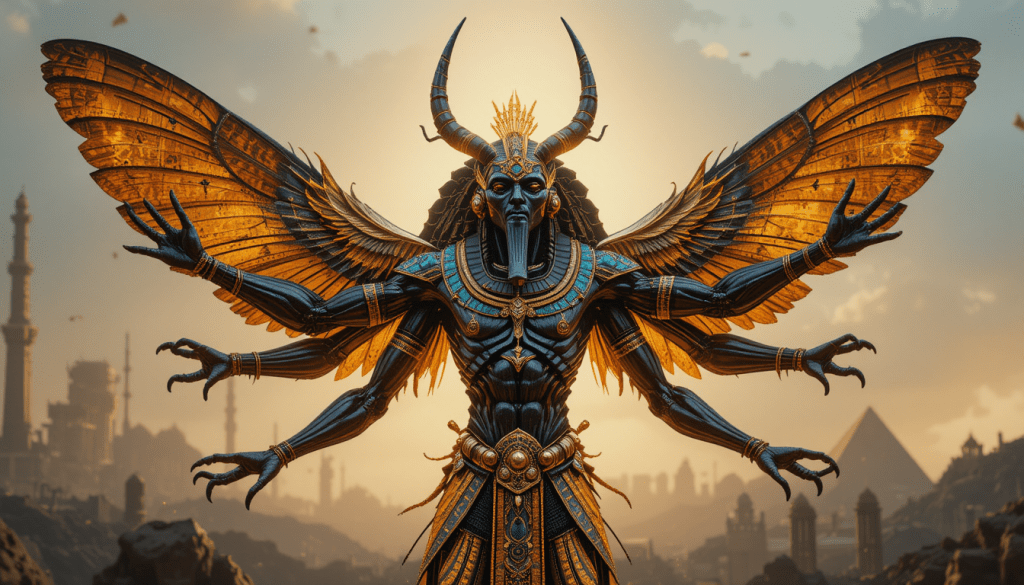
Khepri is an ancient Egyptian deity associated with the rising sun, creation, life, rebirth, and transformation. Often depicted as a scarab beetle or a man with the head of a scarab beetle, Khepri represents the perpetual renewal of life and the cyclical journey of the sun across the sky. He is a symbol of beginnings, potential, and the transformative power of nature.
Examples in Context:
- Mythological Context:
- “In Egyptian mythology, Khepri rolls the sun across the horizon each morning, much like a scarab beetle rolling its ball of dung—a metaphor for the cycle of renewal and rebirth.”
- Cultural Practices:
- “The ancient Egyptians inscribed Khepri’s scarab symbol on tomb amulets, believing it would guide the deceased to their rebirth in the afterlife.”
- Modern Reflection:
- “Today, Khepri serves as a reminder of the eternal cycles in nature, inspiring themes of perseverance and transformation in art and literature.”
Etymology:
The name Khepri derives from the ancient Egyptian verb ḫpr, meaning “to come into being” or “to become.” This linguistic connection reflects Khepri’s primary role as a god of creation, growth, and renewal. His very essence is tied to the emergence of life and the dawning of new possibilities.
Mythology and Symbolism:
1. Khepri and the Scarab Beetle:
Khepri is intrinsically linked to the scarab beetle (Scarabaeus sacer), whose natural behavior fascinated the ancient Egyptians. The beetle was observed rolling balls of dung across the ground, which the Egyptians interpreted as a terrestrial parallel to Khepri’s divine duty of moving the sun across the sky. Furthermore, the lifecycle of the scarab beetle—where larvae hatch from these dung balls—was seen as a miraculous act of spontaneous creation, reinforcing Khepri’s association with rebirth and transformation.
2. The Solar Cycle:
Khepri governs the rising sun and symbolizes the renewal and hope that come with each new day. Unlike Ra, who presides over the midday sun, or Atum, associated with the setting sun, Khepri represents the dawn and the beginning of creation. His role in the solar cycle reflects the Egyptians’ deep respect for the sun as the source of life and energy.
3. Creation and Transformation:
The scarab beetle’s behavior and lifecycle served as metaphors for Khepri’s powers of creation and transformation. Just as the beetle seemed to create life from inert matter, Khepri was believed to continually bring life and order to the world. This concept extended beyond the daily sunrise to the eternal cycle of birth, death, and rebirth—a central theme in ancient Egyptian cosmology.
Depictions in Art and Culture:
- Visual Representations:
- Khepri is often depicted as a scarab beetle or a man with the head of a scarab beetle. In many hieroglyphic and artistic depictions, Khepri is shown pushing the solar disk above the horizon, emphasizing his role in the daily renewal of the world.
- Artifacts:
- Scarab amulets symbolizing Khepri were popular in ancient Egyptian culture. These amulets, often carved from stone and inscribed with protective prayers or symbols, were placed in tombs to ensure the deceased’s safe journey through the afterlife and eventual rebirth.
- Sacred Texts:
- In the Book of the Dead, Khepri is referenced as part of the solar cycle, assisting the deceased in navigating the underworld and emerging into the light of a new existence.
Cultural and Modern Significance:
- Symbolism of Perseverance:
- Khepri’s association with the scarab beetle highlights the virtues of hard work, persistence, and the inevitability of transformation. His mythology encourages the belief that new beginnings are always possible, no matter how challenging life may seem.
- Inspiration in Modern Media:
- Khepri and the scarab beetle continue to appear in modern literature, art, and pop culture. For instance, in video games like Assassin’s Creed Origins, Khepri’s imagery reflects the enduring fascination with ancient Egyptian mythology. Scarab motifs also frequently appear in jewelry, tattoos, and storytelling, symbolizing protection and renewal.
- Ecological Reflection:
- Khepri’s connection to natural cycles resonates with contemporary themes of sustainability and environmental awareness, reminding us of the interconnectedness of life and the importance of respecting the Earth’s rhythms.
Etymological Synonyms and Associations:
- Synonyms:
- Rising Sun God
- Creator Deity
- Scarab Symbol
- God of Rebirth
- Associated Concepts:
- The Sun’s Renewal
- Transformation
- Eternal Life
Takeaway:
Khepri is more than just a god of the rising sun; he is a profound symbol of transformation, renewal, and the eternal cycles that govern life. From his association with the humble scarab beetle to his cosmic responsibility of rolling the solar disk across the heavens, Khepri embodies the boundless potential of beginnings and the resilience to face life’s inevitable changes. His mythology serves as a timeless reminder of the interconnectedness of nature, the cosmos, and humanity’s enduring hope for rebirth and renewal.
Originally published on December 24, 2024, on The-English-Nook.com.
From scarabs to the sun, Khepri reminds us that every ending holds the promise of a new beginning.
Roll forth your like, as I roll the sun across the heavens, renewing this post’s light. ☀️✨
 Word of the Day - The English Nook
Leave a comment