
/ˈɡoʊldən ˈreɪʃioʊ/
Detailed Explanation
The Golden Ratio (symbolized by the Greek letter ϕ or phi, approximately 1.618) is a mathematical concept found when two quantities have the same ratio as the ratio of their sum to the larger of the two quantities. In simpler terms, if you divide a line into two parts, the whole length divided by the longer part is equal to the longer part divided by the shorter part. This ratio is believed to create aesthetically pleasing proportions and is often associated with harmony and beauty in nature, art, and architecture.
Formula
If a and b are two numbers such that:a+ba=ab=ϕ=1.618…\frac{a + b}{a} = \frac{a}{b} = \phi = 1.618 \ldotsaa+b=ba=ϕ=1.618…
Then a and b are said to be in the Golden Ratio.
Etymology
The term “Golden Ratio” was first coined in the 19th century, but the concept has roots in ancient Greek mathematics, particularly associated with Euclid. The Greeks referred to this as “the divine proportion” due to its frequent appearance in geometry and nature. The ratio has been studied for over 2,400 years and was known as the “golden section” or “golden mean.”
Synonyms
- Divine Proportion
- Golden Section
- Phi (ϕ)
Usage in Sentences
- Architecture: “The Parthenon in Greece is said to incorporate the Golden Ratio in its design, contributing to its timeless beauty.”
- Art: “Leonardo da Vinci is believed to have used the Golden Ratio in his painting The Last Supper to achieve aesthetic balance and harmony.”
- Nature: “The spirals of a sunflower, the branching of trees, and the arrangement of leaves often exhibit the Golden Ratio.”
Cultural and Scientific Significance
The Golden Ratio appears in a wide variety of disciplines, including mathematics, art, architecture, biology, and physics. Its perceived visual appeal has made it a sought-after proportion in design and aesthetics for centuries.
- Mathematics: The Golden Ratio is related to the Fibonacci sequence, where the ratio of consecutive Fibonacci numbers approximates ϕ as the numbers get larger.
- Art & Architecture: Many artists and architects, including Leonardo da Vinci, Le Corbusier, and Salvador Dalí, have employed the Golden Ratio in their works to achieve balance and proportion.
- Nature: The Golden Ratio can be seen in the spiral patterns of shells, the branching of trees, and the arrangement of petals in flowers. Many natural phenomena, including hurricanes and galaxies, also follow this proportion.
Examples in Literature and Art
- Vitruvian Man: Leonardo da Vinci’s famous drawing Vitruvian Man is believed to depict human proportions based on the Golden Ratio.
- The Mona Lisa: Scholars have argued that the Golden Ratio is embedded in the composition of The Mona Lisa, contributing to its allure.
- Architecture: The pyramids of Egypt and the Gothic cathedrals in Europe have been suggested to exhibit the Golden Ratio in their designs.
Real-World Examples
- Design and Branding: Many modern logos, like those of Apple and Twitter, are designed using proportions based on the Golden Ratio.
- Nature: Seashells, such as the nautilus shell, grow in a logarithmic spiral that aligns closely with the Golden Ratio.
- Human Body: Studies have suggested that the most aesthetically pleasing human faces and bodies may be those that conform to the Golden Ratio.
Related Concepts
- Fibonacci Sequence: The Fibonacci sequence (1, 1, 2, 3, 5, 8, 13, etc.) is closely linked to the Golden Ratio. As the numbers increase, the ratio between consecutive Fibonacci numbers approaches ϕ.
- Symmetry: The Golden Ratio often appears in the context of symmetry, another concept strongly associated with beauty in both nature and art.
- Proportion: In art and architecture, proportion refers to the relationship between the elements of a composition, with the Golden Ratio being one of the most famous examples of ideal proportion.
Understanding the Appeal of the Golden Ratio
The Golden Ratio is significant because it is perceived as creating perfect proportions, which evoke a sense of harmony and balance. Whether in nature, art, or architecture, it has a seemingly universal appeal across human cultures. Its use in design and aesthetics is not just arbitrary but rooted in the natural world, making it a powerful tool for artists, architects, and designers seeking to create works that resonate with the viewer. While not everything considered beautiful follows this ratio, it remains a compelling and mysterious element in the human quest for understanding beauty and symmetry.
Originally published on October 13, 2024, on The-English-Nook.com.
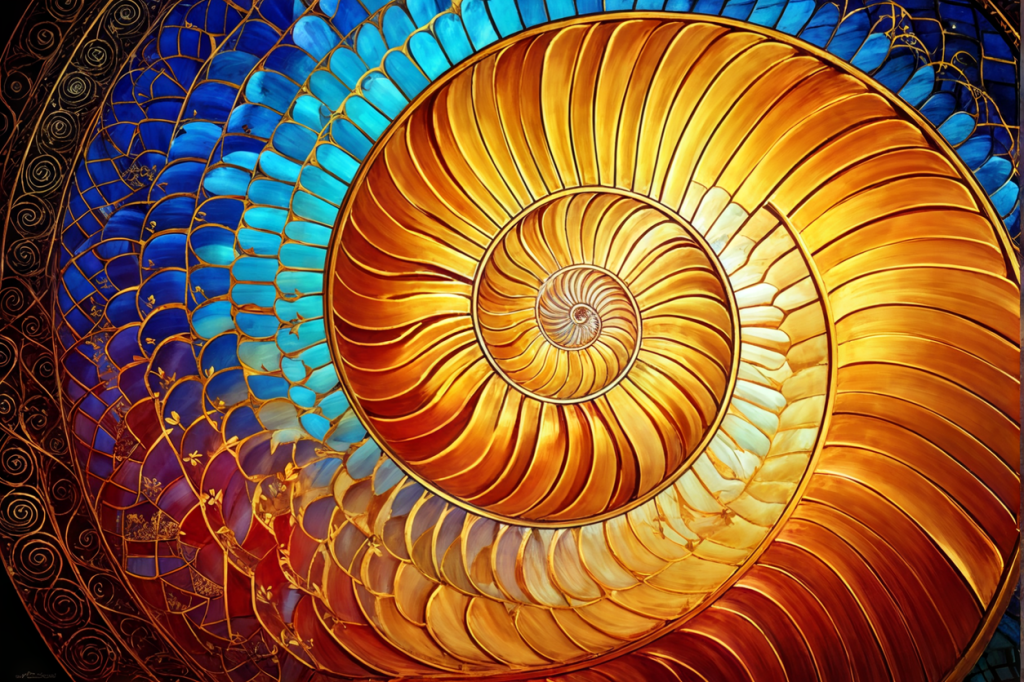
In the perfect balance of nature, your like would complete this moment with divine proportion.
🌿✨
 Word of the Day - The English Nook
Leave a comment