
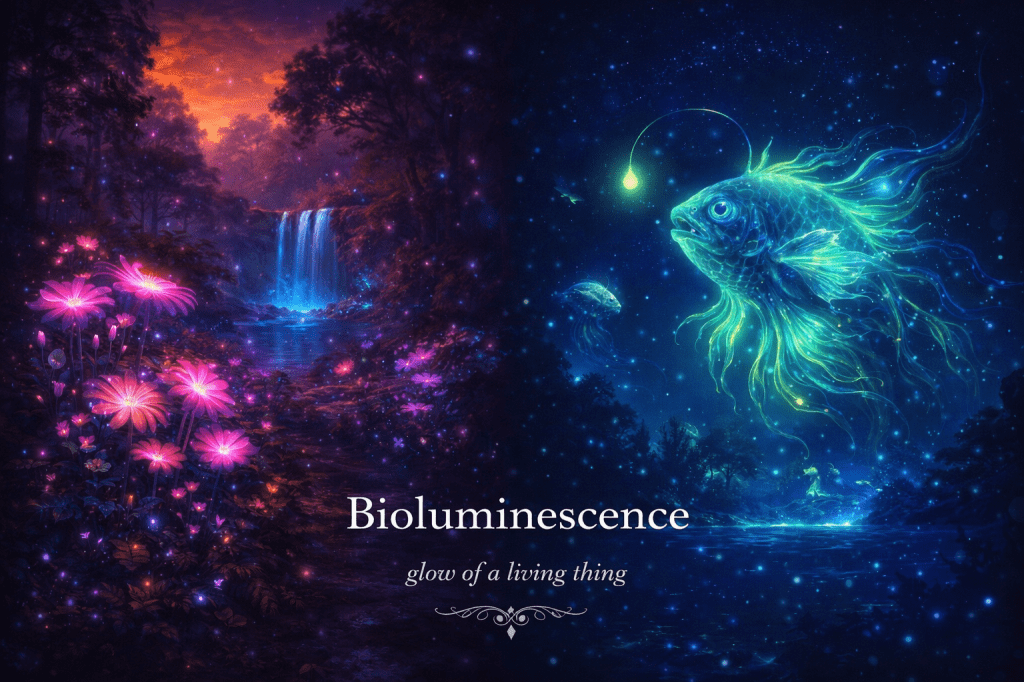
BIOLUMINESCENCE
/ˌbaɪoʊluːmɪˈnɛsəns/
Detailed Explanation
Bioluminescence (IPA: /ˌbaɪoʊluːmɪˈnɛsəns/) is a noun that refers to the natural phenomenon where living organisms produce and emit light. This light is generated through a chemical reaction that typically involves the molecule luciferin and the enzyme luciferase. Bioluminescence is most commonly observed in marine organisms, such as jellyfish, plankton, and certain types of fish, but it can also be found in some terrestrial organisms like fireflies and certain fungi.
Etymology
The word “bioluminescence” is derived from two parts: “bio-” from the Greek word “bios,” meaning “life,” and “luminescence” from the Latin “lumen,” meaning “light.” The combination of these roots reflects the concept of light produced by living organisms.
Synonyms:
- Natural light emission
- Living light
- Glow
- Phosphorescence (though technically different, it’s often used synonymously in popular contexts)
Usage in Sentences
- Marine Biology Context: “The deep sea is home to many bioluminescent creatures that use their light to attract prey or communicate with one another.”
- Nature Observation: “On summer nights, the bioluminescence of fireflies creates a magical display across the fields.”
- Scientific Research: “Scientists study bioluminescence to better understand how these organisms produce light and how it could be applied in technology and medicine.”
Examples in Literature and Media
- Documentaries: “Nature documentaries often highlight bioluminescent organisms, showcasing the stunning light displays of jellyfish and deep-sea creatures.”
- Fiction: “In the novel, the protagonist stumbles upon a hidden cove where the water glows with the bioluminescence of countless tiny organisms.”
Real-World Examples
- Marine Exploration: “Divers in certain parts of the world can experience bioluminescence first-hand, where movements in the water trigger a glowing response from plankton.”
- Conservation Efforts: “Bioluminescent bays, where microorganisms light up the water, have become popular ecotourism destinations, highlighting the importance of preserving these unique environments.”
- Scientific Innovation: “Research into bioluminescence has led to innovations in medical imaging, where the natural light-producing abilities of certain organisms are harnessed for non-invasive diagnostics.”
Related Concepts
- Chemiluminescence: A broader term that refers to the production of light as a result of a chemical reaction, of which bioluminescence is a natural example.
- Phosphorescence: A type of light emission similar to bioluminescence but does not require a living organism; instead, it involves materials absorbing light and slowly releasing it over time.
- Fluorescence: Another light emission phenomenon where substances absorb light at one wavelength and re-emit it at another, typically immediately.
Understanding the Nuance of “Bioluminescence”
Understanding bioluminescence involves appreciating the intricate biological processes that allow certain organisms to produce light naturally. This phenomenon has fascinated humans for centuries, both scientifically and aesthetically, due to its mysterious and often breathtaking manifestations in nature.
Bioluminescence serves various functions in the animal kingdom, including predator evasion, mate attraction, and communication. The word evokes images of glowing oceans, twinkling fireflies, and the otherworldly beauty of deep-sea life. Beyond its natural occurrence, bioluminescence also holds potential for scientific advancements in areas like biotechnology, where researchers are exploring how this natural light can be applied to new technologies.
Originally published on July 28, 2024, on The-English-Nook.com.
 Word of the Day - The English Nook
Leave a comment